


The year is 2026. The biggest threat to your SEO budget is not the competition; it is the $500/month tool subscription you only use 20% of. The era of the all-in-one platform as the sole solution is fading. Many businesses suffer from tool sprawl, paying for three different tools that perform the same function. Others invest in a massive platform when a specialized alternative would yield a much higher return on investment.
The strategic solution for 2026 is the Hybrid Stack. This approach involves pairing one enterprise platform, such as Ahrefs or Semrush, with high-efficiency, specialized tools and free Google resources. This creates a powerful, cost-effective, and customized SEO arsenal.
This post breaks down the true ROI of the most popular SEO tools. We will also reveal 12 secret, underutilized features that can transform common subscriptions into strategic competitive weapons, giving your search engine optimization efforts a decisive edge.
The 12 Secret Weapons: Underutilized Features and Tactics
This section delivers high-value, unique content by focusing on how to use the most popular SEO tools more effectively. These are the alternatives, tips, and features that can provide a significant advantage.
Unlocking Free & Foundational Power
You do not always need a paid plan to get valuable insights. Some of the most powerful free SEO tools are ones you already have access to.
- The ‘Query to Content Gap’ Tactic (Google Search Console): Use your Google Search Console (GSC) report to find keywords where you rank on page two of the search engine results pages (SERPs), but your existing content does not fully cover the topic. By identifying this gap, you can inform your SEO content strategy with LSI keywords to maximize immediate gains.
- Custom Extraction for Structured Data (Screaming Frog): In Screaming Frog, use the custom extraction feature with regex to pull specific, detailed data from competitor HTML. You can extract pricing, review counts, or other structured data for deep competitive analysis. This is a powerful feature in the tool’s free version.
- GTmetrix & WebPageTest Combo (The Free Audit Alternative): Combining these two free tools provides a deeper, more actionable performance audit than many entry-level paid tools. This duo is an excellent alternative for conducting thorough technical site audits without a budget.
Maximizing Enterprise & Content ROI
Enterprise platforms are packed with features. Using them for more than just keyword research or a basic backlink checker is key to maximizing their value.
- The ‘Past 7 Days’ Volatility Check (Ahrefs): Do not just look at average position. Use the 7-day rank history view in Ahrefs to diagnose immediate algorithmic volatility affecting your key pages. This helps you react quickly to changes in keyword rankings.
- PLA (Product Listing Ads) Research (Semrush): Go beyond organic competitor analysis. Use the Advertising Toolkit in Semrush to reverse engineer high-intent e-commerce keywords and gather non-SEO competitive intelligence from Google Ads.
- The Secondary Term Density Switch (Clearscope/Surfer): Do not just score your content for the main target keyword. Toggle the score to optimize for a crucial secondary LSI term. This tactic helps you capture two SERP features from one article, improving on-page SEO.
- The ‘Topic Explorer’ for Rapid Cluster Mapping (seoClarity): Use the Topic Explorer feature to map entire content clusters in minutes. This drastically reduces manual research time for your content marketing plan and helps you build topical authority.
Specialized & Niche Intelligence
Specialized tools offer unique capabilities that can fill the gaps in your main SEO platform.
- Agency-Grade Historical Data Tracking (SE Ranking): SE Ranking often provides superior historical data retention at a more cost-effective price than enterprise tools. Leverage this for niche, long-term rank tracking projects across multiple sites.
- The ‘Evergreen Score’ Filter (BuzzSumo): When searching for content ideas, filter by the “Evergreen Score” instead of volatile social shares. This helps you identify topics that will drive long-term traffic and sustained growth.
- The ‘Comparison Framework’ for Featured Snippets (AnswerThePublic): Use the ‘VS, LIKE, AND’ framework in AnswerThePublic to structure content specifically for comparison-based featured snippets. This helps you create content that directly answers user queries like “A vs. B”.
- The ‘Link Opportunities’ Filter (Moz Pro): In Moz Pro, use the SPAM score filter to quickly discard low-quality link-building ideas. This allows you to prioritize high-DA sites that have not linked to you before, improving the quality of your backlink analysis.
- Google Sheets ImportXML (The Advanced Data Alternative): For SEO professionals comfortable with formulas, the ImportXML function in Google Docs (Sheets) is an advanced, free alternative. It is perfect for quickly scraping small, targeted sets of SERP data, like meta descriptions, for specific analysis without a paid API.
The Foundations of SEO Software
To build a winning strategy, you must first understand the tools themselves.
What Does a “Popular SEO Tool” Look Like?
An SEO software is a platform designed to automate data collection, analysis, and execution across the three main fields of search engine optimization: Technical, Content, and Authority.
These online SEO tools function as advanced crawlers, database aggregators, and data visualization engines. They model Google’s own indexing process to provide competitive intelligence, helping you understand how search engines view your website and those of your competitors.
Why Popular SEO Tools are Important
Manual SEO is impossible beyond a small, 10-page site. SEO analysis tools provide the scale needed to track thousands of related keywords and millions of backlinks. They prevent you from optimizing in a vacuum, showing you exactly what it takes to beat the top-ranking pages. A good tool helps you monitor your website’s SEO health and identify issues like broken links before they harm your performance.
How to Improve Your Tools
The quality of the output from any SEO tool is only as good as the user input. The best way to “improve” the tool is through advanced filtering, segmentation, and integrating its output with other tools, the core idea of the Hybrid Stack.
The Strategic Playbook for 2026
Your strategy dictates your success. Here is how to approach your tool stack for maximum business impact.
Strategy and Requirements
The strategy is the Hybrid Stack. Use a specialized tool for its single best feature (e.g., Clearscope for content optimization) and a large tool for its massive data (e.g., Semrush for keyword analysis).
Any tool you consider must satisfy three key requirements:
- Data Accuracy: The tool must provide accurate data you can trust.
- Custom Filtering: You need the ability to segment data to find valuable insights.
- Workflow Integration: The tool must fit seamlessly into your existing processes.
Uses and Workflow
Popular SEO tools are used for several core functions: keyword discovery, site audits, link profile monitoring, rank tracking, and content scoring.
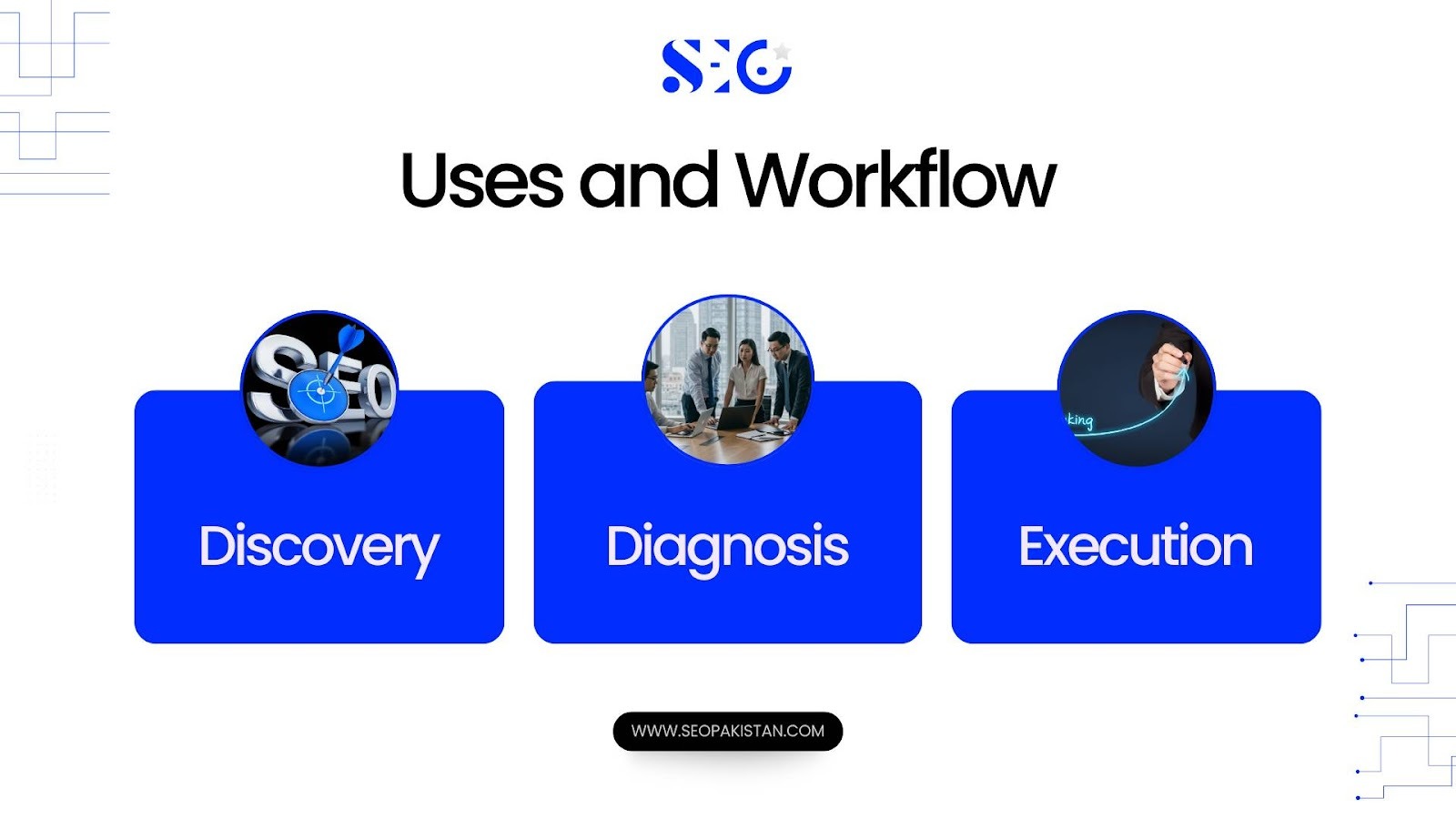
A simple yet effective 3-step workflow demonstrates how to use them:
- Discovery: Find an opportunity (e.g., using Ahrefs’ Content Gap feature).
- Diagnosis: Identify the specific problem (e.g., running a Screaming Frog report to find technical issues).
- Execution: Use a specialized tool to fix it (e.g., using Surfer to write or optimize the content).
Understanding Business Improvement
Improvement is not just about rankings; it is about tracking organic traffic from tool-driven efforts to conversion. A successful tool stack leads to a lower Cost Per Acquisition (CPA) compared to paid channels. This is how you prove the business value of your SEO efforts.
7 Benefits of a Strategic SEO Tool Stack
Implementing a Hybrid Stack offers clear, business-focused benefits.
- ROI Maximization: Stop paying for unused features. Invest only in optimization tools that close specific gaps in your workflow.
- Algorithmic Immunity: Use tool data, like Ahrefs’ volatility check, to diagnose and adapt to algorithm updates faster.
- Resource Efficiency: Automate data extraction and bulk site audits, freeing up your team for creative strategy and high-level SEO tasks.
- Competitive Intelligence: Instantly see your competitor’s link-building strategy, content plan, and PPC bids.
- Data Scalability: Manage thousands of pages and millions of data points without overwhelming manual effort.
- Future-Proofing: Leverage specialized tools that integrate AI and predictive analytics to stay ahead of AI search engines and AI-powered search results.
- Sustained Growth: A well-managed tool stack drives compounding organic returns year after year, forming the backbone of your SEO strategy.
The 2026 Popular SEO Tools Comparison Table
This table offers a snapshot of some of the top SEO tools to help you build your Hybrid Stack.
| Tool (Tier) | Best Use Case | Standout Feature (The Value) | Pros | Cons |
| Ahrefs (E) | Backlink Authority & Competitor Research | Link Intersect/Content Gap | Best backlink data, fast UI | Expensive, poor customer service |
| Semrush (E) | Rank Tracking & Full-Suite Data | Customizable Dashboards/Keyword Magic | Massive data sets, great for tracking | Overwhelming for beginners, steep learning curve |
| Surfer (S) | On-Page Optimization & AI Content | AI-Powered Content Scoring | Excellent for closing content gaps | Credit system limits use |
| Clearscope (S) | Content E-E-A-T & Readability | Content Score and Readability Grade | Highly focused, best for writers | Very expensive for its limited scope |
| SE Ranking (S) | Local SEO & Cost-Effective Tracking | Local Marketing Dashboard | Excellent value, great local features | Data depth lags enterprise tools |
| Screaming Frog (F) | Technical Audits & Crawling | Custom Extraction Feature | Free option, ultimate configuration | Steep learning curve, desktop only |
| Mangools (S) | Beginner-Friendly Keyword Research | KWFinder (Easy Difficulty Score) | Clear, easy-to-use user interface | Lower data limit on daily searches |
| seoClarity (E) | Enterprise AI & Workflow | Sia (Generative AI Assistant) | Automation tools, huge data volume | Custom, high-tier pricing |
The Blueprint for 2026 Success
Mastering the popular SEO tools in 2026 means shifting your focus from subscribing to strategizing. The goal is a Hybrid Stack built for ROI, powered by the secret features that give you a tactical edge. This approach ensures every dollar spent on your SEO performance is an investment, not an expense.
Do not just pay for the software; leverage the intelligence within it. Your success depends on integrating the tool’s output into a streamlined, conversion-focused workflow that turns data into revenue.
Ready to implement this strategy? Our guide, “[The 2025 SEO Tool Stack: 11 Essential Platforms…]” breaks down the step-by-step implementation for each of the 6 core pillars of a successful SEO program with seo pakistan.
Frequently Asked Question
What are popular SEO tools used for?
Popular SEO tools are software designed to help improve your website’s visibility on search engines like Google. They are used for tasks like keyword research, tracking rankings, analyzing competitor strategies, and finding technical website issues.
Do I really need an SEO tool for my website?
For very small sites, you might manage without one. However, to effectively grow your organic traffic, an SEO tool is essential. It provides the data needed to make informed decisions, track performance, and find opportunities that are impossible to spot manually.
What is the difference between free and paid SEO tools?
Free SEO tools, like Google Search Console, offer valuable but often limited data. Paid tools provide much deeper insights, larger databases for keyword and backlink analysis, advanced competitive research features, and automation capabilities that save significant time.
Which is the best SEO tool for a beginner?
For beginners, tools with a user-friendly interface and clear data visualization are best. Platforms like Mangools or SE Ranking are often recommended because they simplify complex data and have a gentler learning curve than larger, enterprise-level tools.
Should I use an all-in-one tool or multiple specialized tools?
It depends on your needs. An all-in-one tool like Semrush or Ahrefs offers a wide range of features in one platform. However, a “hybrid stack” approach, which combines a main platform with specialized tools for tasks like content optimization or technical audits, often provides greater flexibility and a higher return on investment.