

Most marketers think of email for retention and SEO for acquisition. But what if your weekly newsletter could actually help you outrank competitors on Google? While search bots don’t crawl emails, your email marketing strategy can indirectly boost your SEO.
By driving traffic, sparking engagement, and earning backlinks, your emails go beyond retention; they become a secret weapon for improving search rankings. Strong email campaigns signal to search engines that your content is valuable, helping you climb the rankings as algorithms reward user behavior and authority.
This guide explores the specific ways email marketing SEO works in the modern landscape. We will look at how sending the right emails can improve your site metrics, earn backlinks, and ultimately boost your organic visibility.
The Direct vs Indirect Impact of Email Marketing on SEO
Understanding the relationship between email marketing SEO, and your search performance requires distinguishing between direct and indirect factors. While an email campaign doesn’t directly pass “link juice” like a backlink from a high-authority site, the behavioral data it generates can significantly impact your SEO efforts.
Direct Impacts
Direct impacts involve measurable metrics that occur immediately after a subscriber clicks a link. When you execute email marketing SEO correctly, you create a surge of activity on your website.
- Driving traffic to optimized pages: Emails send users directly to specific URLs, signaling to search engines that these pages are relevant and active.
- Increasing dwell time on site: Subscribers who know and trust your brand are more likely to read your content thoroughly, increasing the average time spent on the page.
- Reducing bounce rate: Highly targeted email traffic usually consists of users who actually want to be there, which lowers the percentage of visitors who leave immediately.
Indirect Impacts
The indirect benefits are often more powerful for long-term growth. These are the ripple effects that occur when your content reaches the right people.
- Content amplification leading to more links: When you put high-quality content in front of industry peers via email, they are more likely to reference and link to it in their own work.
- Social sharing from email recipients: Loyal subscribers often share valuable newsletters or articles on their social profiles, increasing brand reach.
- Brand visibility and branded search increase: Consistent emails keep your brand top-of-mind, leading more people to search for your company name directly on Google.
Email Marketing’s Influence on Organic Traffic
Traffic is the lifeblood of SEO. Search engines look for patterns in traffic to determine if a page is gaining popularity. Email marketing allows you to generate traffic on demand, rather than waiting for organic discovery.
This is especially useful for new content:
- Instant Traffic: Publishing a new blog post starts it at zero traffic. Sending it to your email list creates an immediate visitor spike. This influx of traffic (which behaves like organic traffic) helps search algorithms gather data on the page more quickly.
- Targeted Engagement: Segmented lists are key. Sending a generic email can lead to low engagement. But if you send a specialized guide, like one on “Advanced SEO,” to subscribers tagged as “Marketing Professionals,” engagement will be much higher. This ensures the traffic to your site is relevant and reinforces the page’s authority on that topic.
Improving Engagement Metrics That Search Engines Care About
Google and other search engines utilize user experience signals to rank pages. If users click on a result but leave immediately, rankings drop. If they stay and interact, rankings improve. Email marketing helps you curate an audience that is predisposed to engage positively.
Why does email traffic behave differently from cold traffic?
- Dwell time: Users arriving from email tend to read thoroughly, increasing the average time spent on the page.
- Lower bounce rates: Because the content matches the promise made in the email subject line, users are less likely to leave immediately.
- Positive behavioral signals: High interaction rates feed data into search algorithms, suggesting the page satisfies user intent.
- Quality traffic: Segmentation filters out irrelevant visitors, ensuring that the behavioral data collected by search engines reflects a highly engaged audience.
By consistently delivering value through email marketing SEO, you train your audience to interact deeply with your website. This positive feedback loop is essential for maintaining high positions in competitive search results.
Email Content as an SEO Link Building Strategy
Backlinks remain one of the strongest ranking factors. While you cannot force people to link to you, you can use email to drastically increase the probability of earning links. This is where link building meets email strategy.
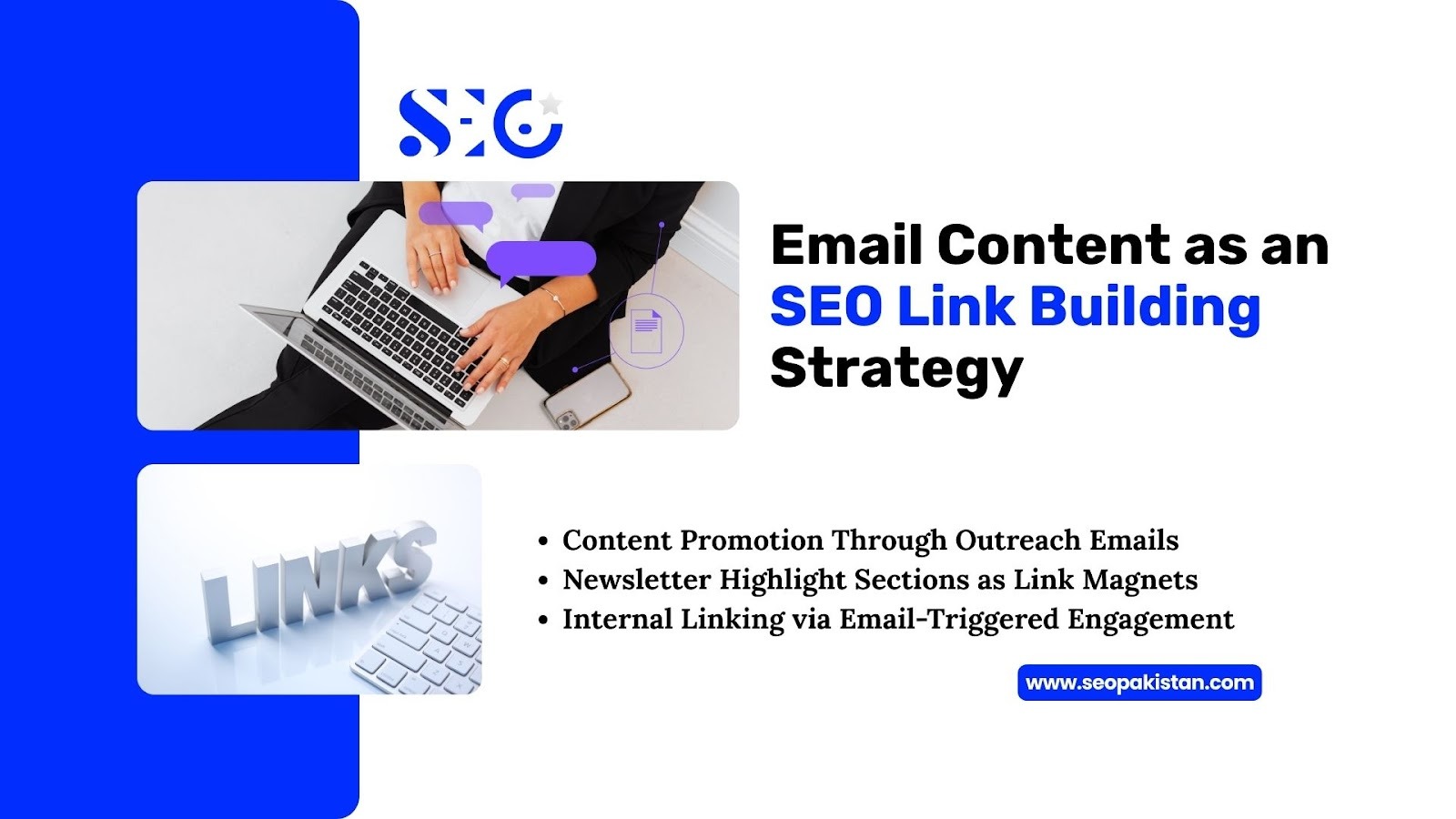
Content Promotion Through Outreach Emails
You should not wait for people to find your content. You must bring it to them. Use email outreach to promote your best “cornerstone” content to influencers and bloggers in your niche. If you have created a comprehensive study or a unique tool, a personalized email can result in a high-value backlink.
Newsletter Highlight Sections as Link Magnets
If you curate a high-value newsletter, you can become a source that others want to reference. Create specific sections that offer unique data, industry trends, or proprietary insights.
- Weekly Best Tools: Lists of resources often get shared and linked to by the tool creators.
- Proprietary Data: Releasing original research via email often triggers citations from journalists and bloggers.
Internal Linking via Email-Triggered Engagement
You can also use email to boost your internal link structure. By promoting older, related posts within your new emails, you drive fresh traffic to deep internal pages. This signals to search bots that your older content is still relevant. It also encourages users to click through multiple pages during a single session, which is a strong engagement signal.
Boost Your Social Signals With Email Marketing
Social signals are not a direct ranking factor, but they correlate strongly with high rankings. High social activity usually leads to more visibility, which leads to more backlinks. Email marketing SEO can act as the catalyst for this social activity.
Include social share buttons directly in your emails. If a subscriber enjoys a particular insight, make it easy for them to post it to LinkedIn or X (formerly Twitter) with a single click. You can also run campaigns that explicitly ask subscribers to share a piece of content if they found it valuable.
When your content gains traction on social media, it generates “search demand.” People start searching for the topic or your brand to learn more. This increased search volume is a powerful indicator of relevance to search engines.
Using Email to Promote Evergreen Content & Pillar Pages
Content decay is a real problem for SEO. Articles that once ranked well can slowly drop if traffic fades. Email automation is the perfect solution to keep evergreen content alive.
1. Set Up Automated Email Workflows
- Create email sequences that automatically send out to your subscribers.
- Include links to your most important content, like pillar pages, in these workflows.
- Example: Use a “Welcome Sequence” for new subscribers to introduce them to your top content.
Drive Consistent Traffic to Key Pages: These automated emails ensure your core content gets traffic regularly, no matter when it was published.
Monitor Your Analytics: Check your analytics to find pages that are losing rankings or traffic.
Feature Low-Performing Pages in Your Newsletter: Include these pages in your email newsletters to give them a fresh boost of traffic and engagement.
Improve Search Results: The extra traffic and engagement from your emails can help improve the rankings of these pages in search results.
Schema & Rich Snippets: Email Promotion’s Role in SEO
Rich snippets, such as “People Also Ask” boxes and star ratings, significantly improve click-through rates. Email marketing can help you capture these coveted spots.
How does email help with technical SEO features?
- Featured Snippets: Use email to drive traffic to pages specifically optimized for snippets (like Q&A formats). High traffic and engagement increase the likelihood of Google selecting your content for the answer box.
- Schema Feedback: Ask your subscribers questions. Their replies can help you structure your FAQ schema more effectively, ensuring you are answering the questions people actually ask.
Analytics: Measuring the Email to SEO Impact
You cannot improve what you do not measure. To prove the value of email marketing SEO, you must track specific KPIs that bridge the gap between your email platform and your website analytics.
What should you track to verify success?
- Email-driven organic sessions: Use UTM parameters to separate email traffic from other direct traffic.
- Time on page: Compare the dwell time of email visitors versus organic visitors.
- Behavioral flow: See where email users go after landing on your site. Do they explore further?
- Backlink acquisition: Monitor new backlinks after an email promotion campaign to see if there is a correlation.
Tools like Google Analytics 4 (GA4) are essential here. By properly tagging your email campaigns, you can visualize exactly how your email list contributes to overall site performance and SEO health.
Common Mistakes in Using Email for SEO
Even experienced marketers make errors that dilute their results. Avoid these common pitfalls to ensure your email strategy supports your SEO goals effectively.
- Sending generic blasts with low CTR: If people do not click, you get no site benefits.
- Not tagging campaign URLs: Without UTM tags, email traffic looks like “Direct” traffic, making analysis impossible.
- Ignoring engagement metrics: High open rates do not matter if bounce rates on the site are high.
- Promoting content with no SEO structure: Sending traffic to a page that is not optimized for keywords wastes the ranking potential of that traffic spike.
Conclusion
The separation between email and search is a thing of the past. To succeed in 2026, you must view email marketing SEO as a unified strategy. By using email to drive quality traffic, you boost user engagement. By using email for outreach, you enhance link building.
Do not leave your content to die on a blog page waiting for a crawler. actively promote it. Build a list that cares about your work, and use that list to signal to Google that you are an authority. When you combine the retention power of email with the acquisition power of SEO, you create a sustainable growth engine that competitors cannot easily replicate.
Start integrating these channels today to secure your search rankings for the future. Ready to dominate the search rankings and future-proof your growth? Visit seopakistan.com to put these strategies into action.
Frequently Asked Questions
Can email marketing really improve SEO?
Yes. While not a direct ranking factor, it drives traffic, improves engagement signals, and facilitates link building and content promotion, which are major SEO factors.
Do search engines read email content?
No. Search engines crawl the web, not your private inbox. The value comes from users clicking out of the email and onto your website.
Should newsletters link only to blog posts?
No. You should link to product pages, service pages, and social media channels to diversify your traffic sources and engagement.
How to tag email links for SEO analytics?
Use a UTM builder to add parameters like utm_source=newsletter and utm_medium=email to every link you send.