


Imagine your business is a hit in your home country. Now, what if you could replicate that success in Germany, Japan, or Brazil? Expanding into international markets opens up massive new revenue streams, but reaching a global audience is more complex than just translating your website.
That’s where International SEO comes in. It’s the key to helping brands shine across different countries and languages by tailoring their sites for global search optimization and multi-country SEO.
Without a strategic approach to international search visibility, businesses risk missed opportunities and ineffective campaigns that fail to connect with regional audiences.
This guide covers proven strategies for improving worldwide ranking and establishing cross-border SEO that drives traffic, builds authority, and increases conversions in diverse markets. You will learn how to structure your website, implement technical SEO elements, localize content effectively, and measure performance across regions.
What is International SEO?
International SEO is the process of optimizing a website to rank in search engines across multiple countries and languages. It involves technical implementation, content localization, and strategic planning to ensure that search engines understand which regions and languages your content targets.
International SEO vs Local SEO
The scale and complexity of targeting differ significantly between local and international SEO. Local SEO focuses on visibility within a specific city or region, often using location-based keywords and local business listings. International SEO operates on a broader scale, targeting entire countries or multiple regions simultaneously.
Key differences include:
- Country targeting vs city targeting: International SEO aims for visibility across entire countries, while local SEO focuses on neighborhoods or cities.
- Language vs geographic intent: International campaigns must account for language variations and cultural preferences, not just geographic location.
- Multi-market visibility goals: It balances competing priorities across multiple markets, requiring strategic resource allocation.
Why International SEO is Your Key to Expansion
Expanding into international markets provides tangible business benefits that extend beyond increased traffic. Companies that invest in international SEO gain access to new customer bases and diversify their revenue sources.
Consider how it contributes to long-term growth:
- Reach new markets and revenue streams: Accessing untapped markets creates opportunities for revenue growth that domestic markets cannot provide.
- Increase global brand authority: Visibility across multiple regions builds credibility and positions brands as international leaders.
- Diversify traffic sources: Relying on a single market creates vulnerability; SEO spreads risk across multiple regions.
- Reduce dependence on one region: Economic downturns or market saturation in one country have less impact when traffic comes from diverse sources.
How Search Engines Determine International Relevance
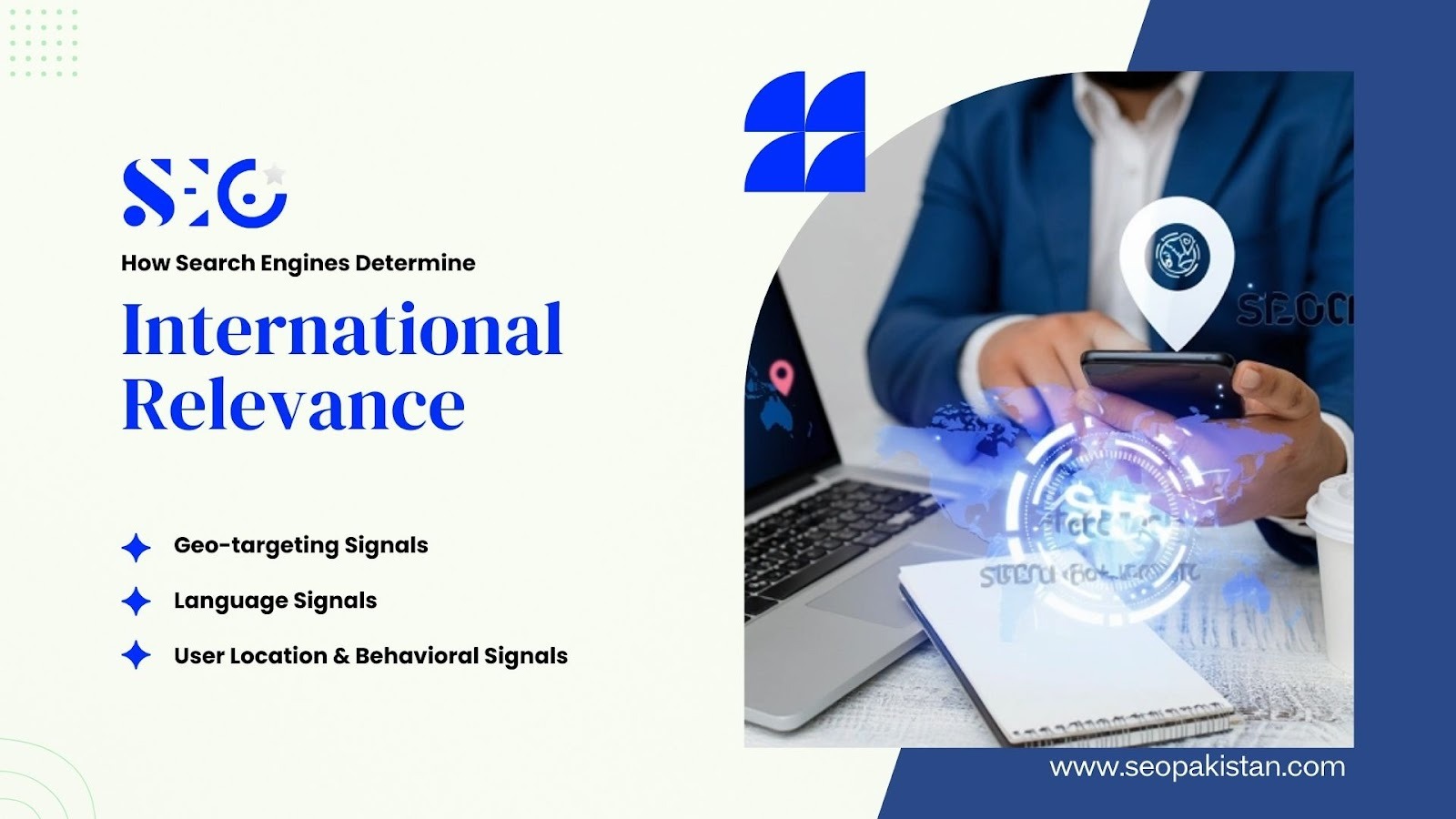
Search engines use multiple signals to determine which country and language versions of content to display. Understanding these signals helps businesses optimize their SEO strategies effectively.
Geo-targeting Signals
Search engines rely on specific indicators to identify the geographic relevance of content. These signals include country-code top-level domains (ccTLDs), server location, and Google Search Console settings.
Using a ccTLD such as .uk or .de provides the strongest geo-targeting signal, telling search engines that content targets users in specific countries.
Language Signals
Language signals help search engines match content to users based on their linguistic preferences. The HTML language attribute, hreflang tags, and on-page content language all contribute to this determination.
Properly implemented language signals ensure that French-speaking users in Canada see French content, while English-speaking users in the same country see English content.
User Location & Behavioral Signals
Search engines also consider user location, IP addresses, and behavioral patterns when determining relevance. Understanding these factors helps optimize international campaigns:
- Hreflang implementation importance: Hreflang tags tell search engines which language and regional versions of pages to display, preventing duplicate content issues.
- Server and hosting signals: Hosting websites on servers located in target countries can improve loading speeds and provide weak geo-targeting signals.
- Local backlinks and citations: Links from websites within target countries strengthen regional relevance and authority.
- Localized content relevance: Content that addresses local needs, cultural references, and regional interests ranks higher in target markets.
Choosing the Right International Website Structure

The structure of your website affects both search engine understanding and long-term scalability. Three primary options exist, each with distinct advantages and considerations.
Country-Code Domains (ccTLDs)
Country-code domains such as example.co.uk or example.de provide the strongest geo-targeting signals. Search engines immediately recognize the intended target country.
However, ccTLDs require separate domains for each country, increasing costs and management complexity. Businesses must build authority independently for each domain, which demands significant resources.
Subdomains
Subdomains, like uk.example.com or de.example.com, provide a balanced approach to geo-targeting while maintaining the authority of a single root domain. They are easier to manage compared to ccTLDs and are ideal for targeting specific markets with tailored content strategies. However, proper implementation is key to avoiding issues like authority dilution.
Here’s how subdomains can support your strategy:
- Moderate geo-targeting signals: Subdomains help focus on specific regions while benefiting from the root domain’s authority.
- Best for unique content strategies: Use subdomains to create localized or market-specific content, catering to distinct audiences.
- Avoid authority dilution: Implement subdomains carefully to ensure they don’t compete with or weaken the main domain.
Subdirectories
Subdirectories such as example.com/uk/ or example.com/de/ provide the best option for consolidating authority while maintaining clear country targeting. All regional versions benefit from the root domain’s authority, making this structure highly scalable.
Subdirectories require less maintenance than ccTLDs and allow for centralized SEO efforts.
Key considerations include:
- Best geo-targeting for higher investment: ccTLDs offer the most accurate geographic targeting but come with a higher cost.
- Scalability considerations: Subdirectories scale more easily as you add new markets.
- Authority consolidation benefits: Subdirectories and subdomains leverage existing domain authority more effectively than ccTLDs.
Keyword Research for Multi-Country SEO
Translating keywords directly from one language to another rarely captures local search intent. Users in different countries search using unique phrases, slang, and regional variations.
Why does localized keyword research matter?
- Search behavior varies by region: Cultural differences influence how users phrase queries and what information they seek.
- Native keyword research importance: Conducting research in the target language reveals actual search terms used by local audiences.
- Local slang and phrasing differences: Regional dialects and colloquialisms affect keyword selection significantly.
- Regional search volume differences: Popular keywords in one country may have low volume in another, requiring market-specific strategies.
Translation alone isn’t enough; it often misses local search intent. For example, a keyword that’s popular in the United States might not perform well in the United Kingdom, despite both being English-speaking countries.
Here’s how to conduct effective keyword research for a new region:
- Analyze SERP Features in Target Regions: Use SEO tools like SEMrush or Ahrefs to go beyond just keyword volume. Set the target country and analyze the SERP features (e.g., featured snippets, local packs, People Also Ask boxes) for your core topics. This reveals the type of content that performs well locally and the search intent behind it.
- Perform Competitor Gap Analysis at the Country Level: Instead of just looking at what keywords local competitors rank for, perform a detailed keyword gap analysis. Identify keywords that your top three local competitors rank for that you don’t.
- Involve Native Speakers: Collaborate with native speakers to understand local slang, colloquialisms, and cultural nuances that affect search queries.
- Explore Local Forums and Social Media: Browse platforms like Reddit, local forums, and social media groups to see how people in that region naturally discuss topics related to your industry.
Content Localization that Translation
Translation converts text from one language to another, but localization adapts content to cultural norms, preferences, and regional expectations. Localization drives rankings because it addresses the specific needs of target audiences.
Cultural Relevance
Content must reflect cultural values, humor, and references that resonate with local audiences. Examples that work in one country may confuse or offend users in another. Localization ensures that messaging feels native rather than foreign.
Local Search Intent
Search intent varies by market. Users in different countries may search for the same product but expect different information. Understanding these nuances allows businesses to create content that satisfies local expectations and ranks higher in regional search results.
Currency, Units & Regional Formatting
Practical details matter. Displaying prices in local currency, using appropriate measurement units, and formatting dates correctly improve user experience and credibility.
Best practices include:
- Adapt examples and cultural references: Use locally relevant examples that audiences recognize and relate to.
- Adjust tone and messaging: Formal communication works well in some cultures, while casual language suits others.
- Local trust signals: Include regional testimonials, certifications, and partnerships that build credibility in specific markets.
Technical International SEO Essentials
Technical implementation determines whether search engines correctly interpret and display regional content. Errors in this area undermine entire SEO strategies.
Avoiding Duplicate Content Issues
International websites often face duplicate content challenges when similar content appears across multiple regional versions. Search engines may struggle to determine which version to rank. Hreflang tags resolve this by signaling that variations serve different audiences.
Canonical Tags & Regional Versions
Canonical tags indicate the preferred version of a page when duplicates exist. For international sites, canonical tags should point to the same-language version rather than a default version. This approach preserves regional targeting while managing duplicate content.
Technical best practices include:
- Reciprocal hreflang tags: Every regional version must link to all other versions, creating a complete network.
- Self-referencing tags: Each page must include an hreflang tag pointing to itself.
- Correct language-region codes: Use ISO standards such as en-GB or fr-CA to specify both language and region accurately.
- Prevent duplicate indexing: Proper hreflang implementation ensures search engines index the correct regional version for each market.
Building Global Authority & Backlinks
Authority building requires market-specific efforts. Backlinks from websites within target countries carry more weight for regional rankings than links from other countries.
How do you build authority across multiple markets?
- Local backlinks improve regional trust: Links from local news sites, directories, and industry publications strengthen relevance in specific countries.
- Country-specific directories: Submit websites to regional directories that users in target markets trust.
- Regional PR and outreach: Build relationships with local journalists, bloggers, and influencers who can provide valuable backlinks.
- Partnerships and local mentions: Collaborate with local businesses and organizations to earn mentions and links from authoritative sources.
Optimizing User Experience for Global Audiences
User experience signals affect both rankings and conversions. Websites that load quickly, function well on mobile devices, and provide intuitive navigation retain visitors and improve performance.
What factors contribute to a positive user experience internationally?
- Fast loading across regions: Use content delivery networks (CDNs) to reduce latency and improve loading speeds for users worldwide.
- Mobile optimization globally: Mobile usage rates vary by country, but optimizing for mobile devices remains critical in all markets.
- Clear language switching: Allow users to switch between language and regional versions easily without disrupting their browsing experience.
- Localized navigation and menus: Adapt navigation structures to match local preferences and user expectations.
What’s Next? The Future of Global SEO
Staying ahead of emerging trends positions businesses for continued success as SEO evolves. Several developments will shape the future of global search optimization.
What trends should businesses monitor?
- AI-powered localization: Artificial intelligence will improve translation accuracy and cultural adaptation, reducing costs and accelerating expansion.
- Voice search in multiple languages: Voice search adoption varies by country, requiring optimization for natural language queries in multiple languages.
- Regional SERP personalization: Search engines will continue refining personalization based on user location, behavior, and preferences.
- Privacy and regional compliance laws: Regulations such as GDPR affect data collection and user tracking, requiring compliant SEO strategies.
Conclusion
Achieving a worldwide ranking and strong international search visibility demands strategic planning, technical precision, and cultural awareness. Businesses that invest in international SEO gain access to new markets, diversify revenue sources, and build global authority. Global search optimization and effective cross-border SEO separate market leaders from competitors who struggle to expand internationally.
Localization beats translation. Technical SEO ensures correct targeting. Market-specific optimization wins rankings. Success requires ongoing measurement, adaptation, and refinement based on regional performance data.
Businesses that commit to these principles position themselves for sustained growth across multiple markets. Discover how to take your business to the next level with expert strategies visit seoakistan.com today!
Frequently Asked Questions
What is international SEO?
To attract audiences from around the world, you need to optimize your website for search engines in different countries and languages—a practice known as international SEO. This strategy combines technical adjustments, localized content, and targeted outreach to connect with users globally
Is translation enough for global SEO?
No. Translation converts text between languages but fails to address cultural nuances, local search intent, and regional preferences. Localization adapts content to meet the specific needs of target markets and drives better rankings and conversions.
How do hreflang tags work?
Hreflang tags tell search engines which language and regional versions of pages exist. They prevent duplicate content issues by signaling that variations serve different audiences. Proper implementation requires reciprocal tags linking all regional versions.
How long does international SEO take to work?
Its timelines vary based on market competition, domain authority, and implementation quality. Most businesses see initial results within three to six months, with significant improvements occurring over six to twelve months as authority builds in target markets.