



I once spent six hours researching a new ergonomic office chair. I read dozens of reviews that all sounded suspiciously similar, filled with generic praise and vague adjectives. When the chair finally arrived, it was nothing like the descriptions. I felt cheated. This experience highlights a massive problem in the digital space: trust is eroding because of low-quality, mass-produced content.
However, artificial intelligence is changing this narrative. When used correctly, AI review writing does not have to mean generating spam or fake opinions. It can be a powerful assistant that helps legitimate content creators organize their thoughts, compare technical specifications, and publish helpful guides faster than ever before.
In this guide, we will explore how to leverage AI to write reviews that are honest, detailed, and truly valuable to your readers. We will cover everything from the basic definitions to advanced workflows that ensure your content remains authentic and trustworthy.
What Is AI Review Writing?
Many people don’t fully understand how this technology works. AI review writing uses artificial intelligence to help write, organize, and improve reviews for products or services. It doesn’t involve making up opinions about things the AI has never experienced.
- It involves feeding real data, personal notes, and technical specifications into a tool that handles the heavy lifting of sentence construction and formatting.
- Often referred to as automated review generation, this process allows writers to focus on deep analysis rather than the mechanics of typing.
- It is a specialized subset of AI content creation, specifically tailored for evaluation and critique.
How It Differs from Traditional Review Writing
The gap between manual writing and AI assistance is significant. Traditional review writing relies entirely on the human author for research, outlining, drafting, and editing. It is a slow, methodical process that ensures a high personal touch but limits volume.
AI-assisted reviews differ from traditional writing in several key ways:
- Speed and Efficiency: AI speeds up the review process by instantly creating the framework and filling in technical details. A four-hour manual review could be cut down to just one hour with an AI workflow.
- Focus: With AI handling the structure, the human writer can concentrate on analysis and adding a personal touch rather than the mechanics of writing.
- Consistency: AI tools don’t get tired. They consistently include specified features and details, which human writers might forget or overlook due to fatigue.
- Volume: Traditional writing is a slow, methodical process that limits the number of reviews a writer can produce. AI assistance allows for a much higher volume of content.
Manual Review Writing vs AI Review Writing
Are you wondering how the two approaches stack up against each other? Here is a breakdown of the key differences in resources and output:
| Feature | Manual Review Writing | AI Review Writing |
|---|---|---|
| Time Investment | High (Hours per post) | Low (Minutes per post) |
| Cost | Expensive (High hourly rates) | Cost-effective (Subscription fees) |
| Consistency | Variable depending on the writer | High adherence to formatting |
| Scalability | Limited by human capacity | Nearly unlimited |
| Creativity | High and nuanced | Moderate (Requires human editing) |
How AI Review Writing Works
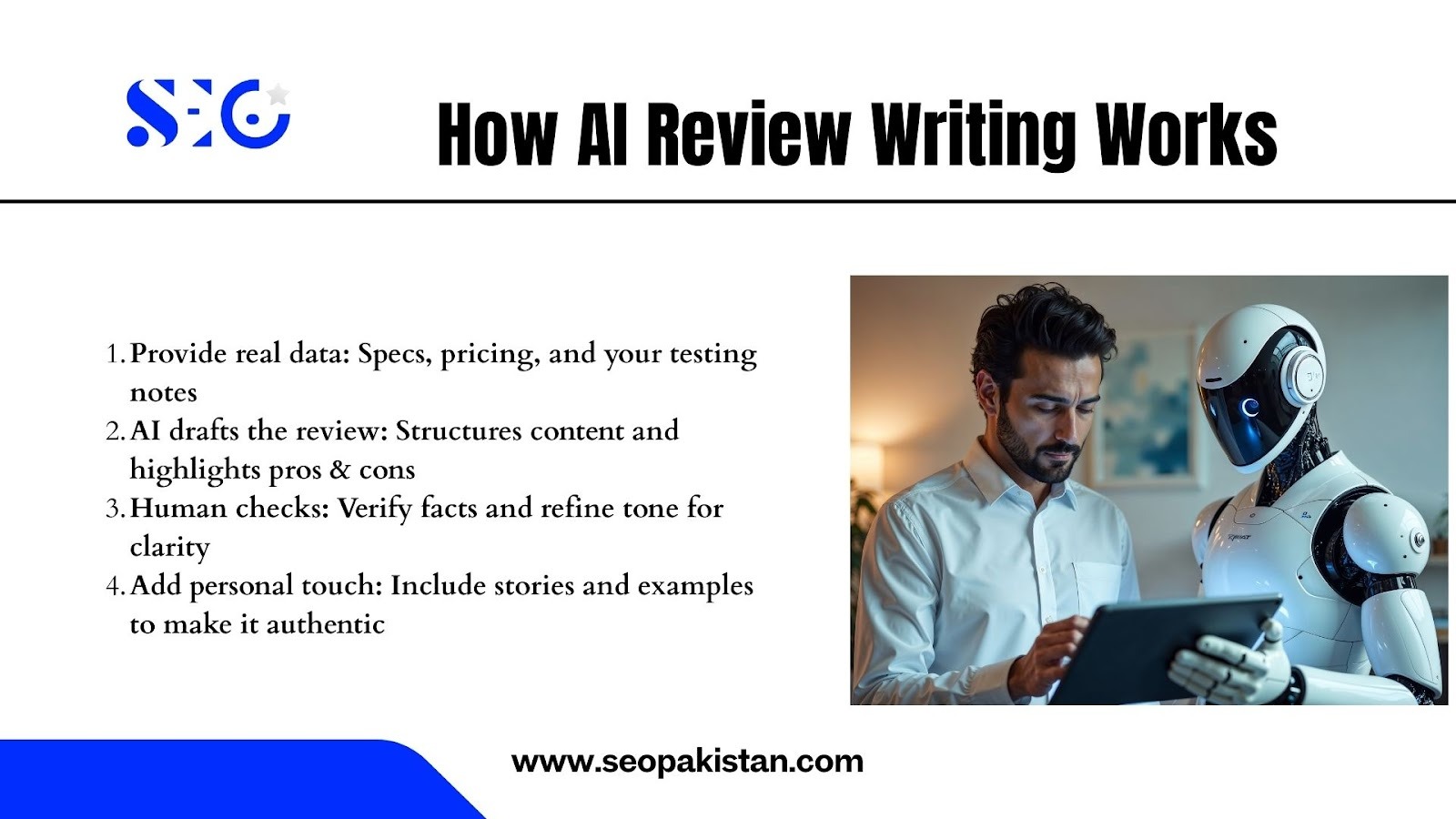
Data Input
You cannot simply ask a tool to “write a review of the iPhone 15” and expect a masterpiece. You must provide the system with raw data.
This includes specific technical specifications, pricing, intended use cases, and, most importantly, your actual notes from testing the product. The AI needs this factual grounding to generate accurate text.
Automated Review Generation
Once the data is in the system, the algorithms take over. The AI analyzes the input and structures it into a logical flow. It uses large language models to predict the best way to describe features and benefits.
It identifies patterns in successful reviews, such as starting with a hook, moving to pros and cons, and ending with a verdict. This automated drafting ensures that the structural integrity of the review is sound before a human ever reads it.
Human Review Layer
This is the non-negotiable step for quality control. An AI can list specs, but it cannot describe the tactile feel of a button or the specific frustration of a confusing menu system.
- Check for accuracy: Review the text for any hallucinations (facts the AI may have invented) to ensure everything is factual and reliable.
- Refine the tone: Adjust the tone to make it clearer, more engaging, and aligned with the intended audience.
- Add personal touches: Include personal anecdotes or relatable examples to make the content more human and helpful.
These steps help transform robotic AI text into a polished, reader-friendly guide.
Types of AI Review Writing
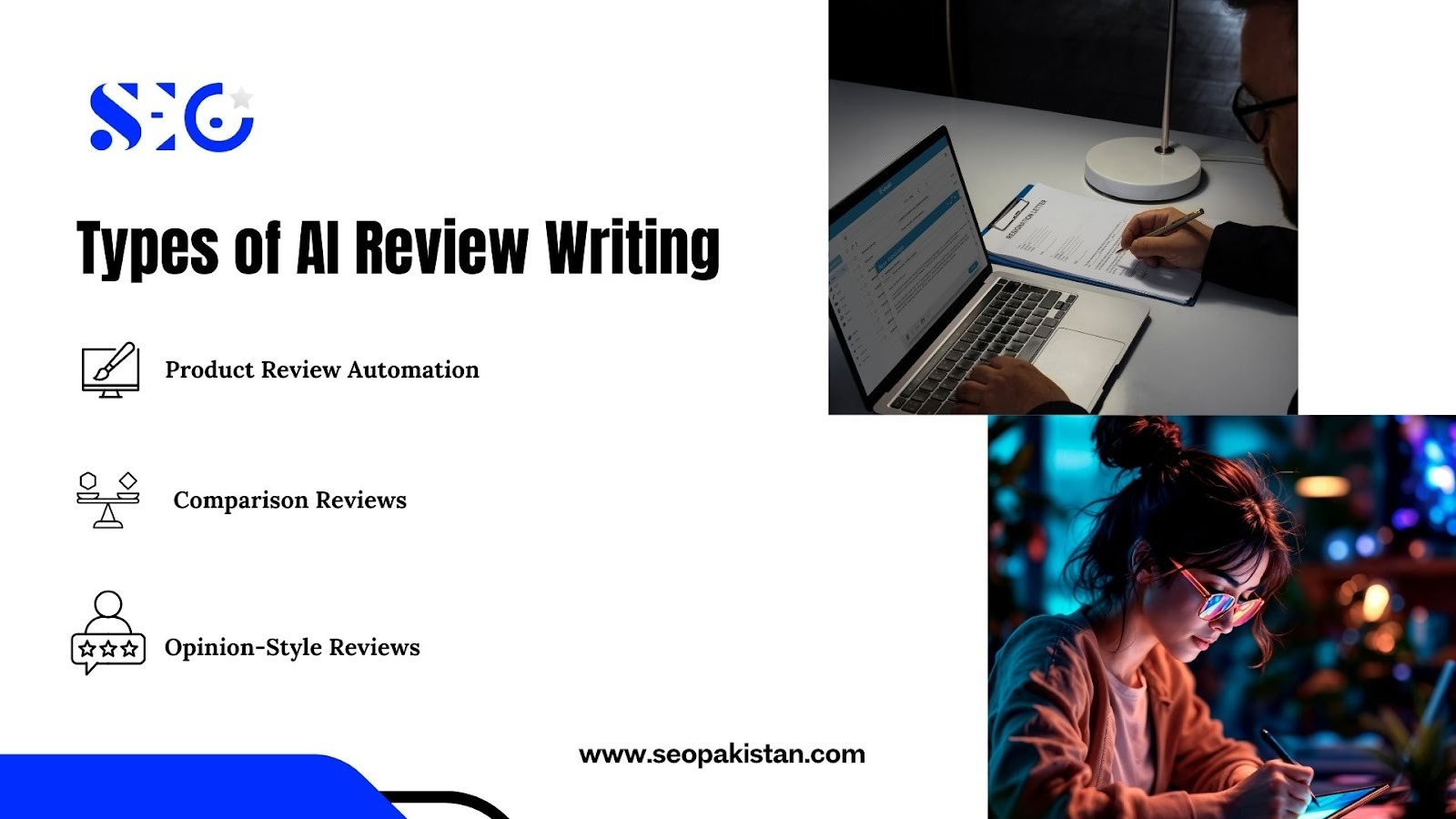
Product Review Automation
This is the most common form you will encounter. It involves creating a standalone assessment of a single item, such as a laptop or a pair of running shoes. These reviews focus deeply on the features, benefits, and drawbacks of that specific unit.
Comparison Reviews
These reviews compare two or more products against each other. AI excels at this because it can objectively compare specs side-by-side without bias. For example, it can instantly pull data points to highlight differences between products.
- Product A: 10-hour battery life, weighs 2.5 lbs
- Product B: 12-hour battery life, weighs 2.8 lbs
By using AI-powered comparisons, you can quickly identify which product best fits your needs. Whether it’s battery life, weight, or other features, let data guide your decision for a smarter purchase.
Opinion-Style Reviews
These are more subjective and focus on the experience of a service or intangible product, like a software subscription or a hotel stay. While AI can help structure these, they require heavy human input to capture the emotional aspect of the experience.
Authentic AI Writing: How to Keep Reviews Human Written
Readers have a finely tuned radar for fake content. If your review sounds like a brochure, they will leave immediately. Authentic AI writing is about using the tool to express your opinion, not replacing your opinion with the tool’s output.
To keep your reviews sounding human and authentic when using AI, follow these steps:
- Inject personal experience: Share specific details that AI can’t invent, like if a product broke after a week or if you were stuck on hold with customer service for an hour.
- Maintain your brand voice: Ensure the tone matches your usual style. if you typically use humor, prompt the AI to write wittily or manually add your own jokes during the editing process.
- Use real data: Ground your review in facts and personal observations to build credibility.
- Provide balanced opinions: Avoid sounding like a brochure by acknowledging flaws. No product is perfect, and showing both sides is the hallmark of trustworthiness.
Step-by-Step AI Review Writing Workflow
Creating a high-quality review requires a systematic approach. Follow this workflow to ensure your AI-assisted content remains high quality:
1. Collect Real Product Information
Do not rely on the AI’s training data, which might be outdated. Gather current specs, price points, and your own testing notes.
- Take photos of the product.
- Note down specific pros and cons during your usage.
2. Define Audience and Intent
Before you start writing, think about your target audience and the goal of your review. Is it to inform, persuade, or entertain? Tailoring your content to a specific reader persona will make your review more effective. Who are you writing for? A budget-conscious student needs different information than a luxury buyer.
- Determine the reader’s expertise level.
- Decide if the goal is to inform or to sell.
3. Generate AI Draft
Now it’s time to leverage AI. Start with a generative AI tool like ChatGPT, Claude, or Jasper. These tools are excellent for creating a first draft quickly. Feed the information you gathered in the previous steps into your chosen AI writing assistant.
Use detailed prompts to guide the structure and ensure the output aligns with your intended tone and audience.
- Ask for specific sections like “Performance,” “Design,” and “Value.”
- Instruct the AI to use an objective tone.
4. Add Human Insights
AI can generate a solid foundation, but it can’t replicate your unique experiences or voice. This step is crucial for making the review authentic and trustworthy. Go beyond the AI’s generic statements and add your personal touch.
This is where you transform the AI-generated framework into content that truly connects with your reader. Weave in your personal stories, specific likes and dislikes, and any surprising discoveries you made while using the product.
- Replace generic adjectives (e.g., “good”) with specific descriptors.
- Add stories about how you used the product in real life.
5. Edit for Tone and Clarity
Now it’s time to refine the AI-generated draft. Read through the entire text, focusing on how it flows and how it sounds. Your goal is to make the review clear, engaging, and easy to read. AI often tends to be wordy or overly formal. Trim the fat and make it sound like you.
- Shorten long sentences.
- Remove repetitive phrases.
6. Optimize for Search Intent
To increase your visibility, you need to align your content with the specific terms and problems your readers are trying to solve. Ensure the review directly answers the specific questions users are typing into Google.
- Check that headings match common search queries.
- Ensure the verdict is clear and easy to find.
Do’s and Don’ts of AI Review Writing
Do you want to avoid common pitfalls that destroy credibility? Keep this checklist in mind every time you draft:
| Do’s | Don’ts |
| Do verify every fact the AI generates. | Do not publish raw AI output without editing. |
| Do disclose that you used AI tools. | Do not pretend to test products you have not touched. |
| Do focus on user experience. | Do not let the AI write the final verdict. |
| Do use AI for structure and formatting. | Do not use AI to fake personal anecdotes. |
Common Mistakes to Avoid
The biggest mistake is publishing raw output. AI review writing software is a drafting tool, not a publisher. The raw text is often bland and repetitive.
Here are a few other common mistakes:
- Over-optimizing: Stuffing your review with so many keywords that it becomes unreadable will hurt your rankings, not help them.
- Making misleading claims: If an AI “hallucinates” a feature that doesn’t exist, publishing it is a surefire way to lose a reader and prompt a product return.
- Forgetting to disclose: It’s unethical to use automation without being transparent. Disclosing your use of AI builds trust with your audience.
- Ignoring your audience’s needs: Writing reviews that don’t address user concerns or questions can make your content irrelevant.
- Skipping fact-checking: Relying solely on AI-generated content without verifying the accuracy of the information can lead to spreading false details.
- Neglecting readability: Using overly complex language or jargon can alienate your audience and reduce engagement.
Example AI Review Writing Prompts
Getting the right output requires the right prompt. Here are templates you can use to get better results:
Product Review Prompt
“Write a comprehensive review of [Product Name] based on the following notes: [Insert Notes]. Target audience is [Audience]. Include sections for Design, Performance, and Value. Maintain a professional but skeptical tone.”
Comparison Review Prompt
“Compare [Product A] and [Product B]. Focus on [Feature 1] and [Feature 2]. Create a comparison table for the specifications. Conclude with which product is better for [Specific Use Case].”
Short Summary Review Prompt
“Summarize the key pros and cons of [Product Name] into a bulleted list. Write a 50-word verdict that tells the reader if they should buy it.”
Conclusion
AI review writing is not a shortcut to effortless riches; it is a tool for enhanced productivity. It allows authentic creators to scale their output without sacrificing quality, provided they remain involved in the editing process. By automating the structural and data-heavy parts of the review, you free up time to focus on what matters: the actual testing and evaluation.
Remember that authentic AI writing requires a human touch. Use the technology to assist you, not to replace you. If you follow the workflows and ethical guidelines outlined in this guide, you can build a library of trusted content that serves your audience and ranks well in search results.
Ready to elevate your content game? Start mastering AI Review Writing today with SEO Pakistan and create authentic, high-quality reviews that your audience trusts!
Frequently Asked Questions
What is AI review writing?
It is the use of artificial intelligence tools to draft, structure, and organize reviews based on data and user input, which are then refined by human editors.
Is AI review writing ethical?
Yes, provided that the writer actually tested the product and ensures the final review accurately reflects their honest opinion. It becomes unethical if used to generate fake reviews for products never tested.
Can AI reviews rank on Google?
Yes, Google ranks content based on helpfulness and quality, not just who (or what) wrote it. However, unedited AI content often lacks the “Experience” factor of E-E-A-T and may perform poorly.
How to make AI reviews sound human?
You must edit the content to include personal anecdotes, specific details from your testing experience, and a unique voice. Removing repetitive phrasing and passive voice also helps.
Can AI fully replace human judgment in review writing?
No. AI cannot experience a product or service, so human judgment is essential to add authenticity, emotional insight, and nuanced evaluation. AI is a tool, not a replacement.
Will readers trust AI-written reviews?
Trust depends on authenticity. Reviews that include real experiences, specific details, and balanced opinions are more credible. Generic or overly promotional AI text will lose reader confidence.