

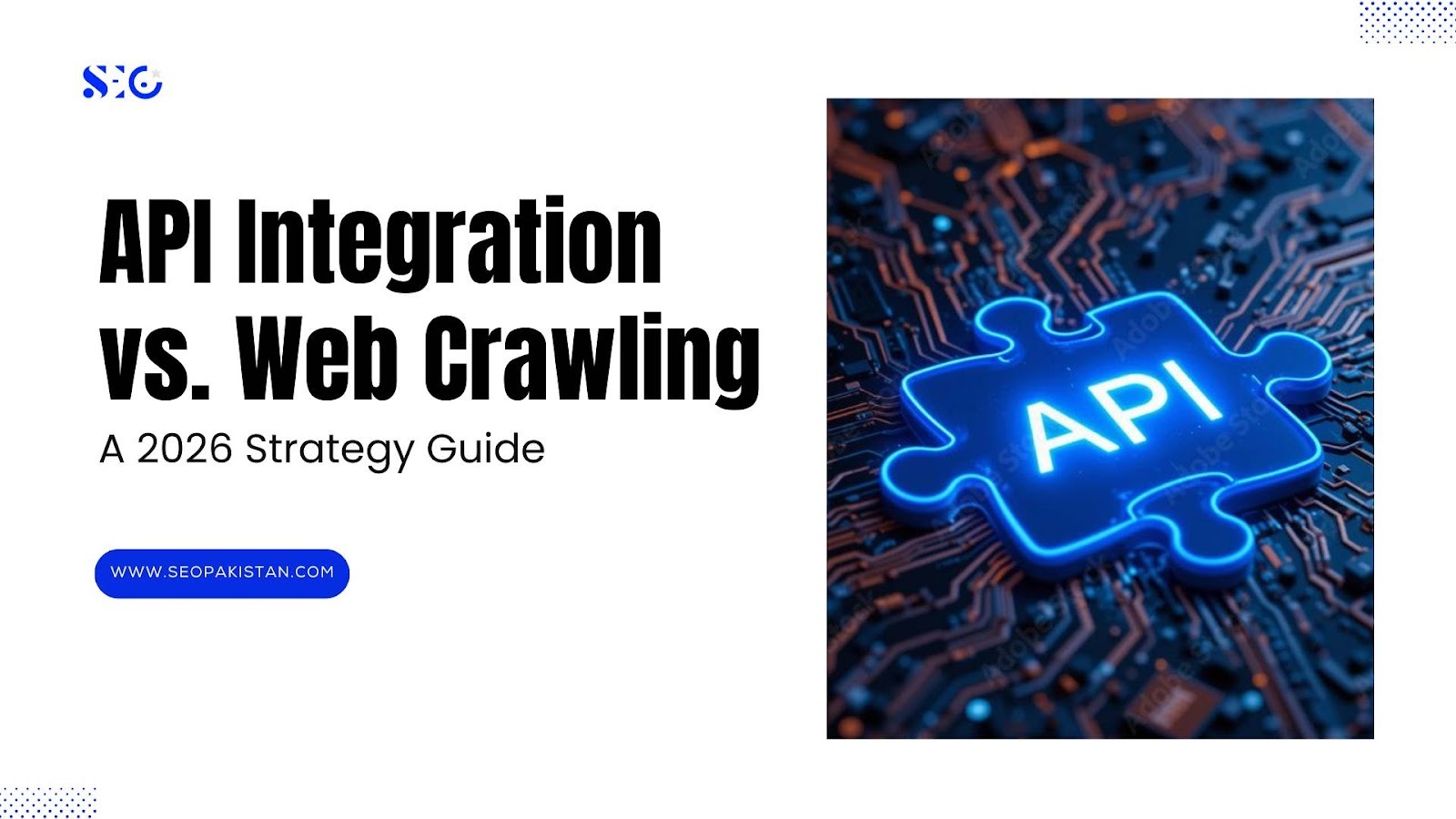
In enterprise data strategy, the conversation is shifting from simple “data collection” to sophisticated “data intelligence.” Your ability to gather, process, and act on information defines your competitive edge. The two primary engines driving this intelligence are at the heart of the main keyword API Integration vs. Web Crawling.
Choosing the right one for your data project is a critical decision for any CTO or Data Architect. An Application Programming Interface (API) acts as a digital handshake, using authorized, structured channels to exchange data between systems.
In contrast, web crawling is a digital explorer, an automated process for discovering and extracting public data from web pages at scale. This guide will help you understand the key differences and architect a resilient data flow for your organization.
Enterprise Data Comparison Matrix
Understanding the fundamental distinctions between these two methods is the first step. Each path offers unique advantages and challenges depending on your specific goals.
| Feature | API Integration (The Official Path) | Web Crawling (The Agile Path) |
| Data Quality | Pre-structured (JSON/XML) | Unstructured (Requires AI-driven HTML parsing) |
| Reliability | Guaranteed (SLA-backed) | Variable (Sensitive to website changes) |
| Access Breadth | Restricted by the provider | Unlimited (Anything publicly visible) |
| Implementation | “Adopt & Integrate” | “Build & Maintain” |
| Cost Basis | OpEx (Usage-based fees) | CapEx + OpEx (Build + Ongoing Maintenance) |
| Real-time Ability | Instant via Webhooks | Latency-prone (Depends on crawl cycles) |
API Integration: The Gold Standard for Reliability
When you need a stable and predictable data source, official channels are the best option. API integration offers a direct, legally sanctioned pipeline to another platform’s data.
The Benefits of an Official API
Using an official API provides several core advantages that are essential for mission-critical operations. The structured format of the data streamlines processing and ensures high data accuracy.
- Predictable Schema: APIs provide data in a documented, structured format like JSON or XML. This consistency means no surprises during ingestion, which significantly reduces errors and simplifies development. You know exactly what data points you will receive.
- Legal Compliance by Design: Accessing data through an API is explicitly permitted by the provider. This eliminates the legal risk associated with violating a website’s Terms of Service (ToS), ensuring your data extraction methods are compliant.
- High-Speed Synchronization: APIs are built for speed. For operations that depend on real-time data, like financial tickers, inventory management, or transaction processing, API calls deliver the instant updates you need.
When APIs Fall Short
Despite being the gold standard, relying solely on API data can create significant limitations. Providers act as gatekeepers, and their priorities may not align with yours.
- The “Gatekeeper” Restriction: You only see what the provider wants you to see. APIs provide access to specific data points, but often omit valuable information like user-generated content or other rich metadata available on the full pages.
- Scalability Bottlenecks: Most APIs impose rate limits, restricting the number of calls you can make in a given period. For large-scale projects, such as training an AI model, these limits can stall progress and become a major bottleneck.
- Dependency Risk: Your data pipeline is entirely dependent on the provider. If they decide to change, restrict, or shut down the API, a trend seen in the “API Great Wall” shifts of 2024-2025, your entire operation can come to a halt overnight.
Web Crawling: Scalable Data Collection for the AI Era
When no official API exists or when the API is too restrictive, web crawling becomes an indispensable tool. Web scrapers allow you to gather data from publicly visible information across the internet, offering unparalleled flexibility and scale.
Agile Data Gathering with Modern Crawlers
Web crawling gives you a competitive edge by allowing you to access data your rivals may not have. It is the key to building comprehensive datasets for competitive intelligence, price monitoring, and market analysis.
- Competitive Advantage: You can access data from competitors who do not offer an official API. This is crucial for tracking keyword rankings, monitoring prices, and analyzing market sentiment from various sources.
- Data Completeness: A web crawler can extract all the data from a webpage’s raw HTML, including hidden metadata, user reviews, and visual elements that APIs often omit. This ensures you gather complete and comprehensive datasets.
- Customizability: You control the entire process. You define the crawl frequency, the depth of exploration across multiple pages, and the exact specific data points you need to extract from the HTML structure.
The 2026 Stealth Requirements for Web Scrapers
The web is no longer a passive environment. Sophisticated anti-bot systems require modern crawlers to be smarter and more adaptable to avoid getting blocked.
- Identifying as a “Polite” Actor: Enterprises must correctly configure their web crawler signatures. This helps avoid accidental IP bans and ensures your crawlers do not overload a website’s server, maintaining good digital citizenship.
- Bypassing AI Firewalls: Navigating advanced anti-bot measures is essential. This involves using tools like 5G residential proxies and techniques like JA3 fingerprinting to mimic human user behavior and avoid detection.
- Self-Healing Architecture: Websites change. A modern web scraping architecture must use AI agents that can automatically adapt to HTML changes, “fixing” the scraper to ensure data collection continues without manual intervention and ongoing maintenance.
Strategic Planning: The Decision Framework
Choosing between an API and web crawling is not about which is “better,” but which is right for the job. Your data project requirements should guide your decision.
Choose API Integration When:
- The data source is a major platform like Google, Amazon, or a social media giant.
- Your application requires 100% accurate data that must be updated in real time.
- You need to access “private” or user-specific data with explicit consent.
Choose Web Crawling When:
- No official API exists, or the API is too expensive for the data volume you require.
- You need to aggregate data across thousands of smaller websites or sources.
- You require historical context or data that APIs may have deleted or do not provide.
The Hybrid Champion: 2026 Best Practices
The most successful enterprise data solutions do not choose one method over the other. They use a dual-track, hybrid approach that leverages the strengths of both.
This strategy uses an API as the core and crawling as the gap-filler.

For example,
You can use an API to pull a product’s core data, like its price and stock level, ensuring reliability for the most critical information. Then, you can deploy a custom web crawler to enrich that core data with “edge” information, such as scraping user-submitted photos, customer reviews, and Q&A sections from the product page. This hybrid model delivers the stability of API data with the comprehensive coverage of web crawling.
Conclusion: Building Your Data Moat
In the end, API Integration vs. Web Crawling is not just a matter of preference APIs offer the stability and reliability your core infrastructure needs, while web crawling provides the agility and flexibility your competitive strategy demands.
In an environment of increasing “data protectionism,” the ability to execute both API integration and web crawling is no longer a simple technical choice; it is a significant competitive advantage. Mastering both approaches allows you to build a defensible data moat around your business, ensuring you have the intelligence to outmaneuver the competition.
Are you ready to architect a resilient data flow? Contact SEO Pakistan today for an Enterprise Data Strategy Audit and let us build your custom integration.
Frequently Asked Questions (FAQs)
What is the difference between API integration and web crawling?
API integration uses structured, authorized channels to access data, while web crawling extracts publicly visible information from web pages using automated tools.
When should I use web crawling instead of an API?
Use web crawling when no official API exists, the API is too restrictive, or you need to gather data from multiple pages or smaller websites.
How does web crawling handle dynamic content?
Modern web crawlers use techniques like JavaScript rendering and headless browsers to extract data from dynamic content and complex HTML structures.
What are the benefits of API integration for real-time data?
APIs provide reliable, real-time data through structured formats like JSON or XML, ensuring data accuracy and instant updates via API calls.
Is web crawling legal for data collection?
Web crawling is legal when it respects site terms, avoids anti-bot measures, and only extracts publicly visible information without violating intellectual property rights.