

Imagine this: a potential customer lands on your website, eager to explore your products. Seconds tick by as the page hesitates, and in that brief pause, they close the tab and vanish. How many customers are you losing to slow load times? This is not just a technical problem; it is a revenue killer.
According to groundbreaking research, even a 0.1-second difference in loading speed can lead to a massive uptick in conversions up to 10%. The secret lies in mastering page speed conversion.
Today, optimizing your website’s speed is the fastest, most effective way to reduce user friction and unlock instant revenue growth. In this blog post, we will reveal the key metrics, essential strategies, and the ten hidden technical flaws silently sabotaging your sales.
Ready to transform your website’s performance into profit? Dive in to discover why page speed conversion could be your ultimate competitive advantage.
Fundamentals of Page Speed and Conversion
To optimize for conversions, you must first understand the right metrics and strategies. It begins with distinguishing between the data used for debugging and the data that reflects actual revenue impact.
Field Data (ROI) vs. Lab Data (Debugging)
Many businesses chase a perfect 100/100 score on PageSpeed Insights. However, this is lab data. It represents a simulated test in a controlled environment. A perfect score is a useful debugging tool, but it does not guarantee a great user experience or high conversions in the real world.
Your focus should be on field data, which is captured by Core Web Vitals. These metrics LCP, INP, and CLS, are based on the actual experiences of your users across various devices, network connections, and locations. A passing CWV assessment is the true indicator of your site’s conversion readiness.
How Page Speed Affects Conversion: The Three Vitals
Core Web Vitals directly translate to user experience and, consequently, conversion rates.
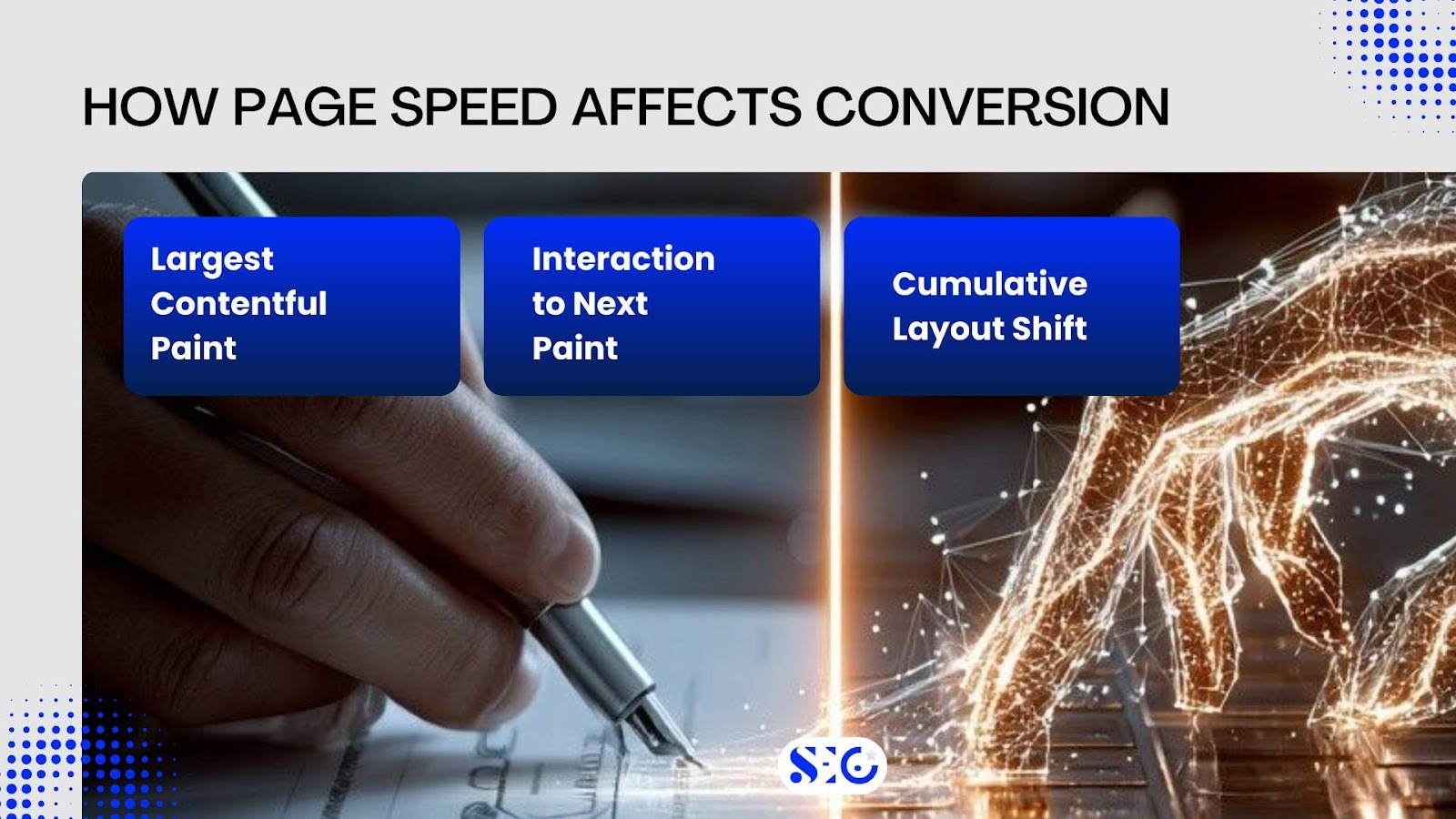
- Largest Contentful Paint (LCP): This metric measures the time it takes for the largest visual element on the page to become visible. A delayed LCP means your value proposition, hero image, or headline is hidden. Users who do not see what they came for will leave.
- Interaction to Next Paint (INP): This measures responsiveness. When a user clicks a button or interacts with a form, a high INP causes a noticeable lag. This sluggishness erodes trust and is a primary cause of form abandonment.
- Cumulative Layout Shift (CLS): This vital measure of visual stability. Unexpected layout shifts, where elements on the page move after loading, cause users to lose their place or click the wrong thing. It is a major source of user frustration and can lead to “rage clicks” and exits.
The Benefits of a Speed-First Strategy
Implementing page speed conversion strategies delivers tangible business benefits. The core principle is to always prioritize the optimization of your conversion funnel pages product, cart, and checkout before all others. This requires consistent monitoring, a Content Delivery Network (CDN), and a dedicated strategy for critical CSS.
Here is how specific optimizations translate to ROI:
| Optimization Strategy | Conversion Impact | Estimated ROI Increase |
| Prioritizing Critical CSS | Eliminates render-blocking resources, speeding up LCP. | +8% conversion lift on mobile. |
| Optimizing Conversion Images | Faster loading of product images builds trust and confidence. | Reduced bounce rate by 5%. |
| Reducing Third-Party Scripts | Cuts down execution time, improving INP and responsiveness. | Decreased form friction by 10%. |
| Implementing Smart Caching | Ensures returning users experience near-instant load times. | Higher customer loyalty and repeat sales. |
| Fixing Layout Shifts (CLS) | Eliminates user frustration and accidental clicks. | Up to 12% reduction in misclicks. |
| Improved Ad Quality Score | Faster landing pages boost Google Ads Quality Score. | Lower Cost Per Acquisition (CPA). |
Top 10 Hidden Technical Flaws Killing Your Conversions
Beyond the basics, several specific technical issues can silently sabotage your site’s performance and revenue. Let us explore ten frequent issues that could be hindering your conversions.
- The Hidden Font Swap Flash (CLS Killer): Using font-display: swap without optimizing font delivery causes a jarring text shift as the custom font loads, triggering a high CLS score on your most important headlines.
- Unthrottled Third-Party Bloat (INP Killer): Non-critical marketing tags, like chat widgets and tracking pixels, that load synchronously can delay both LCP and INP, especially on conversion-focused pages.
- Lazy Loading Critical Assets (LCP Killer): Mistakenly applying lazy loading to the primary above-the-fold image or the main call-to-action button is a critical error. This forces the most important content to load last.
- Invisible Image Height/Width Debt (CLS Killer): Failing to define explicit height and width attributes for images and ad slots causes the page layout to repeatedly shift and redraw as these elements load.
- Excessive JavaScript Execution on Mobile (INP Killer): Shipping heavy, desktop-level JavaScript to mobile users overloads low-power CPUs. This crushes INP and makes form interactions painfully sluggish.
- Unoptimized Background Images (The Hero Killer): A large, uncompressed hero background image is often the single biggest contributor to a slow LCP on your main sales pages.
- The Cascading Stylesheet (CSS) Graveyard (LCP Killer): Legacy or unused CSS code must still be downloaded and parsed by the browser, even if only 10% of it is needed for rendering the visible portion of the page.
- Server-Side Jitter (TTFB Killer): Inconsistent Time To First Byte (TTFB) due to poor server-side caching or slow database queries can destroy user confidence before the page even begins to render.
- The Form Validation Lag (INP Killer): Using heavy, client-side JavaScript libraries for simple form validation can cause a noticeable delay between a user typing and the validation response appearing, creating friction.
- Uncached A/B Testing Elements (LCP Killer): Running conversion experiments without proper caching forces every user to re-render the test element, delaying the LCP for the entire audience.
Strategy, ROI, and Maintenance
Fixing these issues requires a strategic framework focused on measurable business results.
Proving ROI and Understanding Business Improvement
The only definitive way to prove the value of speed optimization is through A/B testing. You must demonstrate that the faster, optimized version of a page generates a statistically significant higher conversion rate than the original.
The primary use for page speed conversion is risk elimination and maximizing the efficiency of your ad spend. Faster landing pages lead to better ad performance and a higher return. Case studies prove this approach works. Rakuten 24 saw a 33% increase in conversion rate by focusing on Core Web Vitals, and redBus achieved a 7% increase in sales through similar efforts.
Best Practices for Ongoing Optimization
Performance is not a one-time project; it requires continuous maintenance.
- Optimize for Mobile Users: With mobile as the primary traffic source, you must use mobile-friendly templates and apply aggressive image and code optimization for these users.
- Manage Plugins: Regularly update your plugins, remove any that are unused, and always opt for lightweight solutions to prevent performance regression over time.
- Integrate Speed with SEO: Your SEO strategy should set clear performance goals (e.g., “Achieve LCP under 1.5s on all money pages”). Automated tools can then execute the technical tasks required to meet those goals.
You need to optimize for page speed conversion because it is a finite, measurable project with a clear and immediate ROI.
Conclusion: Speed is the Foundation of Conversion
Page speed conversion is no longer a technical checkbox; it is the fundamental layer of Conversion Rate Optimization (CRO). By shifting your focus from generic lab data scores to real-world field data, you can address the user experience where it truly matters. When you systematically tackle the 10 hidden technical flaws from the “Hero Killer” to third-party bloat, you directly unlock untapped revenue potential.
Looking ahead, artificial intelligence will play a larger role in predicting performance issues and automating the delivery of critical CSS and images. But you do not need to wait for the future.
Your next step is simple. Run a Lighthouse audit on your highest-revenue page today. If your LCP is over 2.5 seconds, you are leaving money on the table. Start by fixing the “Hero Killer” optimization so that the main hero image is displayed immediately with seo pakistan.
Frequently Asked Questions
What is page speed conversion?
Page speed conversion measures how website loading speed impacts user actions like sales or sign-ups, directly affecting revenue.
Why is page speed important for conversions?
Faster page speeds reduce bounce rates, improve user experience, and increase conversion rates, especially on key pages like checkout or product pages.
What are Core Web Vitals?
Core Web Vitals are Google’s metrics (LCP, INP, CLS) that assess a website’s speed, responsiveness, and visual stability, crucial for user experience.
How can I improve my page speed?
Optimize images, reduce third-party scripts, use caching, and prioritize critical CSS to enhance loading speed and user experience.
What is the ROI of improving page speed?
A 0.1-second improvement can boost conversions by up to 10%, making it a high-impact strategy for revenue growth.