

Search engine optimization has evolved far beyond stuffing keywords into a webpage. Modern algorithms prioritize context, expertise, and depth. This shift requires a strategy that connects concepts rather than just matching search terms. Topical map SEO represents this strategic evolution. It moves away from isolated articles and towards a cohesive web of information that signals true authority to search engines.
By creating a structured ecosystem of content, you demonstrate to Google that you do not just mention a subject; you master it. This guide explores the mechanics of topical maps, detailing how they differ from traditional methods and why they are essential for building topic authority.
You will learn how to plan, build, and measure a topical map that transforms your site into a go-to resource. We will cover practical steps, necessary tools, and real-world examples to help you implement comprehensive content planning that drives sustainable growth.
What is a Topical Map in SEO?
A topical map is a semantic blueprint that organizes your website’s content based on relationships between ideas rather than just keywords. It visualizes how main topics connect to subtopics, supporting articles, and specific user questions. Unlike a flat list of keywords, a topical map creates a hierarchy that mirrors how users think and how search engines understand language.
This structure relies heavily on semantic SEO, ensuring that every piece of content serves a distinct purpose while supporting a broader theme.
- Like a library for your website: Think of a topical map as a library’s classification system. A simple keyword list is like a shopping list of books, but a topical map organizes them on the shelf so visitors can easily find everything on a specific subject in one place.
- Signals expertise to search engines: When search engines crawl a site with a strong topical map, they find clusters of logically linked, related content.
- Encourages comprehensive ranking: This signals that your website offers in-depth coverage, not just surface-level answers. It helps your site move beyond ranking for a single search query to ranking for an entire concept.
Why Topical Maps Are Important for SEO
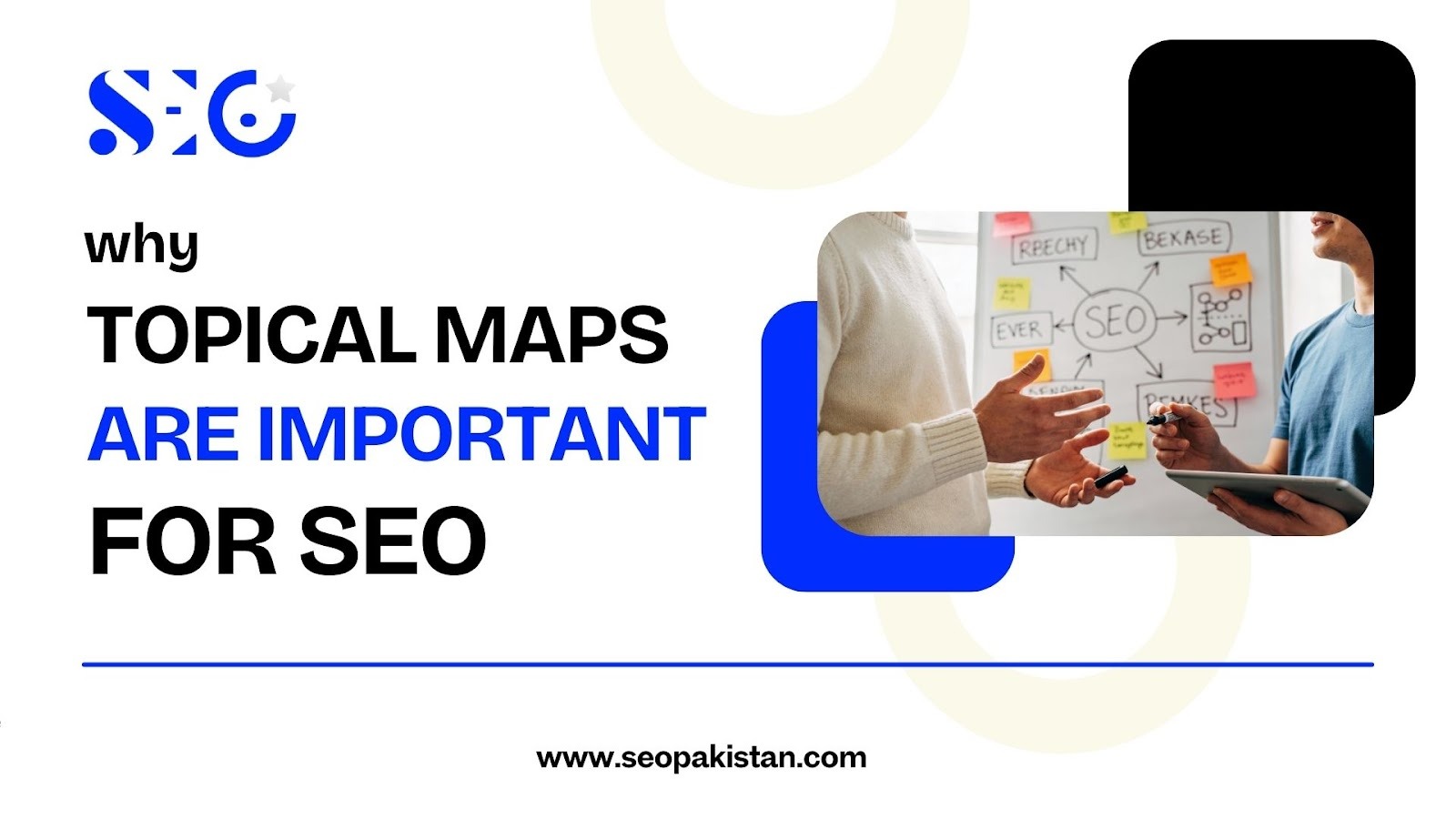
Search engines like Google have become increasingly sophisticated at understanding the intent behind a search. They use semantic analysis to determine if a website offers a complete answer or just a partial one. Topical map SEO is the most effective way to signal comprehensive coverage to these algorithms.
A robust topical map provides the architecture for this authority. It shows that you answer the “what,” “why,” and “how” of a topic, satisfying user curiosity without forcing them to bounce back to the search results.
Implementing a content cluster strategy through topical mapping offers significant benefits:
- Better Rankings: Comprehensive coverage often leads to higher rankings for a wider range of long-tail keywords.
- Internal Linking Efficiency: A logical map creates natural opportunities to link pages, distributing page authority effectively.
- Improved User Retention: Users stay longer when they can easily navigate from a general overview to specific details.
- Higher CTR: Authoritative content often captures rich snippets and answer boxes.
Core Components of a Topical Map
A successful map requires more than just a list of blog post ideas. It needs a structural integrity that supports both the user journey and crawler efficiency. These components work together to build topic authority.
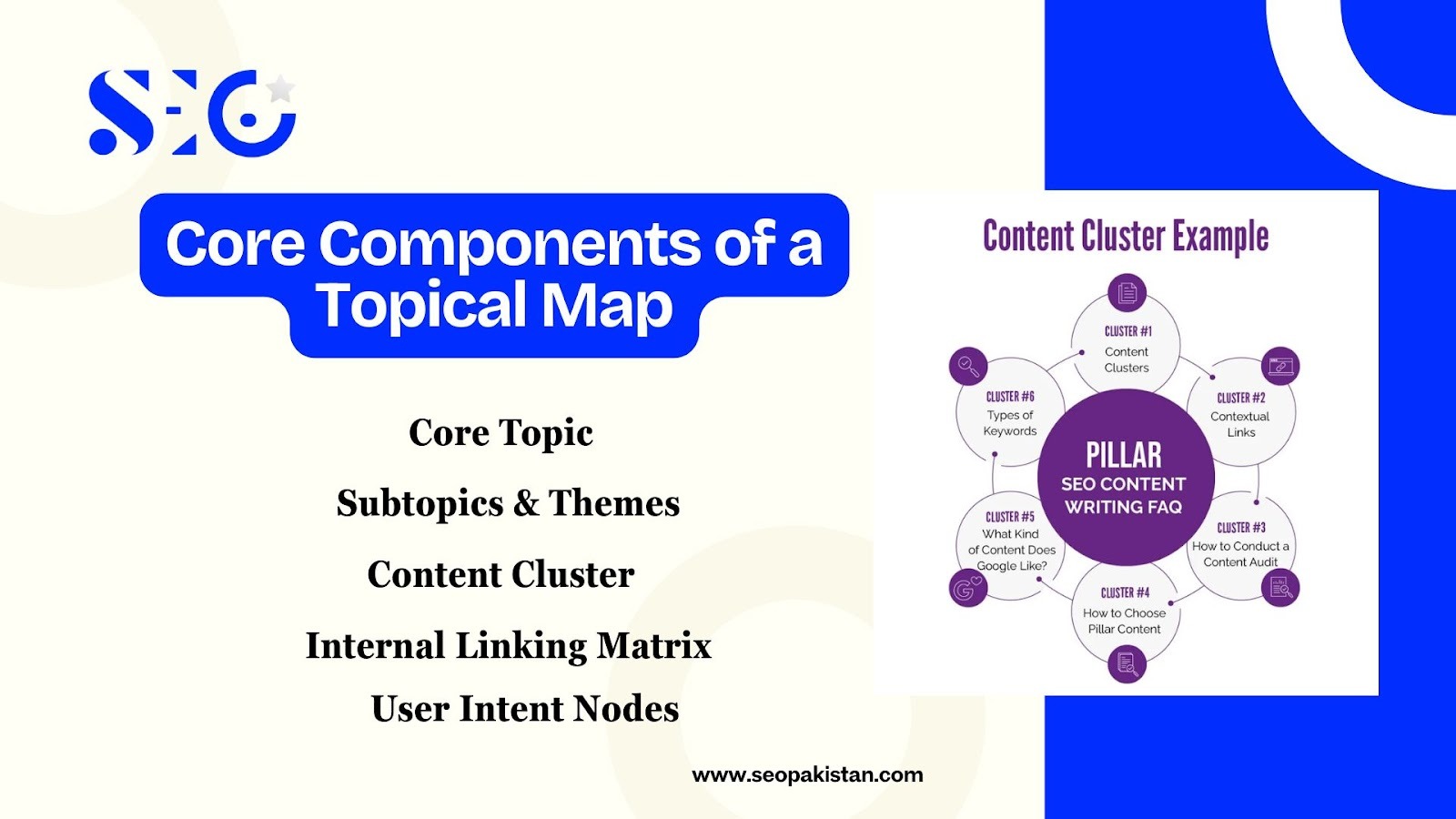
The anatomy of a topical map typically includes four distinct layers:
- Core Topic: This is the central pillar or the “seed” concept. It is broad, high-volume, and represents the primary focus of your authority (e.g., “Digital Marketing”).
- Subtopics & Themes: These are the semantic extensions of the core topic. They break the main subject down into specific categories (e.g., “SEO,” “Social Media,” “Email Marketing”).
- Content Clusters: These are groups of supporting articles that cover specific questions or long-tail keywords within a subtopic. They provide the depth required for topical authority.
- Internal Linking Matrix: This is the strategic web of links connecting the clusters to the pillar page and to each other, guiding link equity throughout the section.
- User Intent Nodes: Every node in the map must address a specific intent—informational (learning), transactional (buying), or navigational (finding).
Step‑by‑Step Guide: How to Build a Topical Map
Building a topical map is a deliberate process that moves from abstract concepts to concrete content plans. It requires research, strategic thinking, and a clear understanding of your audience’s needs. Follow this workflow to create a semantic content mapping strategy that dominates your niche.
5.1 Define Your Core Topic
Your core topic serves as the foundation for your entire strategy. It must align perfectly with your business goals and the high-level intent of your target audience. Choosing a topic that is too narrow limits your growth potential, while one that is too broad makes it difficult to establish authority quickly.
To select the right core topic, you must analyze your unique selling proposition and where you want to be known as an expert. For an SEO agency, the core topic might be “Topical Map SEO” or “Technical SEO audits.”
- Assess Relevance: Ensure the topic directly relates to your product or service offering.
- Check Volume: Confirm there is sufficient search interest to justify a content cluster.
- Analyze Competition: Look at what top competitors cover and identify gaps in their high-level approach.
5.2 Conduct Semantic Content Research
Once you have a core topic, you need to understand the language and concepts surrounding it. This involves digging deeper than standard keyword volume to find the entities and relationships that define the subject. You are looking for the context that search engines expect to see.
Use semantic research tools to uncover the “things” (entities) associated with your “strings” (keywords). This phase shapes your semantic SEO structure.
- Identify Entities: Find the people, places, and concepts that are semantically linked to your core topic.
- Gather Questions: Use tools like AnswerThePublic or “People Also Ask” to find the specific questions users have.
- Group by Intent: Categorize your findings based on whether the user wants to know, do, or go.
5.3 Plan Your Content Cluster Strategy
With your research in hand, you must organize the chaos into a structured hierarchy. This stage involves defining your pillar pages and the supporting cluster content that will orbit them. The goal is to ensure no content stands alone and every piece supports the whole.
A strong content cluster strategy relies on clear parent-child relationships between pages. The pillar page offers the overview, while the clusters provide the granular detail.
- Define Pillar Pages: Create comprehensive guides that cover the broad subtopics.
- Map Cluster Content: Assign specific long-tail keywords and questions to individual articles.
- Plan FAQs: Identify common questions that can serve as dedicated sections or standalone posts.
5.4 Create a Semantic Content Map
Visualization helps you see the gaps and opportunities in your plan. A semantic content map is a visual representation, often a diagram or spreadsheet, that shows how every piece of content connects. This step is crucial for planning your internal linking strategy before you write a single word.
Seeing the map allows you to spot logical flaws or areas where you lack depth. It ensures your comprehensive content planning is truly comprehensive.
- Draw the Hierarchy: Use a mind-mapping tool to visually connect the core topic to subtopics and clusters.
- Define Links: Draw lines indicating where internal links should go to support the hub-and-spoke model.
- Spot Gaps: Look for areas in the visual map that look thin or disconnected.
5.5 Build a Comprehensive Content Plan
The final step turns your map into an actionable production schedule. You need to prioritize which clusters to build first based on business value and difficulty. This transforms your theoretical map into a live editorial calendar.
Your plan should include detailed briefs that guide writers on how to maintain the semantic integrity of the map.
- Prioritize Clusters: Start with the topics that have the highest potential for conversion or the lowest competition.
- Schedule Production: Assign realistic deadlines for drafting, editing, and publishing.
- Create Briefs: Ensure every content brief references the topical map and specifies internal linking targets.
How Topical Maps Differ from Traditional Keyword Strategies
Understanding the distinction between these two approaches is vital for modern SEO success. Traditional strategies often lead to disjointed content that competes with itself, while topical map SEO builds a unified force.
Here is how the two methodologies compare in key areas:
| Feature | Traditional Keyword List | Topical Map SEO |
| Focus | Individual keywords | Core topic + clusters + subtopics |
| Internal Linking | Minimal | Strategic hub-and-spoke |
| Content Depth | Low | Comprehensive coverage of the topic |
| Authority | Harder to build | Signals topical authority to Google |
| User Intent | Often ignored | Integrated (informational, transactional, navigational) |
Traditional keyword lists focus on capturing traffic for specific terms, often ignoring how those terms relate. Topical maps focus on capturing authority for an entire subject area. The internal linking in a traditional strategy is often an afterthought, whereas in a topical map, it is the nervous system that holds the strategy together.
Tools and Techniques for Topical Mapping
Creating a high-quality topical map requires the right set of tools to mine data and visualize relationships. You need technology that can look beyond simple keyword matching to understand semantic relevance.
Several categories of tools support semantic content mapping:
- Semantic Research Tools: Platforms like Surfer SEO, MarketMuse, or Clearscope help identify the LSI keywords and entities that search engines associate with your topic. They are essential for ensuring your content covers the subject depth required.
- Visualization Tools: Mind-mapping software like MindMeister, XMind, or even Lucidchart allows you to create the visual schema of your map. This helps stakeholders understand the strategy.
- Spreadsheets and Taxonomy Managers: Tools like Airtable or Excel are necessary for tracking the status of content clusters, managing URLs, and overseeing the production workflow.
- Authority Measurement: Tools like Ahrefs and SEMrush help you track your visibility across topic clusters rather than just individual keywords.
Best Practices for Semantic Content Mapping
To maximize the effectiveness of your topical map, you must adhere to specific best practices that align with search engine algorithms. It is not enough to just group content; the execution must be precise.
Follow these guidelines to ensure your map builds genuine authority:
- Prioritize Semantic Keywords: Focus on entities and concepts rather than just high-volume search terms to capture broad intent.
- Enforce Hub-and-Spoke Linking: rigorously link from cluster pages up to the pillar page and between related cluster pages to consolidate authority.
- Update Regularly: Search trends change, so revisit your map quarterly to add new subtopics or refine existing ones.
- Match Intent Categories: Ensure every node on your map clearly aligns with a specific stage of the buyer’s journey (awareness, consideration, decision).
Real Examples of Topical Maps
Seeing how a topical map functions in the real world clarifies the concept. These examples demonstrate how different business models utilize topical map SEO to dominate their respective niches.
Consider these scenarios for topic authority building:
Example 1: Topical map for e‑commerce category authority
An online retailer sells coffee equipment.
- Core Topic: Home Brewing
- Subtopics: Espresso Machines, French Press, Pour Over.
- Cluster (French Press): “Best French Press for beginners,” “French Press brewing ratio,” “Cleaning your French Press.”
- User Intent: Informational guides link to transactional product category pages.
Example 2: Topical map for local business SEO blog strategy
A plumbing company serves a specific city.
- Core Topic: Residential Plumbing
- Subtopics: Emergency Repairs, Maintenance, Installation.
- Cluster (Maintenance): “Winterizing pipes in [City],” “Hard water issues in [Region],” “Drain cleaning tips.”
- Local Relevance: Content connects general plumbing advice with specific local issues and services.
How to Measure Topical Authority and Performance
You cannot improve what you do not measure. Tracking the success of a topical map requires looking at metrics that indicate group performance rather than just single-page success. You are looking for signals that Google trusts your site as a subject matter expert.
Monitor these key indicators to assess your progress:
- Cluster Ranking Gains: Watch for improved visibility across the entire group of keywords associated with a cluster.
- Internal Linking Impact: Use site audit tools to ensure link equity is flowing correctly to your pillar pages.
- Engagement Metrics: Higher time on page and deeper scroll depth often indicate that users are finding the comprehensive answers they need.
- Topic Coverage Scores: Some SEO tools provide a score on how well you cover a topic compared to competitors.
- Search Console Trends: Analyze clicks and impressions for topic groups to see if the overall trend is upward.
Final Thoughts
Topical map SEO provides the most reliable path to establishing long-term authority in search results. It forces you to move beyond the short-sighted pursuit of individual keywords and embrace a holistic view of your niche. By connecting concepts through comprehensive content planning, you build a resilient structure that serves both search engines and human readers.
Success in modern SEO favors depth over breadth. A systematic approach to semantic content mapping ensures that every piece of content you create adds value to a larger picture. Start building your map today, and you will lay the foundation for sustainable traffic and undisputed industry leadership.
Don’t wait, supercharge your SEO strategy now and stay ahead of the competition! Visit seopakistan.com for proven SEO services that deliver guaranteed results!
Frequently Asked Question
What is a topical map in SEO?
A topical map in SEO is a strategic plan that organizes content into hierarchical clusters based on semantic relationships. It connects a core topic to subtopics and supporting articles to demonstrate comprehensive expertise to search engines.
How does semantic content mapping improve rankings?
Semantic content mapping improves rankings by helping search engines understand the context and depth of your content. It signals that your site covers a topic thoroughly, which increases trust and authority for related search queries.
Can topical maps help with feature snippets?
Yes, topical maps help with featured snippets. By answering specific user questions within detailed cluster content, you increase the likelihood of Google pulling your content for direct answers and position zero results.
What’s the difference between a content cluster and a topical map?
A content cluster is a single group of related pages orbiting a pillar page. A topical map is the blueprint for the entire website, often containing multiple content clusters that relate to one another.
What tools can I use to create a topical map?
You can use tools like Ahrefs or SEMrush for keyword research, Surfer SEO for semantic analysis, and mind-mapping software like XMind or Lucidchart to visualize the structure.