

The way users find information online is undergoing a fundamental shift. Perplexity AI ranking determines how answer engines decide which sources to feature when users ask questions in natural language. We are moving away from the era of ten blue links and entering an age where direct, synthesized answers dominate the user experience.
This evolution requires a new approach to content strategy known as answer engine optimization. Searchers no longer want to hunt for data; they want immediate, accurate results.
Understanding how to achieve Perplexity AI visibility is now essential for digital marketers who wish to remain relevant. This guide explains how Perplexity functions and provides actionable steps to optimize your content for this new frontier.
The Rise of Answer Engines and Their SEO Impact
Traditional search engines act as librarians, pointing you toward a book that might contain your answer. AI-powered answer engines like Perplexity, ChatGPT, and Gemini act as researchers, reading the book for you and summarizing the specific information you need. This distinction changes everything about how we create content.
Perplexity AI ranking is now a key ranking frontier because it prioritizes information synthesis over simple link retrieval. While traditional SEO focuses on getting a user to click a link, optimization for answer engines focuses on getting the engine to cite your content as a source. The goal is no longer just traffic; the goal is authority and citation within a synthesized response.
What Is Perplexity AI Ranking?
Perplexity is an AI research tool that acts like a sophisticated ranking system. It doesn’t just list web pages; it reads them, understands their context, and creates a clear, coherent answer using information from several high-quality sources.
The ranking process is based on synthesizing information from multiple documents. Here’s how it works:
- The engine scans the web for reliable data.
- It evaluates the credibility of each source.
- It then assigns a relevance score based on how well the content answers the specific details of a user’s question.
- The AI favors factual, well-structured, and authoritative content, using it as a key part of its final answer.
How Perplexity AI Differentiates Search from Answer Generation
It is crucial to understand the mechanical differences between a search engine and an answer engine. A search engine ranks links, while an answer engine generates knowledge.
Perplexity combines multiple sources into a concise answer, removing the need for the user to visit several websites to piece together information. The role of semantic understanding is paramount here; the engine must comprehend the intent behind the query, not just the keywords.
The following table illustrates the core differences between these two retrieval methods:
| Feature | Traditional SERP | Perplexity Answer |
| Output | List of results | One synthesized answer |
| User Action | Click required | Answer inline |
| Targeting | Keywords | Semantic relevance |
| Success Metric | Link ranking | Source citation ranking |
Core Ranking Signals Behind Perplexity AI Visibility
To succeed in this new environment, you must understand the specific signals Perplexity uses to evaluate content. These signals differ slightly from Google’s algorithms, placing a heavier emphasis on factual accuracy and clear structure.
Content Relevance & Semantic Matching
Perplexity looks for content that fully addresses the topic at hand. It is not enough to mention a keyword; the content must demonstrate a deep understanding of the subject.
Does your content cover the entity thoroughly and align with user intent?
- Rich entity recognition: The engine identifies specific people, places, and concepts to ensure the content is factually grounded.
- Topic completeness: Covering a subject exhaustively increases the likelihood that the engine will deem your source the most useful.
- Intent alignment: The content must directly answer the question the user asks without unnecessary fluff or distraction.
E-E-A-T (Experience, Expertise, Authoritativeness, Trustworthiness)
Authority is a primary filter for answer engines. Because Perplexity aims to provide accurate answers, it prioritizes sources that have established credibility in their field.
Why does high authoritativeness improve visibility?
- Source reputation signals: Domains with a history of publishing accurate, high-quality information receive preferential treatment.
- Expert authorship: Content written by recognized experts helps the engine verify that the information is trustworthy.
- Content relevance: Content that closely aligns with the user’s search intent is prioritized, ensuring it meets their needs effectively.
- Freshness of information: Regularly updated content is favored, as it reflects the latest and most accurate information available.
Content Structure & Clarity
Robots read code and structure before they read text. If your content is difficult for a machine to parse, it will not be included in the synthesized answer.
How does organization impact machine readability?
- Section headers: Clear H2 and H3 tags help the AI understand the hierarchy and relationship between different ideas.
- Logical organization: A flow that moves from simple definitions to complex explanations assists the engine in extracting relevant snippets.
- Structured data: Implementing schema markup clarifies exactly what the content is about, removing ambiguity for the crawler.
Source Diversity & Citation Patterns
Perplexity rarely relies on a single source. It aims to provide a balanced view by pulling information from various reputable sources.
How does diversity impact ranking?
- Perplexity shows multiple sources: The engine seeks to validate facts by cross-referencing them against other high-authority domains.
- Citation networks: If your content cites other authoritative sources, and other authoritative sources cite you, it creates a trust network that the AI values.
- Content relevance and depth: AI prioritizes content that is both highly relevant to the search query and provides in-depth, well-researched information.
User Engagement & Interaction Signals
While Perplexity focuses on answers, user behavior still provides clues about quality. The engine learns from how users interact with the provided citations.
What behaviors signal quality to the algorithm?
- Time spent reading: If users click a citation and stay on the page, it signals that the source provided value.
- Click-backs: A user returning to the AI interface quickly may indicate the source did not satisfy their curiosity.
- Scroll behavior: Deep scrolling on a source page indicates that the user found the comprehensive details they were looking for.
Answer Engine Optimization (AEO): What It Is and Why It Matters
Answer engine optimization is the practice of tailoring content specifically for AI-driven synthesis tools. While traditional SEO focuses on getting humans to click, AEO focuses on making it easy for AI to read, understand, and summarize your content.
AEO involves a shift toward conversational search SEO. Here’s what that means and why it’s important:
- How users search: People interact with tools like Perplexity using full, natural-sounding sentences and follow-up questions, much like talking to a friend.
- How your content should respond: Your writing needs to mirror this conversational style. It should provide direct, clear answers to potential questions.
- Why it matters: This approach makes it easier for the answer engine’s AI to find, understand, and feature your answers in its summaries, boosting your content’s visibility.
Practical Optimization Strategies for Perplexity AI Ranking
Achieving high visibility requires a strategic shift in how you produce content. The following strategies are the actionable core of optimizing for Perplexity AI ranking.
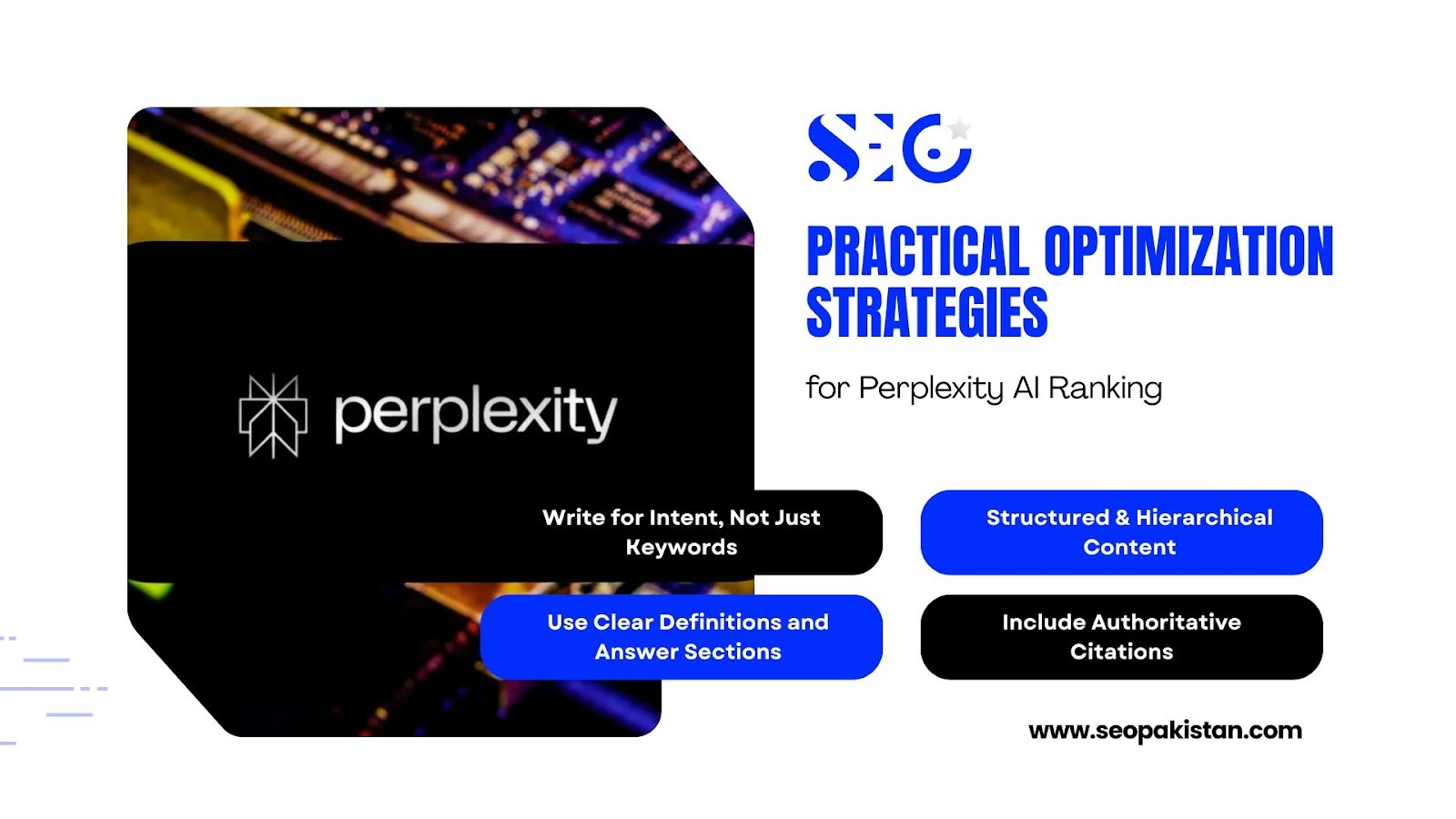
Write for Intent, Not Just Keywords
Keywords help engines categorize content, but intent tells them if the content is useful. You must anticipate the specific problems the user is trying to solve.
How do you align content with complex user needs?
- Match user question intent: Analyze the specific questions your audience asks and answer them directly in the first few sentences of a section.
- Anticipate follow-up queries: Conversational search SEO requires you to answer the immediate question and the logical next question in the same piece.
- Use natural language: Write in a conversational tone that mirrors how users phrase their questions to improve clarity and engagement.
- Incorporate structured data: Enhance your content with schema markup to help search engines better understand and display your answers.
Structured & Hierarchical Content
AI models struggle with walls of text. You must break your content down into digestible, logical chunks that the algorithm can process independently.
What formatting tactics help AI parse text?
- Use strong H2/H3 hierarchy: Use descriptive headings that act as summaries for the content that follows.
- Short paragraphs: Keep ideas distinct to prevent the AI from conflating two separate concepts.
Use Clear Definitions and Answer Sections
Perplexity often looks for a direct definition to begin its synthesis. Providing this clearly can win you the “definition” slot in the answer.
How do you structure content for direct answers?
- Define terms: Explicit definitions (e.g., “X is Y”) help the engine understand the core concept immediately.
- Use Q&A formatting: Asking the question in a heading and providing the answer immediately below mirrors the answer bot optimization process.
- Directly answer common queries: Avoid burying the lead; state the answer first, then provide the nuance.
Include Authoritative Citations
You cannot become an authority if you exist in a vacuum. Linking to other trusted sources validates your data and helps Perplexity trust your content.
Why are external links vital for Perplexity AI’s visibility?
- Link to high-authority sources: Citing government bodies, academic institutions, or industry leaders signals that your research is grounded in fact.
- Use structured references: Clearly attribute data and quotes to their original owners to establish a chain of trust.
- Diversify your citations: Reference a variety of trusted sources rather than relying on a single one to show a breadth of research.
Optimize for Semantic Entities
Search is moving from keywords to entities. You must ensure the AI understands the people, places, and concepts you discuss and how they relate to one another.
How do you strengthen entity signals?
- Entity signals: consistently use the proper names of people, places, and concepts rather than vague pronouns.
- Contextual associations: Discuss related topics in proximity to help the AI map the relationships between different entities.
Content Formats That Rank Best in Perplexity & Similar Engines
Certain content structures lend themselves better to AI synthesis than others. To maximize your Perplexity AI visibility, you should prioritize formats that are easy for a machine to deconstruct.
Which structures are most likely to be cited?
- How-to guides: Step-by-step instructions are highly structured and easy for an answer engine to summarize sequentially.
- Q&A structured content: This format directly mirrors the user’s interaction with the engine, making extraction seamless.
- Definitive/ultimate guides: Comprehensive resources that cover an entire topic allow the AI to pull multiple answers from a single URL.
- Lists and comparison tables: Structured data in list or table form is the gold standard for answer bot optimization.
- Definitions + actionable steps: Defining a problem and immediately offering a solution provides high utility for synthesized answers.
Comparison: Traditional SEO vs Answer Engine Optimization
It is helpful to visualize how your strategy must change. The following table highlights the operational shifts required to move from SEO to AEO.
| Dimension | Traditional SEO | Answer Engine Optimization |
| Primary Goal | Rank in SERP | Rank in synthesized answers |
| Primary Signal | Backlinks & Keywords | Relevance & context |
| Content Structure | Page level | Passage & entity level |
| User Intent Focus | Keyword match | Conversational intent |
| Output | List of links | Instant answer |
Conclusion
The digital landscape is changing, and Perplexity AI ranking is at the forefront of this shift. Content creators must now prioritize accuracy, structure, and authority over simple keyword placement. By adopting conversational search SEO strategies, you position your brand as a trusted source of truth.
To succeed, you must focus on answer engine optimization tactics like clear formatting and entity-based writing. This approach ensures your content is not just found but understood and utilized by the next generation of search tools.
As you refine your strategy, remember that improving your AI research tool ranking ultimately serves the human user by providing faster, more reliable information. Visit seopakistan.com to learn how we can help you achieve your SEO goals!
Frequently Asked Questions
What is Perplexity AI ranking?
Perplexity AI ranking is the system the Perplexity engine uses to evaluate, select, and synthesize information from across the web to provide a direct answer to a user query.
How does Perplexity differ from Google search?
Google provides a list of links that the user must browse, whereas Perplexity reads the sources for you and generates a single, comprehensive summary with citations.
How do I know if my content is being used by Perplexity?
You can check referral traffic in your analytics software for visitors from Perplexity, or manually search your target questions to see if your site appears as a citation.
Can traditional SEO help answer engine ranking?
Yes, foundational SEO practices like technical health, site speed, and basic keyword research are still necessary for the AI crawler to find and index your site.