

Stop guessing and start gaining.
Achieving a 40% boost in your conversion rate is not about luck. It is not about changing button colors at random. It requires a disciplined, concentrated 30-day plan that targets high-leverage friction points.
Many marketers view conversion rate optimization (CRO) as a vague, endless maintenance task. We are redefining it. We treat website conversion optimization as a time-limited, aggressive project designed for explosive short-term wins.
What does successful optimization look like? It looks like a continuously shrinking Customer Acquisition Cost (CAC) and a systematically increasing Customer Lifetime Value (CLV).
This guide outlines a 4-Week High-Impact Strategy. We reveal the 7 “Quick-Win” tests you must prioritize in the next 30 days to maximize your conversion rate boost.
The CRO Blueprint: Features, Cost, and ROI
To master website conversion optimization, you must first understand the mechanism, the investment, and the return. This is not magic; it is a structured engineering of user behavior.
How Website Conversion Optimization Works
The 30-day cycle follows a rigid, focused path:
- Analyze (Week 1): Gather data on user behavior.
- High-Impact Test (Week 2): Deploy psychological triggers.
- Funnel Test (Week 3): Fix structural friction.
- Scale (Week 4): Validate and hard-code the wins.
The core feature of this strategy is A/B testing combined with qualitative data validation. You need access to user data through analytics, specific tools like heatmaps or session replays, and dedicated time for deployment.
We use these strategies primarily to maximize the profit margin of existing traffic. This improves ad campaign ROI and secures quick wins that gain business buy-in.
The Cost and Investment
What does website conversion optimization actually cost?
Cost Category 1: Tools
You will need essential software.
- Paid Tools: Heatmaps, session replays, and advanced A/B testing platforms provide the visual data you need.
- Free Tools: Google Analytics 4 (GA4) provides the quantitative foundation.
Cost Category 2: Time
The time investment is critical, particularly in Week 1. Analyzing data requires focus. Whether you use an internal team or an external consultant, you must allocate hours for deep analysis.
The ROI
CRO is often the investment with the most quantifiable return. If you achieve a 40% conversion rate boost on a checkout page, you directly increase revenue by that same margin without spending a penny more on ads.
6 Benefits of Implementing CRO Strategies
| Benefit Category | Description | Impact on Business (The 30-Day Win) |
| Maximized ROI | Turns existing traffic into profit. | Lowers Customer Acquisition Cost (CAC) immediately. |
| Superior User Experience | Fixes friction points identified by data. | Increases Customer Lifetime Value (CLV) long-term. |
| Better Market Insight | Provides understanding of user motivation. | Improves product development and future messaging. |
| Increased Trust | Reduces confusion and anxiety. | Builds higher brand loyalty and faster decisions. |
| Scalable Results | A validated win is permanent. | Creates predictable revenue growth from Day 31 onward. |
| Faster Testing Velocity | Forces the team to prioritize rapid execution. | Builds a continuous testing culture. |
The Secret Essential Guide: 7 High-Impact Quick-Wins
These are not random ideas. These are 7 psychological triggers reframed as “High-Impact, Low-Effort Tests.” They require minimal development time but leverage massive cognitive biases for rapid shifts in your website conversion optimization metrics.
Scarcity and Urgency
Test time-limited offers or stock counters on your high-traffic product pages. This focuses on the immediate impulse buy. If a user believes an item might run out, they act faster.
The Framing Effect in Pricing
How you frame the price matters more than the price itself. Test value-based copy against cost-based copy.
- Variation A: “$150/month.”
- Variation B: “Save $5/day”
Often, the value-based framing (Variation B) dramatically increases conversions because the cost feels trivial.
Social Proof Above the Fold
Replace generic testimonials with quantitative, specific case studies in your hero section. “Great service” is weak. “We helped Client X save $10,000 in 3 days” is powerful.
Loss Aversion in the CTA
Humans fear loss more than they desire gain. Change your button copy to trigger this fear.
- Gain: “Get Started”
- Loss: “Do Not Miss Out”
Testing this simple text change can lead to surprising uplifts in click-through rates.
The Decoy Effect in Bundles
Introduce a third, strategically priced bundle. This option exists solely to steer users toward the highest-profit option. By making the expensive option look like a better deal compared to the decoy, you increase the average order value.
Eliminating “Rage Clicks.”
Use heatmaps and session replays to find elements that users click on that do not work. These are “rage clicks.” They cause massive anxiety and friction. Fixing these non-clickable elements improves the user experience immediately.
The Zeigarnik Effect for Data Capture
People are more likely to finish a task they have already started. Implement a multi-step progress bar on long forms. Show the user they are “50% complete” as soon as they start. This encourages completion and reduces form abandonment.
Mastering and Improving CRO: The 30-Day Execution Strategy
To achieve the 40% boost, you need a structured plan. We break this down into four actionable weeks.
Week 1: The User-Centric Strategy (DBH Method)
We use the DBH method for rapid prioritization.
- Drivers (Motivation): Review your traffic sources. Ensure your messaging aligns with the user’s intent. Are they coming to learn or to buy?
- Barriers (Friction): Funnel analysis is mandatory here. Identify the single page with the highest traffic and highest drop-off. This is your target for the next two weeks.
- Hooks (Incentive): Verify your primary value proposition is irresistible.
The Conversion Strategy Checklist
Before you launch any test, review the four pillars of success: Clarity, Friction, Motivation, and Anxiety.
Weeks 2 & 3: Mastering High-Impact Testing
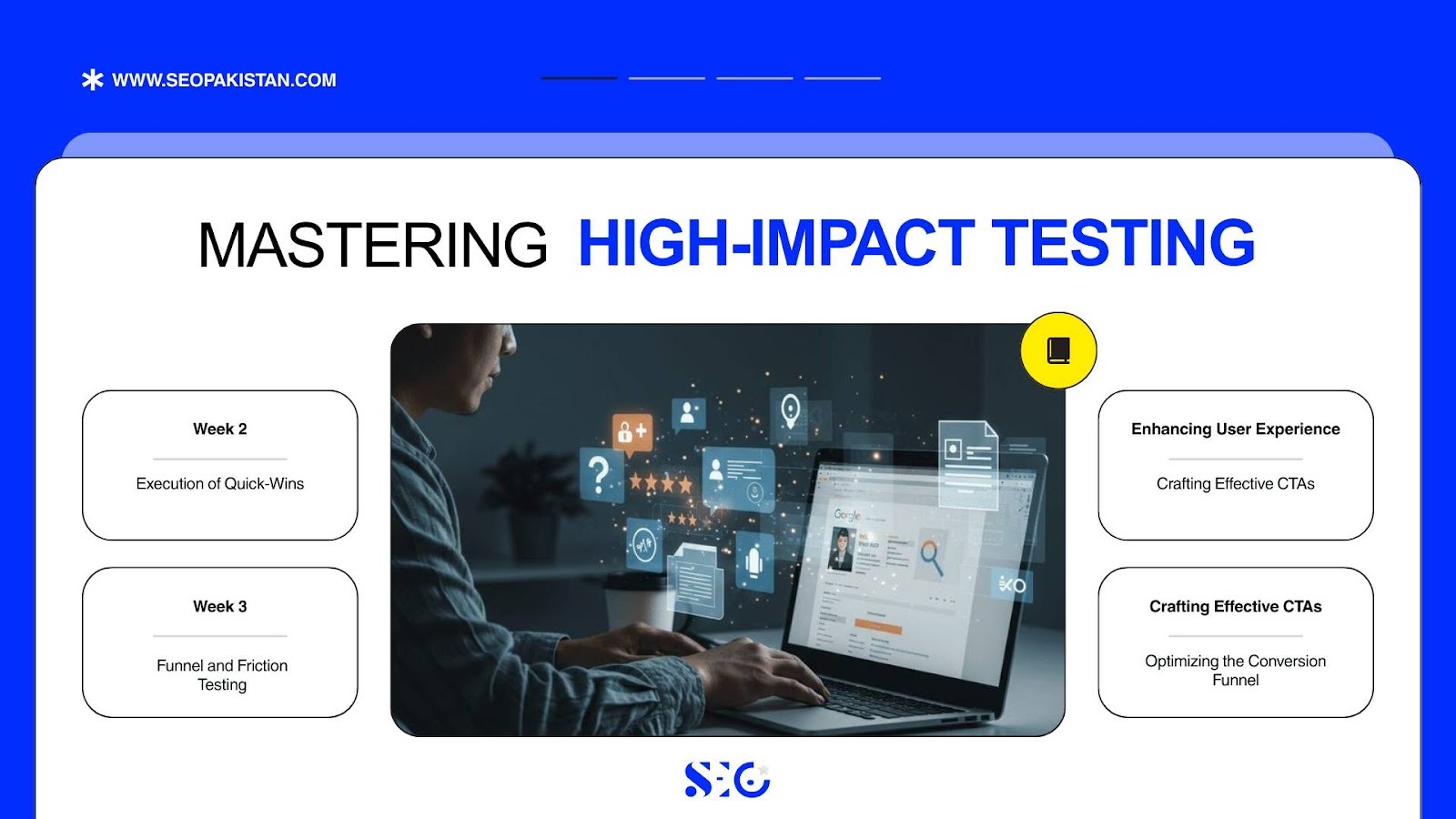
Week 2: Execution of Quick-Wins
Launch 3 to 4 of the Quick-Win Tests listed above on the target page you identified in Week 1. Focus on copy changes and minor element placement. Prioritize tests that leverage Scarcity, Loss Aversion, and Social Proof. These are high-confidence, low-effort changes.
Week 3: Funnel and Friction Testing
Now we move to high-effort, high-impact structural changes.
- Enhancing User Experience: Test a simplified mobile form layout.
- Crafting Effective CTAs: Test a completely new CTA design based on psychological triggers.
- Optimizing the Conversion Funnel: Eliminate one mandatory form field. Every field you remove typically increases your conversion rate.
Week 4: Tooling and The Continuous Process
Review and Scaling
Review the statistical significance of your Week 2 and Week 3 tests. Mastering website conversion optimization is achieved by ensuring winning variations are permanently deployed to the live code. Do not leave them running in the testing tool.
Essential CRO Tools
Ensure your tool stack is integrated.
- Quantitative: Google Analytics 4 (GA4) tells you what is happening.
- Qualitative: Heatmaps and Replays tell you why it is happening.
- Voice of Customer (VoC): Surveys tell you how the user feels.
Document all results. Then, re-enter the 30-day cycle with the next highest-priority page.
Conclusion: Your 40% Boost Starts Now
Achieving a 40% conversion rate boost in 30 days is entirely possible with a focused website conversion optimization strategy. It requires you to stop guessing and start executing a focused, high-impact plan.
By using the Drivers, Barriers, Hooks framework to pinpoint your biggest leak in Week 1, and deploying the 7 High-Impact Quick-Win Tests in Week 2, you systematically turn hesitant visitors into reliable customers.
Do not wait.
Find your highest-traffic, highest-drop-off page today. Select your first two quick-win tests from this guide and launch them immediately with seo pakistan. Your customers are waiting to convert; you just need to remove the barriers.
Frequently Asked Questions
What is website conversion optimization?
Website conversion optimization is the process of improving your website to increase the percentage of visitors who take desired actions, such as making a purchase or signing up.
Why is website conversion optimization important?
It helps maximize the value of your existing traffic, reduces customer acquisition costs, and boosts revenue without increasing ad spend.
How can I start optimizing my website?
Begin by analyzing user behavior with tools like heatmaps and Google Analytics. Identify high-traffic pages with high drop-off rates and prioritize fixing those.
What are quick-win strategies for conversion optimization?
Use psychological triggers like scarcity, social proof, and loss aversion. Test small changes like CTA text, pricing formats, and progress bars on forms.
How long does it take to see results from CRO?
With a focused 30-day plan, you can see measurable improvements in conversion rates, often as high as 40%, depending on your starting point.