

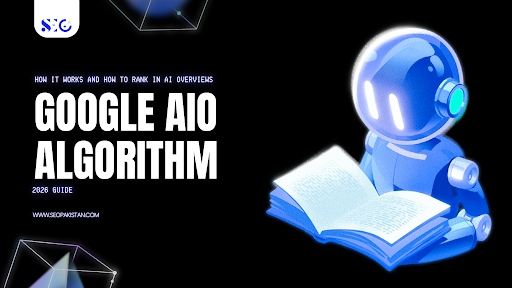
The Google AIO algorithm is Google’s AI-powered retrieval and synthesis system that generates AI Overviews by analyzing search intent, retrieving relevant information from high-ranking web pages, and combining it into a concise, cited response. Instead of ranking entire pages alone, it evaluates semantic passages, entity relationships, structured data, and E-E-A-T signals to determine which content deserves citation.
To rank in AI Overviews in 2026, create answer-first content, implement schema markup, build topical authority, optimize for semantic completeness, and support every factual claim with credible, verifiable sources.
This guide breaks down how the algorithm retrieves and synthesizes content, the ranking factors that determine whether you get cited, and the specific changes to make on your site.
Table of Contents
Introduction
What Is the Google AIO Algorithm?
The Model Behind AI Overviews
Why Google Built the AIO Algorithm
The Impact on Search Traffic and Zero-Click Results
How Does Google AIO Work? The RAG Pipeline Explained
Query Analysis
Retrieval — Building the Candidate Set
Chunking and Embedding
Synthesis and Grounding
Google AIO Algorithm vs. Traditional SEO vs. AEO
Google AI Overviews Ranking Factors for 2026
Semantic Completeness and Topical Authority
Structured Data and Schema Markup for AI
Real-Time Factual Verification
Entity Knowledge Graph Density and E-E-A-T Signals
Multi-Modal Content Integration
Optimal Passage Length
How to Optimize Content for AI Overviews
Adopt the Answer-First Model
Use Snippet-Bait Formatting
Implement an llms.txt File
Build Internal Links Around Topic Clusters
Advanced Technical SEO for AI Visibility
Connected Schema
Interaction to Next Paint (INP)
Run Entity Gap Analysis
How to Measure AI Overview Performance
Common Mistakes That Block AI Overview Citations
Conclusion
Frequently Asked Questions
What Is the Google AIO Algorithm?
The Google AIO algorithm is a generative retrieval layer that synthesizes information from multiple high-quality sources into a direct, on-page answer, rather than simply listing links the way a traditional search interface does. It reads pages the way a research assistant would, pulling out the relevant passage, not just indexing the domain, to build each AI response.
The Model Behind AI Overviews
Google Search’s generative layer is built to interpret multi-part, conversational queries and return an answer synthesized from several sources at once, rather than a single best-matching page.
It draws on the same entity data that powers Google’s Knowledge Graph, which is why AI systems increasingly reward clearly defined entities over loosely related keywords.
Why Google Built the AIO Algorithm
The goal of AI search is efficiency: resolve complex, multi-part queries with comprehensive answers in one summary so users don’t need to click through several sites to piece an answer together.
The Impact on Search Traffic and Zero-Click Results
AI Overviews now appear across a large and growing share of informational queries, which has pushed up zero-click search results searches that end without a single organic click.
The practical takeaway is the same regardless of the exact figure: sites that don’t adapt their content structure lose search visibility and website traffic on informational terms, even if they still rank #1 in traditional search results and hold their organic traffic baseline.
How Does Google AIO Work? The RAG Pipeline Explained
Understanding how Google AI Overviews work starts with Retrieval-Augmented Generation (RAG), a four-stage process, documented in general terms on Google Search Central, of analyzing user intent, retrieving candidate pages, breaking them into passages, and synthesizing an answer with source citations.
1. Query Analysis
The system first classifies search intent to decide whether a query warrants a generated summary, factoring in user context from the session and any follow-up questions the searcher has already asked.
This typically applies to informational queries rather than navigational ones (e.g., “what is X” gets an overview; “login to X” doesn’t).
2. Retrieval — Building the Candidate Set
The algorithm pulls from the top 10–20 traditional organic rankings to form a “Candidate Set,” the same pool that would otherwise populate a page of clickable links. If your page doesn’t rank in the top 20 organically for a query, it has effectively no chance of being cited in the AI Overview for that query; traditional ranking systems are still the gate, not a separate track.
3. Chunking and Embedding
Rather than reading a page as one unit, the system splits it into semantic chunks,s passages of roughly 300–500 tokens, and evaluates each chunk independently for relevance.
4. Synthesis and Grounding
The model combines the most relevant chunks into a coherent, AI-generated summary and maps specific sentences back to their source URLs to generate citation cards. Ranking #1 organically does not guarantee a citation; semantic completeness of the specific passage does.
Google AIO Algorithm vs. Traditional SEO vs. AEO
Unlike traditional SEO, where traditional SEO signals like backlinks, exact-match keywords, and traditional rankings carried the most weight, the optimization target here has shifted to being cited within a synthesized answer.
That’s also what answer engine optimization (AEO), sometimes grouped under the broader term generative engine optimization, is built around.
| Feature | Traditional SEO | Google AIO Algorithm | AEO Focus |
| Primary goal | Rank #1 for a keyword | Secure a citation card | Be the quoted/synthesized source |
| Ranking unit | The entire page | Semantic chunks/passages | Individual answer-ready passages |
| Main signal | Backlinks and keyword density | E-E-A-T and entity density | Structured data and clear entity relationships |
| User journey | Search → click → read | Search → synthesized answer | Search → answer → optional click |
| Core KPI | Organic CTR | Share of Synthesis (how often you’re the cited source) | Citation frequency across AI answer surfaces |
In short: Google’s AIO is Google’s specific implementation of the broader AEO shift happening across AI-powered search and assistants.
Google AI Overviews Ranking Factors for 2026
Six factors determine whether a page gets pulled into an AI Overview and cited: semantic completeness, structured data, real-time factual grounding, entity density, multi-modal content, and passage length. Content optimization today weighs these signals well beyond simple keyword relevance.
Semantic Completeness and Topical Authority
Content that covers a topic from every relevant angle and explicitly connects related entities performs better in AI retrieval. If you’re writing about the Google AIO algorithm, that means also covering RAG, large language models, and the underlying Gemini model by name, not just the target keyword.
This entity coverage is what builds topical authority in the eyes of both traditional and generative ranking systems, since AI models weigh entity relationships more heavily than exact-match terms, and it matters more for your target audience’s actual questions than for chasing incremental keyword rankings on head terms.
Structured Data and Schema Markup for AI
Schema markup gives the algorithm an explicit, machine-readable map of your content — Article, FAQ, and Author/Organization schema all help the system verify who wrote what and connect it to a recognized entity.
Consistent brand mentions and a complete Google Business Profile reinforce the same entity outside your own site. This is table stakes for AI Overview eligibility, not an optional technical extra.
Real-Time Factual Verification
AI-generated answers favor grounded, sourced claims over vague ones.
- Avoid: “Studies show that zero-click searches are rising.”
- Use: A specific, linkable source and figure, e.g., “According to [Source, Year], X% of searches ended without a click.”
Every statistic in your content should be traceable to a real, cited source. Unsourced numbers are a liability on a page about AI-driven, fact-checked search.
Entity Knowledge Graph Density and E-E-A-T Signals
Whether your brand is recognized as a distinct entity connected via schema to real authors, your organization, and credible external references is a core input to E-E-A-T signals for AI citations.
A page with an unverified or inconsistent author byline works against this, so keep author names and credentials identical across the article, author box, and schema.
Multi-Modal Content Integration
Content that mixes original text, images, and short-form video gives AI platforms additional “verification” signals beyond text alone, and tends to see stronger citation rates; the same structured, spoken-language answers also perform well for voice search.
Optimal Passage Length
Open each H2/H3 with a 40–60 word direct answer. This “answer nugget” format lets the model lift a self-contained passage without needing to edit or summarize it, further increasing the odds that the exact passage becomes the citation.
How to Optimize Content for AI Overviews
This kind of AIO optimization comes down to three structural changes in your content creation process: direct answers up front, extractable formatting, and machine-readable site signals.
Adopt the Answer-First Model
Place a direct, complete answer immediately under every H2, no throat-clearing or setup sentences first. This lets the algorithm identify the section’s core value in the first pass.
Use Snippet-Bait Formatting
Bulleted lists, tables, and short numbered steps are easier for the algorithm to extract cleanly than dense paragraphs, and they double as strong candidates for traditional featured snippets.
Implement an llms.txt Fil.e
A machine-readable summary at yourdomain.com/llms.txt gives AI crawlers a direct map of your site architecture, helping them prioritize and understand your most important content.
Build Internal Links Around Topic Clusters
Link related deep-dive articles to each other (for example, this page and a dedicated AI Overview/SGE explainer) so the algorithm can trace topical authority across your domain through internal linking. This supports “query fan-out,” where the AI explores related subtopics before finalizing an answer.
Advanced Technical SEO for AI Visibility
Beyond content, two technical levers affect whether a page is even eligible for the Candidate Set: connected schema and page interactivity. A third, the nosnippet meta tag, lets you opt specific pages out of AI Overview extraction entirely if you’d rather protect that content for direct visits.
Connected Schema
Link the Person schema for your author to your Organization schema and any reviewer credentials, rather than tagging the article alone. This builds the web of trust the algorithm uses to validate E-E-A-T.
Interaction to Next Paint (INP)
Poor interactivity scores can disqualify a page from the Candidate Set before content quality is even evaluated. Core Web Vitals performance remains a baseline requirement, not a legacy metric.
Run Entity Gap Analysis
Use generative AI and other AI tools to compare which entities and subtopics competitors cover that you don’t, then close those gaps directly in your content rather than adding unrelated keyword volume.
How to Measure AI Overview Performance
Track AI Overview impact through three signals: Google Search Console’s Search Appearance filter for AI Overviews, branded search lift, and manual citation tracking for your priority queries.
- Search Console: Filter impressions/clicks by “AI Overview” appearance type to see which queries are triggering overviews and whether you’re capturing clicks from them.
- Share of Synthesis: Manually or via a rank-tracking tool, log how often your domain is cited as a source versus competitors for your target queries — this is the AI-era equivalent of tracking keyword rank position.
- Branded search and direct traffic: Citations without clicks still build brand visibility; a lift in branded search volume and organic traffic over time is a reasonable proxy for AI overview visibility even on zero-click searches.
Common Mistakes That Block AI Overview Citations
- Burying the answer. Long intros before the actual answer reduce the odds the algorithm extracts that passage.
- Unsourced statistics. Numbers without a linkable citation get deprioritized by the same fact-verification layer this article covers.
- Inconsistent author identity. Mismatched bylines and author schema weaken the entity trust signals AI Overviews depend on.
- Keyword stuffing headers. Bolding or repeating the exact keyword in every heading, or targeting specific keywords instead of specific questions, reads as manipulative to both readers and quality systems; natural variation performs better.
- Ignoring page speed and INP. A page can have perfect content and still be excluded from the Candidate Set on technical grounds.
Conclusion
The Google AIO algorithm is redefining how websites earn visibility by shifting the focus from simply ranking pages to becoming trusted sources within AI-generated answers. Success in Google AI Overviews depends on publishing comprehensive, answer-first content supported by strong E-E-A-T signals, structured data, semantic relevance, and verifiable facts.
As AI-powered search continues to evolve, businesses that optimize for entities, topical authority, and user intent will be better positioned to secure citations, strengthen brand credibility, and attract qualified organic traffic. The sooner you adapt your SEO strategy to AI search, the greater your competitive advantage will be.
Ready to future-proof your website? Start optimizing your content for the Google AIO algorithm today at seo pakistan and position your brand as a trusted authority that AI search engines choose to cite before your competitors.s
Frequently Asked Questions
What is the Google AIO algorithm, and why does it matter for SEO?
The Google AIO algorithm is the AI system that powers Google AI Overviews by retrieving, evaluating, and synthesizing information from multiple trusted sources into a single answer. Unlike traditional search rankings, it focuses on semantic relevance, entity relationships, and E-E-A-T signals. Optimizing for the Google AIO algorithm helps websites improve visibility in AI-generated search results, increase brand exposure, and earn citations even when users don’t click through immediately.
How can I rank in Google AI Overviews?
To rank in Google AI Overviews, create comprehensive, answer-first content that satisfies search intent and demonstrates topical authority. Use clear headings, concise paragraphs, structured data, internal links, and credible sources to support factual claims. Strong E-E-A-T signals, optimized page experience, and semantic coverage of related entities also improve your chances of being selected as a cited source within AI-generated answers.
What is the difference between the Google AIO algorithm and traditional SEO?
Traditional SEO focuses on improving page rankings through backlinks, keyword optimization, and technical performance. The Google AIO algorithm goes further by selecting the most relevant passages from authoritative pages to generate AI summaries. This means content should be well-structured, factually accurate, and semantically complete so AI systems can easily extract and cite the most valuable information.
Does schema markup improve Google AIO algorithm visibility?
Yes. Schema markup helps the Google AIO algorithm understand your content by providing structured, machine-readable information about your pages, authors, and organization. Implementing Article, FAQ, Organization, Person, and Breadcrumb schema strengthens entity recognition and supports E-E-A-T. While schema alone does not guarantee AI Overview citations, it improves content interpretation and increases eligibility for AI-powered search features.
What are the most important Google AIO algorithm ranking factors in 2026?
The most important Google AIO algorithm ranking factors include semantic completeness, topical authority, entity optimization, structured data, E-E-A-T, factual accuracy, and strong technical SEO. Fast-loading pages, excellent Core Web Vitals, clear answer-first formatting, multimedia content, and well-connected topic clusters also improve the likelihood of appearing in Google AI Overviews and other AI-powered search experiences.