

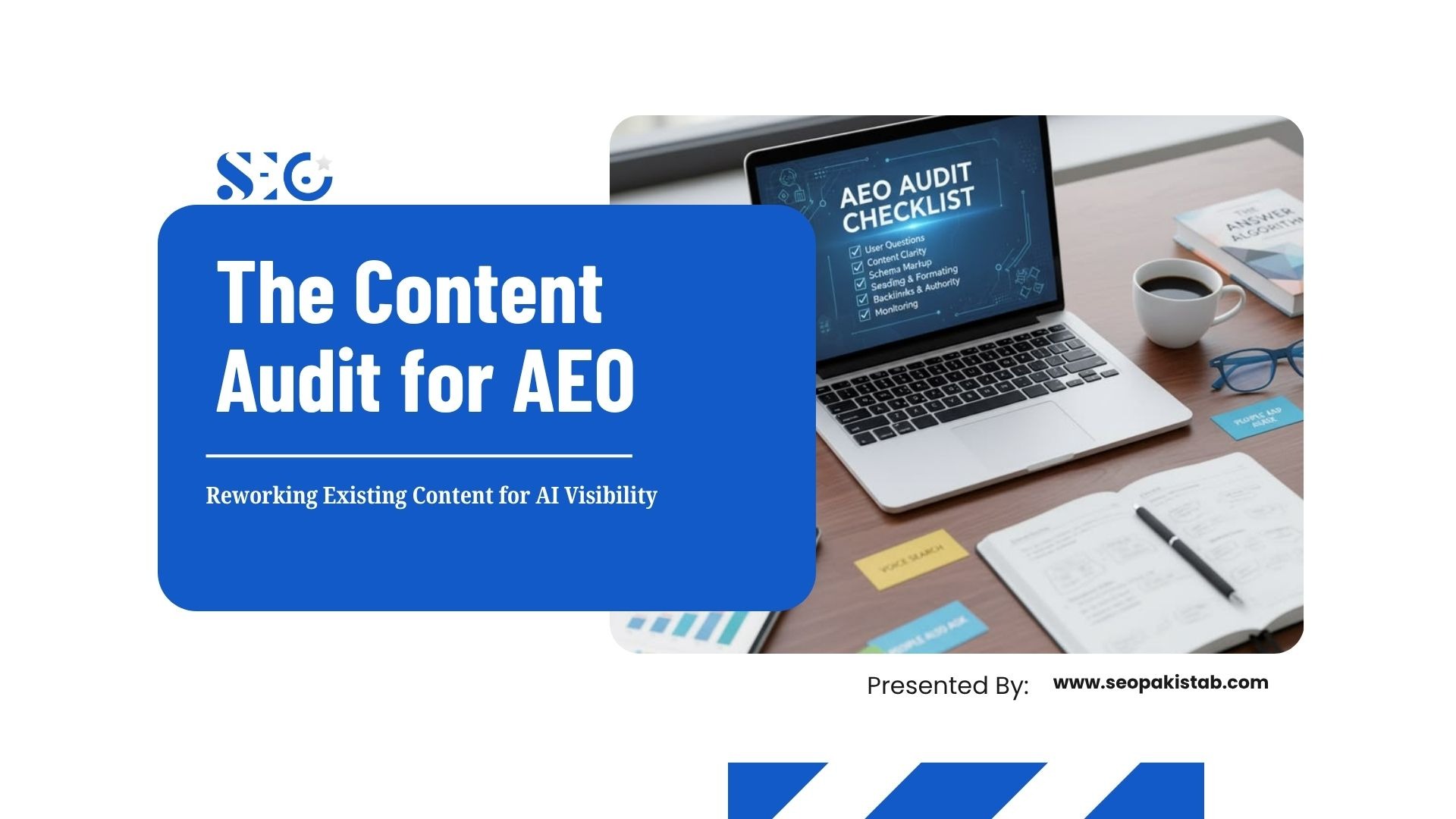
Search engines are evolving, using AI to provide direct answers instead of just links. This means traditional SEO is no longer enough. To stay visible, businesses must adapt. A Content Audit for AEO (Answer Engine Optimization) is crucial. It involves restructuring your website to become a primary data source for AI.
This process moves beyond keywords, focusing on how information is organized and presented. By implementing an answer engine optimization strategy and using semantic SEO optimization, your brand can become a trusted authority, ensuring algorithms can easily parse and present your content as direct answers.
Why Traditional SEO Audits Fail in AI Search Environments
Traditional optimization methods focus exclusively on ranking links in a standard search layout. AI-driven search engines retrieve specific facts instead of ranking entire pages. High-ranking pages often fail to appear in Google AI overviews because they lack extraction potential.
Long introductions and weak formatting prevent machines from finding the exact answer quickly. You must adopt a retrieval-first content architecture to maintain your market share.
Ranking Position No Longer Guarantees Visibility
Search visibility has shifted from position-based ranking to answer-based selection. A page appearing in the top three results may still be ignored by AI systems if it lacks extractable structure or semantic clarity.
AI systems break content into passages and evaluate each section independently. This means visibility now depends on how well individual sections answer user intent, not just overall page authority.
Key changes include:
- Snippet-first evaluation: AI systems prioritize answer snippets over full-page ranking.
- Zero-click behavior: Zero-click searches reduce dependency on traditional listings.
- Passage-level scoring: Content is evaluated at the paragraph level instead of the page level.
- Structural weighting: Structured clarity influences inclusion in AI summaries.
Why AI Engines Ignore Well-Optimized Content
Many businesses assume that keyword-optimized content automatically performs well in AI search, but this is not true. AI systems often ignore content that lacks structural clarity or direct answer formatting.
Performing a Content Audit for AEO reveals that even well-ranked pages may be invisible to AI if they aren’t structured for direct retrieval.
Even high-quality SEO content can fail if it does not align with retrieval logic.
Common issues include:
- Buried answers: Answers are buried deep inside paragraphs instead of leading each section.
- Weak heading hierarchy: Poor structure confuses content segmentation and hides key concepts.
- Filler content: Excess filler content reduces semantic density and dilutes factual statements.
- Missing entity links: Lack of clear entity relationships weakens topical trust.
- No direct response formatting: Introductions fail to answer the query in the first few lines.
Understanding How AI Retrieval Systems Actually Select Content
AI search engines do not “rank pages” in the traditional sense. Instead, they retrieve, evaluate, and recombine content fragments based on relevance, clarity, and authority signals. This retrieval-based system fundamentally changes how content must be structured.
AI models break content into semantic chunks, analyze meaning, and then decide whether a section should be used in a generated answer.
Passage-Level Retrieval and Context Windows
AI systems extract specific passages rather than entire articles. Each passage competes independently for inclusion in an AI response.
This means:
- Standalone units: Each section must function as a standalone answer unit.
- Defined intent: Headings must clearly define intent for the reader and the crawler.
- Immediate meaning: Paragraphs must deliver clear answers without unnecessary buildup.
- Consistent context: Context must remain consistent within each section.
Entity Relationships and Topical Reinforcement
AI systems use entities (people, places, concepts) to understand content. Strong content connects related concepts instead of just repeating keywords, and it relies on consistent terminology so the model does not misread the same idea as two different topics.
Effective entity strategies include:
- Connecting related technical concepts within a topic
- Reinforcing industry-specific terminology
- Building structured topical clusters across content
- Linking supporting ideas to primary subject matter
Why Information Gain Improves AI Visibility
Information gain is a scoring system used by search engines to measure the amount of new information your content provides compared to other top-ranking pages. By offering unique value, backed by raw data where possible, you signal to algorithms that your content is a worthwhile addition to the search results.
Here’s why prioritizing information gain is crucial for AI visibility:
- Avoids penalization for duplication: Search engines deprioritize duplicate content to conserve processing resources. To gain visibility, your content must offer unique insights not found in competitors’ work.
- Establishes you as a primary source: Original analysis and proprietary data compel search algorithms to recognize and cite your website as the authoritative source on a topic.
- Adds value to the search ecosystem: Providing expert interpretation of existing data sets differentiates your brand from generic, ai generated responses and adds significant value for users.
- Secures long-term traffic: Publishing unique, proprietary insights is the most reliable strategy for building sustainable organic and referral traffic.
The Enterprise AEO Audit Framework
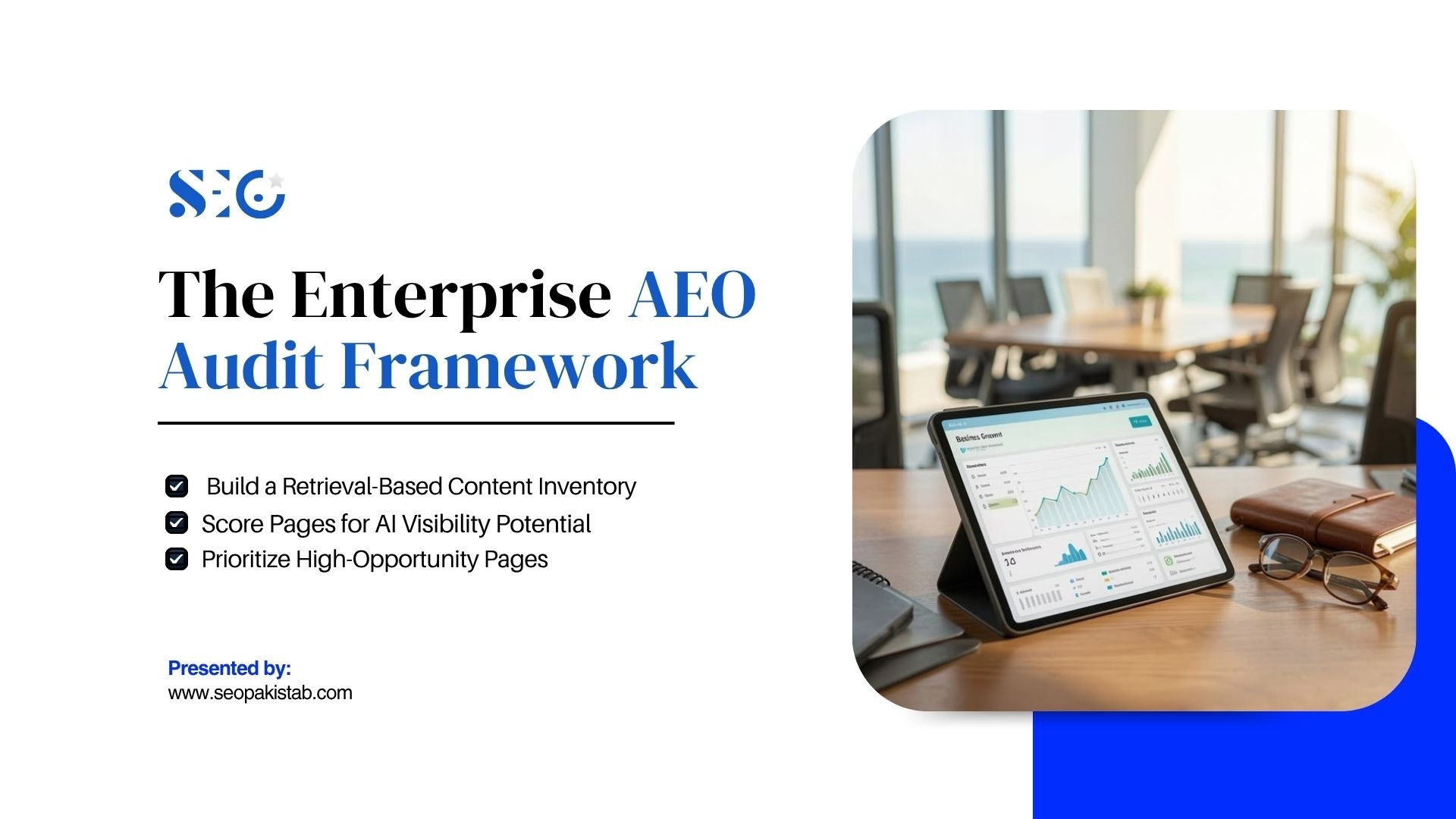
A true AEO content audit is not just a simple content checklist. It is a structured system for evaluating how well your content performs in AI retrieval environments. Enterprises use scoring models and prioritization frameworks to decide which content should be optimized first, often starting with a search intent audit across their top target queries.
Step 1: Build a Retrieval-Based Content Inventory
You must first categorize your pages by their primary user intent. Identify FAQ opportunities hidden within long-form blog posts. Find informational pages that currently drive high traffic but lack direct answers.
Important classifications include:
- Informational pages (definitions, explanations)
- Transactional pages (service or product pages)
- Question-based content (FAQs, guides)
- Authority content (pillar pages, technical blogs)
Each piece of content must be evaluated based on how easily AI systems can extract answers from it.
Step 2: Score Pages for AI Visibility Potential
Create a scoring framework to evaluate your existing inventory objectively through a systematic review rather than a one-off glance. Evaluate the retrieval readiness of every single page. Measure the semantic strength of your writing against top-performing competitors.
Analyze answer clarity to ensure algorithms can parse your sentences easily. Evaluate authority signals like author bios and internal linking structures.
| Audit Factor | Weak Signal | Strong Signal | AI Visibility Impact |
| Answer Clarity | Buried answers | Direct concise responses | Improves extraction |
| Semantic Depth | Thin coverage | Entity-rich content | Increases retrieval confidence |
| Structure | Long paragraphs | Modular sections | Enhances chunk retrieval |
| Authority Signals | Generic claims | Evidence-backed expertise | Improves citation trust |
| Formatting | Wall of text | Lists, tables, FAQs | Better AI readability |
Step 3: Prioritize High-Opportunity Pages
Not all pages need equal optimization effort. AEO audits prioritize pages that already have visibility potential but fail due to structure or formatting issues.
High-priority categories include:
- Pages ranking in positions 2–10
- FAQ-heavy pages
- High-impression but low-click pages
- Informational guides
- Comparison content
- Definition-based articles.
Reengineering Existing Content for AI Extraction
When performing a Content Audit for AEO, rewriting old content requires a different approach than traditional copywriting. You need to implement retrieval formatting to make your text machine-readable. This involves using an answer-first structure that places the most important information at the very beginning of the section.
This improves overall AI readability and satisfies user intent instantly. We will explore how to restructure your paragraphs and headings for maximum extraction potential.
Rewriting Introductions for Direct Answer Retrieval
The introduction is the most important part of AI visibility. AI systems often extract answers from the first meaningful paragraph of a section.
Strong introductions must:
- Provide immediate answers within the first 2–3 sentences
- Remove storytelling or generic framing
- Focus on clarity and direct meaning
- Align with user intent immediately
Restructuring Content Into Retrieval Chunks
Break massive walls of text into smaller sections. Create a better H2 and H3 hierarchy to guide the algorithm through your logic. Bullet formatting allows machines to extract lists quickly.
Effective restructuring includes:
- Breaking long sections into smaller semantic units
- Using descriptive H2 and H3 headings
- Ensuring each section answers one intent
- Adding tables for comparative clarity
- Using bullet points only where they improve readability
Optimizing for Conversational Search Queries
Natural language queries dominate modern search behavior. Voice-search behavior dictates that users ask full questions instead of typing broken keywords. To align with this shift:
- Use question-based headings
- Mirror natural language patterns
- Write as if answering a real user query
- Focus on clarity instead of keyword repetition
Semantic Optimization Beyond Keywords
Entity coverage matters significantly more than traditional keyword density. Semantic completeness proves to the algorithm that you understand the entire topic. You achieve topical authority development by answering every possible logical question related to your core subject.
Keywords simply act as signposts. Entities represent the actual concepts and relationships the machine tries to understand.
Building Entity-Rich Content Architecture
Entity-based optimization strengthens AI understanding of your content. Instead of focusing on keywords, content must connect related ideas.
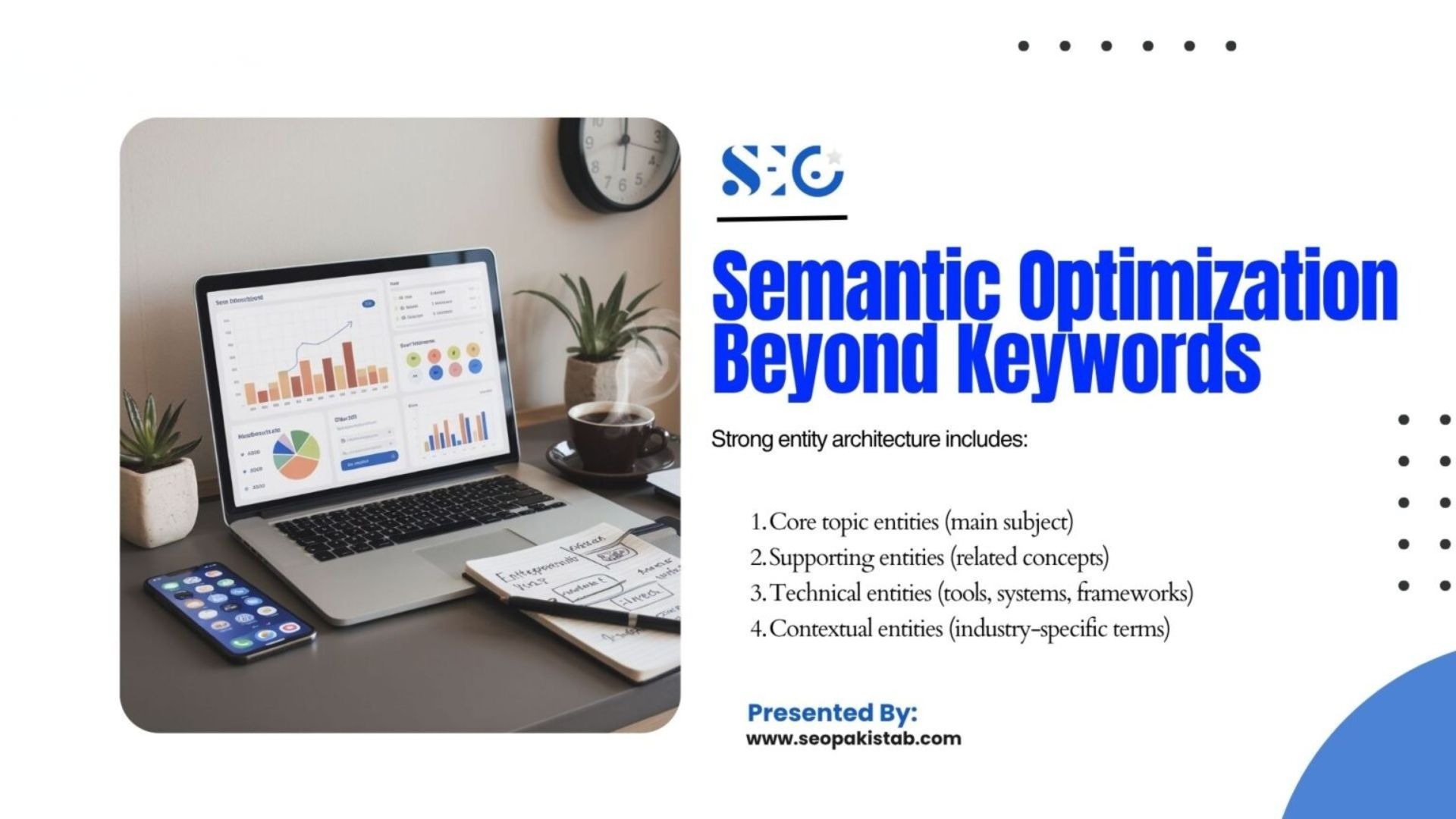
Strong entity architecture includes:
- Core topic entities (main subject)
- Supporting entities (related concepts)
- Technical entities (tools, systems, frameworks)
- Contextual entities (industry-specific terms)
Topical Authority vs Keyword Density
Keyword stuffing fails because modern algorithms understand synonyms and intent. Comprehensive coverage improves trust far better than unnatural repetition. Key differences include:
- Keyword density focuses on repetition
- Topical authority focuses on completeness
- AI favors depth over repetition
- Coverage breadth increases trust signals
Structured Data and Machine Readability
Schema markups translates your human-readable text into a language machines understand perfectly. Schema implementation determines how quickly an algorithm can categorize your content. Structured data supports extraction by explicitly labeling the different parts of your page.
You must implement a schema to give your aeo content the best possible chance of retrieval.
Most Important Schema Types for AEOThe
FAQPage schema tells the search engine exactly where your questions and answers reside. HowTo schema breaks complicated processes into numbered steps for easy extraction.
Essential schema types include:
- FAQPage for question-based content
- How-to for procedural guides
- Article schema for blog content
- Q&A schema for conversational formats
- Organization schema for authority building
Why Structured Data Alone Is Not Enough
Weak content still fails even with perfect schema markup attached. Semantic quality matters significantly more than technical categorization. Retrieval confidence depends entirely on the expertise demonstrated within the actual text.
The schema simply acts as a highlight marker. You must ensure the highlighted text actually provides value to the reader.
Measuring AI Visibility and Retrieval Performance
You must deploy specific AEO tracking systems to measure your optimization efforts. Retrieval-focused analytics look beyond traditional click-through rates. Visibility measurement tracks how often your brand appears in AI-generated summaries.
Revenue generation relies on accurate tracking and continuous improvement.
Tracking Featured Snippet Acquisition
Snippet monitoring tools alert you whenever you capture or lose a top position. Search Console analysis helps you identify pages hovering just outside the snippet zone. Impression growth indicates that search engines are testing your content in new formats.
Track these metrics daily to protect your high-value assets.
Monitoring AI Overview Visibility
AI Overview tracking remains a developing field within digital marketing. You must manually check high-value queries to confirm citation appearance. Search visibility shifts often happen rapidly after algorithm updates.
Measuring Zero-Click Search Impact
Reduced click behavior does not always indicate a failed marketing campaign. Brand visibility growth within zero-click searches still builds massive trust. SERP interaction changes require you to measure success through overall revenue growth instead of simple traffic numbers.
Identifying Retrieval-Driven Traffic Growth
Branded search often follows successful AI visibility campaigns. Authority growth leads to higher conversion rates across your entire website. Conversational search traffic brings highly qualified leads who know exactly what they want.
Measure the quality of the traffic rather than just the volume.
Common AEO Audit Failures That Reduce AI Visibility
Major optimization failures occur when teams treat AEO exactly like traditional SEO. Structural weaknesses prevent search engines from parsing your best information. Many pages fail retrieval simply because they utilize poor formatting.
You must avoid these common pitfalls to maximize your return on investment.
We frequently see the following failures during enterprise audits.
- Long introductions push the actual answer below the digital fold.
- Generic AI-written content provides zero information gain.
- Poor semantic depth leaves the algorithm looking for better sources.
- Weak H2 hierarchy confuses the machine reading your page.
- Keyword stuffing destroys readability and ruins trust scores.
- Missing entities prove a lack of true topical authority.
- Thin topical coverage fails to answer the user’s query completely.
- Weak answer formatting prevents clean passage extraction.
Final Thoughts
A Content Audit for AEO is now mandatory. AI retrieval has completely changed the SEO landscape, making semantic optimization and answer extraction crucial for controlling digital market share. By implementing a rigorous content audit for AI search, you can transform your website into a revenue generator. Focus on providing exact answers and incorporating content retrieval optimization into every page.
Act now, before your competitors realize the rules have changed. To dominate tomorrow’s search landscape, partner with SEO Pakistan. Get a free SEO analysis today, and let’s start your journey to the top of the search results
Frequently Asked Questions
What makes a page appear in AI answers?
Pages with direct answers under clear headings have a higher chance of being used. Strong structure, semantic clarity, and relevant entities signal trustworthiness and improve retrieval by AI algorithms.
How often should I conduct an AEO audit?
We recommend conducting a Content Audit for AEO at least quarterly. AI search evolves rapidly, so continuous monitoring and optimization of your top-performing pages are crucial to protect your digital market share.
Does structured data guarantee AI visibility?
No. While schema helps AI interpret your content, it doesn’t guarantee a top spot. High-quality, authoritative content is still essential for securing a place in AI Overviews.
Why do high-ranking pages get excluded from AI Overviews?
Poor formatting can prevent AI from extracting clean sentences. If a page covers a topic too broadly or lacks specific details, the algorithm may overlook it for AI-generated answers.
What’s the biggest AEO mistake?
Treating AEO like traditional SEO. Companies often waste resources by focusing only on keywords instead of optimizing for machine readability, retrieval structure, and user intent, causing their content to be overlooked.
What is Content Retrieval Optimization?
It’s the process of structuring your content so AI can easily find, understand, and extract direct answers. This involves clear headings, concise sentences, and strong semantic relevance to improve visibility.