

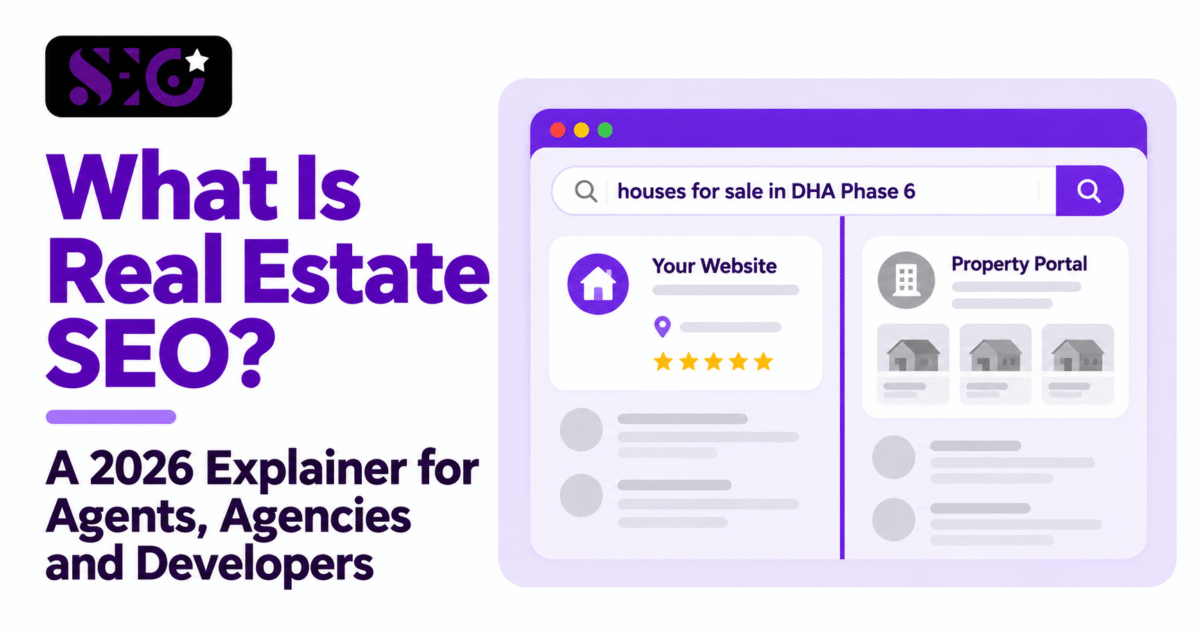
What is real estate SEO? It is search engine optimization applied to a property website, so buyers, sellers, and renters find it when they search online. Real estate agents, real estate brokers, agencies, and developers use it to appear in Google Search results, on Google Maps, and inside AI answers. Real estate SEO explained simply: you earn organic traffic instead of buying every click, and local SEO for real estate carries most of that weight.
How Real Estate SEO Works
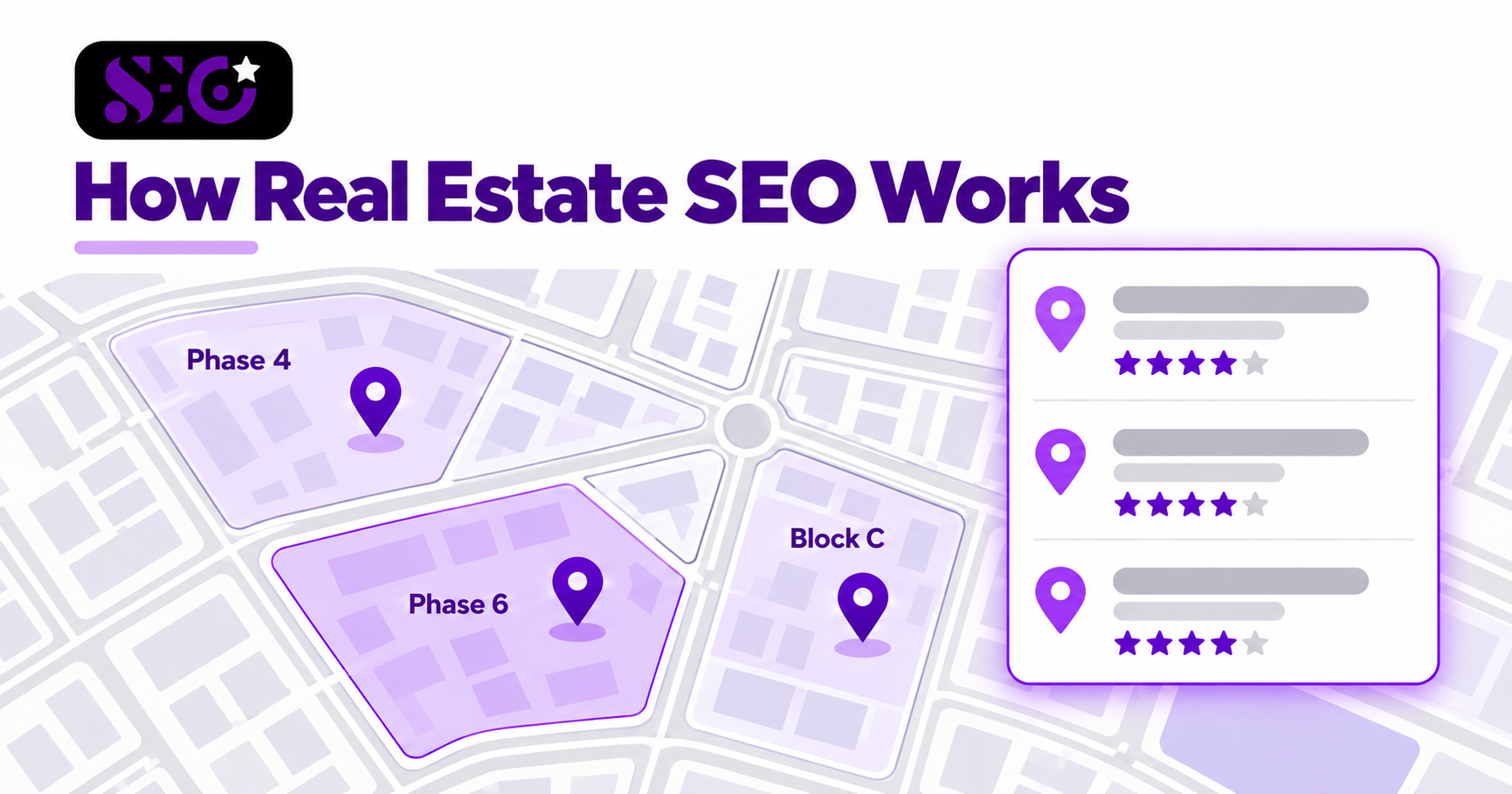
Search engines match each search to the pages they trust most.
That judgment rests on four things:
- Relevance: the page names a specific society, phase,e or price bracket, not a generic feed of real estate listings.
- Location signals: address details, area pages,s and consistent business details build local search visibility.
- Trust: named agents, verifiable credentials and genuine online reviews build trust with buyers.
- Page experience: a mobile-friendly page that loads quickly, since many buyers browse properties on their phones.
Google explains these fundamentals in its SEO Starter Guide, and they apply to property sites as they do elsewhere.
Results appear in three places, and each needs different work.
- Organic search engine results, where area guides, property listings and blogs compete for organic traffic.
- The Google Maps local pack, where your Google Business Profile and local signals decide placement.
- AI answers, where Google AI Overviews and assistants summarise information, then cite sources.
How Real Estate SEO Differs From General SEO
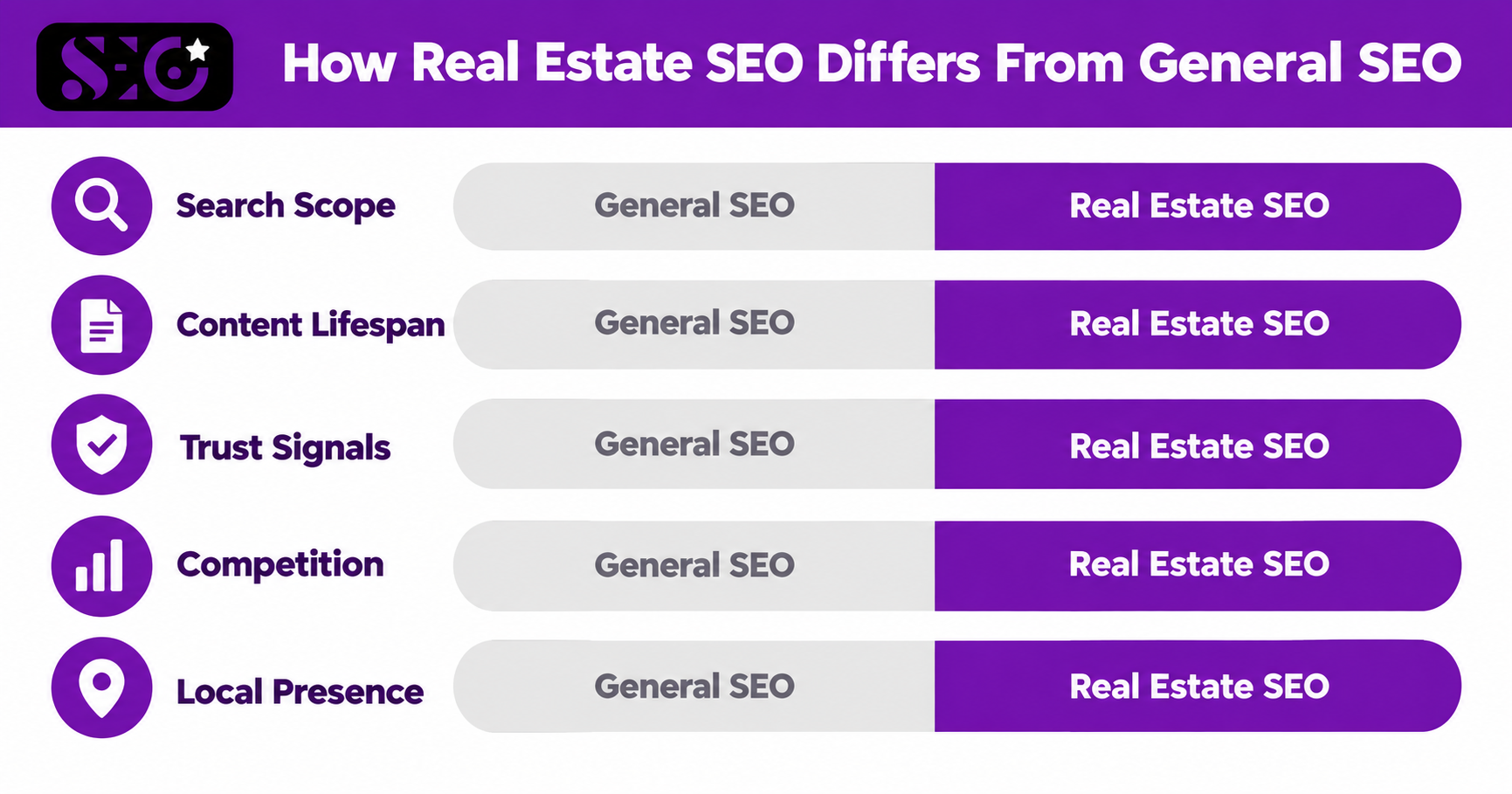
Real estate SEO follows the same rules as general SEO, yet four pressures hit it at once.
That mix explains why a standard SEO plan rarely works on a property site.
- Hyper-local searches: buyers use target keywords naming a society, phase, or block, such as a DHA phase in Lahore or one US neighborhood. Generic city pages miss that demand.
- Listings that sell or expire: property pages change status constantly, so dead pages pile up far faster than on a normal business site.
- Trust for a big financial decision: the home buying process commits large sums, so buyers look for real people, credentials, and reviews before they call.
- Portals competing for the same searches: large portals hold top positions for broad searches, which changes where an agent can compete.
The table sets general SEO beside real estate SEO on the factors that change your workload.
Use it to see which parts of a standard plan carry over and which need a property approach.
| Factor | General SEO | Real Estate SEO | Why it matters | Example |
| Search scope | National or broad topics | City, society,y or phase | Narrow searches match what buyers want but need more pages | “House for sale, DHA Phase 6” |
| Content lifespan | Pages stay useful for years | Listings expire when a property sells | You need a plan for dead pages, not just new ones | A sold listing, no redirect |
| Trust signals | Helpful when present | Central, because buyers commit large sums | Reviews and named agents build buyer trust | Profile with licence and reviews |
| Competition | Similar-sized businesses | Large portals plus every local agency | You compete for different searches than portals | Portals rank broad terms; you rank area guides |
| Conversion action | Form fill or signup | Viewing request, call, or WhatsApp | Contact routes must work on mobile, every page | A pinned call button |
| Local presence | Optional for many businesses | Essential, since buyers search by place | Maps can be a major source of calls | Local pack, “estate agent in Gulberg” |
Relevant keywords sit at the centre of this work. Our guide to real estate SEO keywords covers how those searches break down by area and intent.
Your Own Website vs Property Portals: Do You Need Both?
Most real estate agents need both, because portals and your own site do different jobs.
Portals bring reach. Your website builds an asset you own.
Portals such as Zameen.com, Graana, and Zillow give you three things immediately:
- Ready audience: potential buyers visit them first, so your listing reaches people with no extra work.
- Established trust: searchers know the brand and expect current listings.
- Search visibility: portals already rank for broad searches a new site cannot reach.
What portals do not give you matters just as much.
They do not build your brand, your lead list, or your control over how you appear, and the enquiry belongs to the platform first.
The property portal vs website question is one of division, not choice.
Real estate professionals who handle both well keep them from competing:
- Write original listing content rather than copying the portal text.
- Publish area and society guides, since portals rarely cover local detail in depth.
- Build a full agent profile where you control the story.
- Link portal listings back to your site where the platform allows it.
- Keep your business name, address, and phone number identical everywhere.
Local positioning works the same way at city level. Our guide to real estate SEO in Lahore breaks that down for one market.
The Four Building Blocks of Real Estate SEO
At a working level, real estate SEO rests on four building blocks.
Knowing each one shows whether an agency proposal is complete.
What each block covers on a property website:
- On-page SEO: page content and structure, including listing descriptions, area guides, titles,s and internal links between related property listings.
- Local SEO: everything tying your real estate services to a place, from your Google Business Profile to service area pages, reviews,s and contact details.
- Technical SEO: the mechanics that let search engines crawl and index a listings site, covering speed, mobile optimization, structured data and expired pages.
- Off-page SEO: signals from outside your site, such as local press mentions, directory listings and quality backlinks from relevant property sites. Link building sits here.
This article defines the blocks rather than teaching the process.
For the full workflow, our step-by-step real estate SEO guide walks through each stage in order.
Real Estate SEO and AI Search in 2026
AI search has changed how property questions get answered.
Google AI Overviews and assistants such as ChatGPT, Gemini and Perplexity summarise areas, prices and agents, then cite a few sources instead of listing ten links.
That shift rewards clarity and local knowledge. Google documents these surfaces in its guidance on AI features and your website.
Four qualities make content easier for these systems to cite:
- Clear, direct answers near the top of a page, not buried under long introductions.
- Real local expertise: area guides covering commute routes, schools and development stages.
- A consistent name, address, and phone number across your site, profile,e and every directory.
- Current, structured pages, since stale prices and sold listings undercut the whole site.
One honest caveat matters here: nobody can guarantee an AI citation.
These systems pick sources on their own terms and change often, so treat AI visibility as an outcome of useful content, not a promise.
How Long Real Estate SEO Takes and What Affects Cost
Real estate SEO builds results gradually rather than switching them on.
Timeline and investment depend on where your site starts and how crowded your real estate market is, so an honest answer starts with your situation.
Five factors move both more than anything else:
- Competition in your city: a crowded market with active portals needs more content and stronger signals before search engine rankings move.
- Current site condition: a slow site with indexing faults needs repair first, and our guide to technical SEO for real estate covers what that involves.
- Content volume: a ten-page site needs far more groundwork than one with area guides and archives.
- Links and mentions: a brand local media already cites starts ahead of one with no external footprint.
- Local presence: a complete Google Business Profile with real reviews shortens the path to the local pack.
Paid advertising answers a different question.
Google Ads buys position at once and stops when the budget does, while SEO compounds. Many agencies run paid advertising for launches and SEO for area searches that keep bringing visitors.
Best Practices for Real Estate SEO
Strong real estate SEO comes from doing a few unglamorous things consistently.
These habits separate property sites that generate leads steadily from those that publish listings and hope.
Apply all six, whatever the size of your agency:
- Write original listing descriptions: describe each property in your own words, since duplicated portal copy gives search engines no reason to prefer your page.
- Build area and society guides: cover what living in a phase actually involves, because this content keeps ranking after listings expire.
- Keep your Google Business Profile complete and active: fill every field, post updates, and add real photographs. The official Google Business Profile Help resources list current requirements.
- Collect genuine reviews: ask satisfied clients directly and reply to every review, since reviews shape local rankings and the decision to call.
- Handle sold and expired listings: redirect them to the relevant area page, or mark them sold with similar properties shown, instead of deleting them.
- Measure what happens: Google Search Console shows which queries reach you and Google Analytics shows what visitors do next, so you decide based on data, not guesses.
Common Mistakes to Avoid
Most property websites underperform for a few repeated reasons.
Recognising them early saves months of wasted work.
Watch for these five mistakes:
- Duplicate listing text: copy lifted from portals or brochures leaves your pages identical to dozens of others.
- Broken expired listings: sold properties left as dead pages waste the authority those pages built.
- Portal-only presence: every enquiry arrives through a platform you do not control, so you build no asset.
- Ignoring Google Business Profile: an unclaimed profile keeps you out of the local pack, where many property searches convert.
- Thin society pages: near-identical pages with only the society name changed rarely rank for anything.
Conclusion
Understanding what is real estate SEO comes down to one idea: you optimize your property website to be the clearest, most trustworthy answer to the searches buyers already run.
The work spans on-page content, local SEO for real estate, technical health and outside signals, and it rewards patience over shortcuts.
Done steadily, it brings serious enquiries rather than raw traffic. Treat portals as reach and your website as the asset you own, because that is where SEO for real estate websites pays off.
Want a clear picture of where your property site stands? Talk to SEO Pakistan.
Frequently Asked Questions
Is real estate SEO worth it for a small agency?
Yes, often more so than for large agencies, because a small agency can target societies and areas that bigger competitors overlook.
A focused site covering three or four neighborhoods in real depth beats broad national pages, and it brings more clients from a smaller catchment. The work suits local businesses planning to stay in one market for years, not those chasing instant enquiries.
What is the difference between real estate SEO and local SEO?
Local SEO is one part of real estate SEO, not a separate discipline. Many people mean local SEO when they ask about real estate SEO, because so many property searches name a place.
Local SEO covers your Google Business Profile, Maps visibility, service area pages, and consistent details. Real estate SEO adds listing structure, area guides, expired listing handling, and the content that reaches buyers searching beyond your own neighborhood.
Can I rely only on property portals instead of a website?
You can generate enquiries that way, though you give up a lot. Portals control the lead, the data, and how you appear, and any rule change hits your business at once.
Running your own site alongside portal listings builds something you own, and gives potential clients useful information before they call. It is one of the real estate SEO basics many agents overlook.
Can I do real estate SEO myself?
Yes, particularly the parts closest to your expertise. Writing original listing descriptions, building honest area guides,s and keeping your Google Business Profile active all sit within reach.
Technical work such as speed, structured data, and expired listings usually needs specialist help, so many agencies split the work instead of choosing one route.