

Imagine this: you type a question into a search engine, and instead of scrolling through pages of blue links, you’re instantly greeted with a clear, concise answer tailored just for you. This is the future of online search. Search engines are evolving rapidly, moving beyond the traditional list of links, as artificial intelligence takes the spotlight.
With AI delivering direct, synthesized answers, the way we discover information is being completely reinvented. The era of endless scrolling is giving way to smarter, faster, and more intuitive searches. This evolution requires marketers to understand the critical distinctions of SEO vs GEO.
This article explores how the search paradigm shift changes the rules of digital visibility. We will examine why traditional strategies no longer suffice on their own and how generative engine optimization complements existing efforts to capture traffic in an AI-first world.
What Is Traditional SEO?
Search Engine Optimization (SEO) focuses on ranking web pages within a list of results. The primary objective is to drive clicks from a search engine results page (SERP) to a specific website. To achieve this, practitioners manipulate specific signals that algorithms prioritize.
How does the classic model work to drive traffic?
- Keyword Targeting: Marketers identify specific terms users type into the search bar and integrate them into content.
- Backlink Acquisition: Websites earn links from other reputable sites to build authority and trust signals.
- Technical Optimization: Developers ensure site speed, mobile responsiveness, and crawlability meet engine standards.
What Is GEO (Generative Engine Optimization)?
GEO stands for Generative Engine Optimization, representing the new frontier of digital discovery. It is the process of optimizing content specifically for AI-powered search experiences. Unlike traditional search engines like ChatGPT, Google AI Overviews, and Perplexity synthesize information to generate a single, comprehensive answer.
What defines this new approach to AI search optimization?
- Direct Answers: The engine creates a response rather than a list of links, requiring content to be factually dense.
- Citation Focus: The goal is to be cited as a source within the AI response rather than just ranking at the top.
- Contextual Relevance: Success depends on how well the content answers the user’s underlying intent within the generated narrative.
The Search Visibility Paradigm Shift Explained
The debate between SEO vs. GEO highlights a massive paradigm shift driven by user behavior. Users no longer want to sift through multiple websites for a simple fact or comparison; they prefer “answer engines” that digest the information for them. This transition moves the goalpost from acquiring traffic to building brand presence within the AI response itself.
Here’s how this shift impacts your strategy:
- Reduced Cognitive Load: Generative AI lessens the user’s workload. It delivers synthesized answers instantly, eliminating the need to click, read, and interpret information from multiple sources.
- From Clicks to Presence: The focus is no longer on driving clicks. Instead, the goal is to establish your brand’s presence directly within the AI-generated answer.
- A New Conversational Approach: Treat search as a conversation, not a directory. Your new objective is to ensure your brand provides the clearest and most authoritative answer to the user’s query.
Key Differences Between SEO and GEO
Distinguishing between these two disciplines requires a look at their core mechanics. The following comparison highlights the operational differences in the battle of SEO vs GEO.
| Aspect | SEO (Search Engine Optimization) | GEO (Generative Engine Optimization) |
|---|---|---|
| Primary Goal | Rank on SERPs and drive organic traffic | Be cited, referenced, or synthesized in AI-generated answers |
| Target Consumer | Human search users | AI models + end users |
| Discovery System | Crawlers, indexing systems | Retrieval, embedding, and reasoning layers |
| Core Algorithm Type | Ranking algorithms (PageRank, relevance scoring) | LLM interpretation + RAG pipelines |
| Query Matching | Exact & partial keyword matching | Semantic and intent-based matching |
| Optimization Focus | Keywords, backlinks, metadata | Meaning, entities, relationships, clarity |
| Content Representation | HTML pages | Chunks, embeddings, vectors |
| Indexing Unit | Full web pages | Paragraphs, sections, facts |
| Content Granularity | Page-level relevance | Sentence / passage-level relevance |
| Content Style | Long-form, keyword-heavy | Answer-first, concise, context-rich |
| Information Density | Moderate (optimized for scanning) | High (optimized for extraction) |
| Context Handling | Limited cross-page context | Strong cross-document synthesis |
| Structured Data | Schema.org (optional boost) | Schema, tables, Q&A formats (critical) |
| Metadata Importance | Title tags, meta descriptions | Headings, labels, semantic markers |
| Internal Linking | Boosts crawlability and authority | Helps concept reinforcement |
| Backlinks | Primary authority signal | Secondary or indirect signal |
| Authority Signals | Domain authority, link equity | Source trust, factual accuracy, consistency |
| Freshness Signals | Update timestamps, recrawl frequency | Data recency in training / retrieval layers |
| Technical Performance | Page speed, Core Web Vitals | Content clarity > load speed |
| Rendering Requirements | HTML rendering, JS indexing | Clean text extraction |
| Duplication Handling | Canonicals, duplicate suppression | Conflicting facts reduce inclusion |
| Content Updates | Improves rankings over time | Improves likelihood of reuse |
| Output Format | Ranked list of links | Conversational answer, summary, steps |
| User Action | Click-through to site | No-click answer consumption |
| Measurement Metrics | Rankings, clicks, impressions, CTR | AI citations, answer presence, inclusion rate |
| Tracking Tools | GSC, GA4, SEO crawlers | AI visibility tools, prompt testing |
| Competitive Model | Position-based competition | Fact-level competition |
| Failure Mode | Lower rankings | Omission from AI responses |
| Optimization Lifecycle | Ongoing technical & content tuning | Continuous factual alignment |
| Best Content Types | Blogs, landing pages | FAQs, definitions, comparisons, tables |
| Primary Risk | Algorithm updates | Model hallucination or omission |
| Visibility Outcome | Traffic acquisition | Brand or source recall |
| End Result | User visits website | User trusts AI-delivered answer |
Why the Shift Matters for Marketers
The rise of zero-click searches threatens organic traffic numbers for businesses that refuse to adapt. If an AI provides the answer immediately, the user has no reason to click through to a website. This reality makes AI search visibility critical for brand survival.
- Marketers need to rethink content strategies beyond just driving link clicks.
- Generative AI often answers queries directly (e.g., “best CRM software”) by listing options without directing users to external sites.
- If your brand isn’t included in the AI-generated response, it becomes invisible to that user.
- This shift significantly impacts brand awareness and customer acquisition.
- Being visible in generative AI responses is becoming a critical “seal of approval” for relevance and trustworthiness.
Why this matters:
In the evolving battle of SEO vs GEO, traditional search tactics are no longer enough. To stay competitive, brands must adapt their strategies to ensure they are featured in AI-generated answers, building trust and maintaining visibility as generative AI redefines the digital landscape.
How to Optimize for Traditional SEO
While the landscape changes, the foundation remains. The debate of traditional vs modern SEO is not an “either/or” choice; the classic methods still drive significant traffic for transactional and navigational queries.
What steps ensure your website remains discoverable in standard indices?
- Keyword Research: Identify high-volume terms that indicate specific user intent and map them to relevant pages.
- On-page Optimization: Utilize proper title tags, header structures, and meta descriptions to improve click-through rates.
- Technical Health: Ensure the website loads quickly and is mobile-responsive to satisfy Core Web Vitals.
- Link Building: Acquire high-quality backlinks to signal authority to the search engine crawlers.
- Content Quality: Maintain freshness and relevance to ensure the site remains a trusted resource.
How to Optimize for GEO
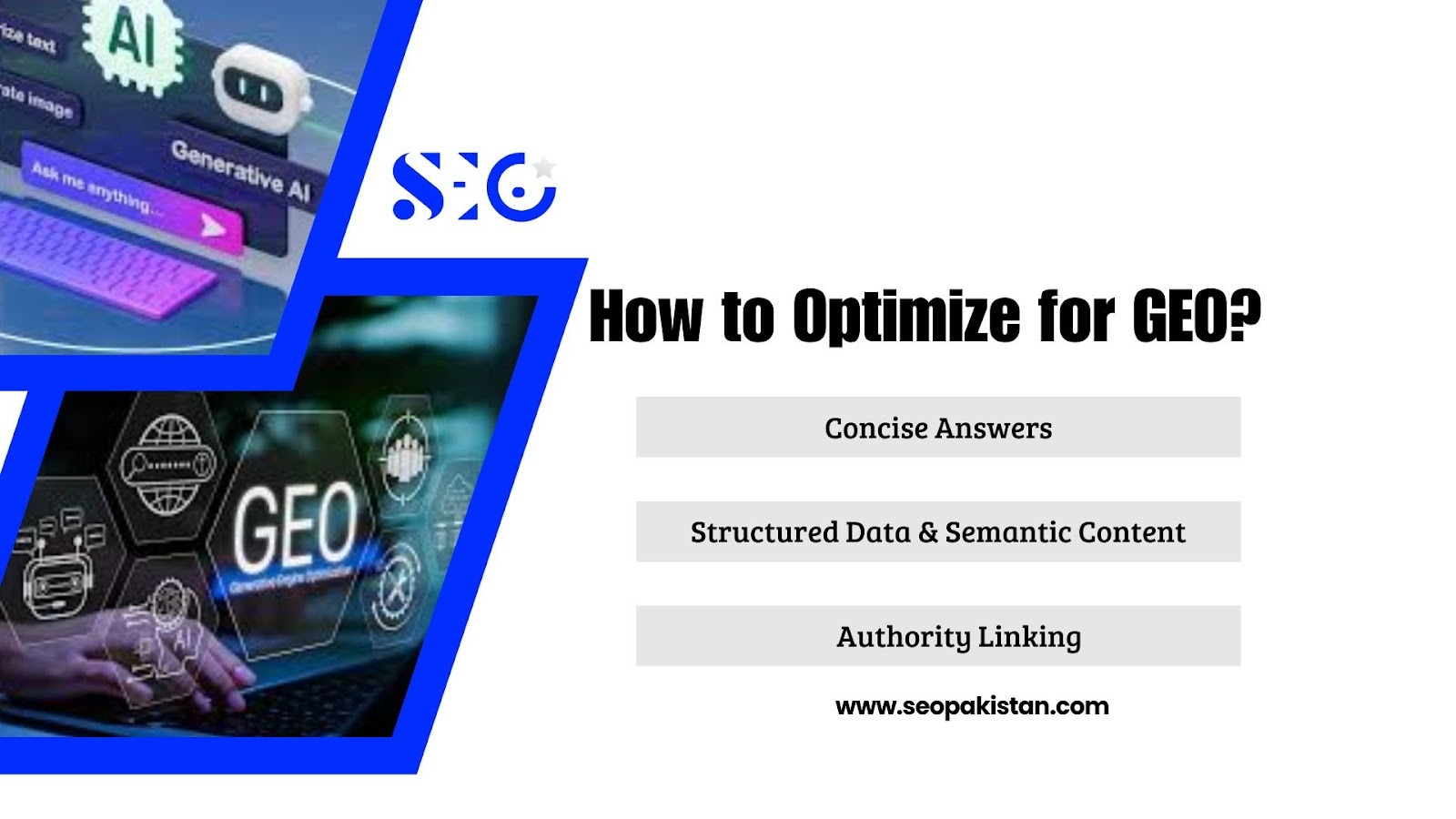
Optimizing for generative engine optimization requires a shift in content structure. You must write for the machine’s understanding of context and facts, ensuring your content is easy for an AI to parse and quote.
How do you convince an AI model to cite your content?
- Concise Answers: Place direct, clear answers to common questions early in the content or in specific sections.
- Structured Data: Use Schema markup, tables, and lists to help machines parse and understand data relationships.
- Semantic Content: Focus on context and intent rather than exact keyword matching to satisfy the AI’s logic.
- Authority Linking: Cite trusted sources within your content to establish a network of credibility that AI values.
- Quote-Worthy Text: Create content segments that are factually dense and easy for AI to reliably quote in answers.
It is important to note that GEO does not replace SEO but complements it. A site that is technically broken (bad SEO) will likely not be crawled effectively enough to succeed in GEO.
Who Benefits from SEO, Who Benefits from GEO
Businesses that rely on transactional traffic still benefit heavily from traditional methods. E-commerce stores, for example, need users to land on product pages to convert. However, brands that thrive on thought leadership must embrace the new model.
Which contexts favor AI search optimization over traditional lists?
- Complex Queries: Users asking “how to” or comparison questions benefit from the synthesis of GEO.
- Quick Facts: informational sites that provide definitions or data points need GEO to appear in zero-click answers.
- Brand Awareness: Companies that want to be top-of-mind during the research phase need to appear in AI summaries.
Measuring Success in the Era of SEO + GEO
Measuring performance now requires a hybrid approach. While clicks matter, tracking AI search visibility offers a view into the future. Marketers must monitor how often AI models cite their brand.
How do we track success in this dual landscape?
- Traditional Metrics: Continue to monitor rankings, organic traffic, click-through rates (CTR), and bounce rates.
- New GEO Metrics: Track AI citation frequency, brand mentions within answers, and generative visibility share.
- Tool Utilization: Use search engine dashboards and emerging AI visibility tools to monitor presence in AI overviews.
- Content Optimization: Focus on creating AI-friendly content by incorporating structured data and conversational keywords.
- Competitor Analysis: Monitor competitor performance in AI-driven results to identify gaps and opportunities.
Conclusion
The shift from SEO to GEO isn’t about choosing a winner; it’s about evolving your digital strategy to stay relevant. As generative engines reshape how users find information, brands must adapt by blending technical SEO foundations with AI-optimized content.
This dual approach ensures your brand remains visible, whether a user types a query into Google or asks an AI for a recommendation. The debate of SEO vs GEO is settled by embracing both.
In summary, this post explores the emergence of Generative Engine Optimization, the key differences between traditional search and AI summaries, and the hybrid metrics needed to measure success today.
Ready to lead the future of search? Don’t leave your brand’s visibility to chance. Visit seopakistan.com today to master GEO and ensure your business becomes the top recommendation in every AI-driven result. Optimize for the new era now!
Frequently Asked Questions (FAQs)
What is the difference between SEO and GEO?
SEO focuses on ranking links on a results page to drive clicks, while GEO optimizes content to be synthesized and cited directly in AI-generated answers.
Why is GEO becoming more important?
GEO is vital because users increasingly prefer direct answers from AI over browsing multiple websites, leading to a rise in zero-click searches.
Can traditional SEO still help in AI search?
Yes, technical SEO ensures your site is crawled and indexed, which is a prerequisite for AI models to access and learn from your content.
How do I measure GEO success?
Success is measured by how often your brand or content is cited in AI responses and your share of visibility in generative answers.
Should all businesses invest in GEO?
Most businesses should consider it, especially those in information-heavy industries, but transactional businesses must still prioritize traditional SEO for conversions.