

Search engine optimization has evolved far beyond the days of keyword stuffing and link farming. Today’s search engines are sophisticated machines capable of understanding context, user intent, and the overall quality of a digital experience.
To succeed in this competitive landscape, professionals must move past basic tactics and embrace comprehensive SEO approaches. This brings us to a critical junction in strategy: understanding the nuances between semantic vs holistic SEO. While these concepts overlap, they represent distinct philosophies on how to signal relevance and authority to search engines.
This guide explores the differences between these two methodologies. We will examine how semantic SEO focuses on meaning and relationships, while holistic SEO emphasizes the health of the entire digital ecosystem. By the end, you will understand how to integrate these advanced optimization methods to build a robust, future-proof strategy.
What Is Semantic SEO?
Semantic SEO is the practice of optimizing content around topics, concepts, and entities rather than individual keywords. It focuses on meaning and the relationships between words.
Search engines have moved from matching text strings to understanding the intent behind a query. When a user searches for “jaguar,” algorithms analyze context to determine if the user wants the animal, the car, or the sports team. Semantic SEO aligns your content with this level of understanding.
Key components of this approach include:
- Entities: Distinct people, places, or things that search engines recognize.
- Intent Processing: Deciphering what the user wants to achieve (learn, buy, go).
- Topic Clusters: Grouping related content to demonstrate depth of expertise.
- Knowledge Graphs: The database Google uses to understand how facts connect.
- Structured Data: Code that explicitly tells search engines what your content means.
What Is Holistic SEO?
Holistic SEO is a strategy that treats a website as a single, interconnected ecosystem. It optimizes every aspect of a site to improve its overall performance in organic search.
The term “holistic” implies that the whole is greater than the sum of its parts. You cannot focus solely on content while neglecting technical health, nor can you rely on backlinks if your user experience is poor. Holistic SEO integrates technical performance, content quality, user experience (UX), brand authority, and security.
This approach considers integrated SEO strategies, such as:
- Site Architecture: How easy it is for users and bots to navigate.
- Brand Signals: How often and positively people mention your brand online.
- Cross-Channel Consistency: Ensuring your message is unified across social media, email, and search.
Core Principles: Semantic vs Holistic SEO
While both strategies aim to improve rankings, their foundational principles differ significantly. Understanding these distinctions allows you to deploy them effectively.
Semantic SEO Principles
- Content mapped to user intent: Every piece of content must solve a specific user problem.
- Entity and topic association: Using recognized entities to anchor content in a specific subject area.
- Contextual relevance: Ensuring words and phrases support the main topic naturally.
- Structured data and schema: Providing explicit clues to search engines about content meaning.
- Topic breadth and depth: Covering a subject comprehensively to establish authority.
Holistic SEO Principles
- Sitewide coherence: Ensuring all parts of the site work together seamlessly.
- User experience and engagement: Prioritizing how users interact with the site.
- Technical quality and crawlability: Removing barriers that prevent search engines from indexing pages.
- Authority building: cultivating trust through off-site signals and brand reputation.
- Content ecosystem integration: Managing the lifecycle of content from creation to retirement.
Semantic SEO Explained: Deep Dive
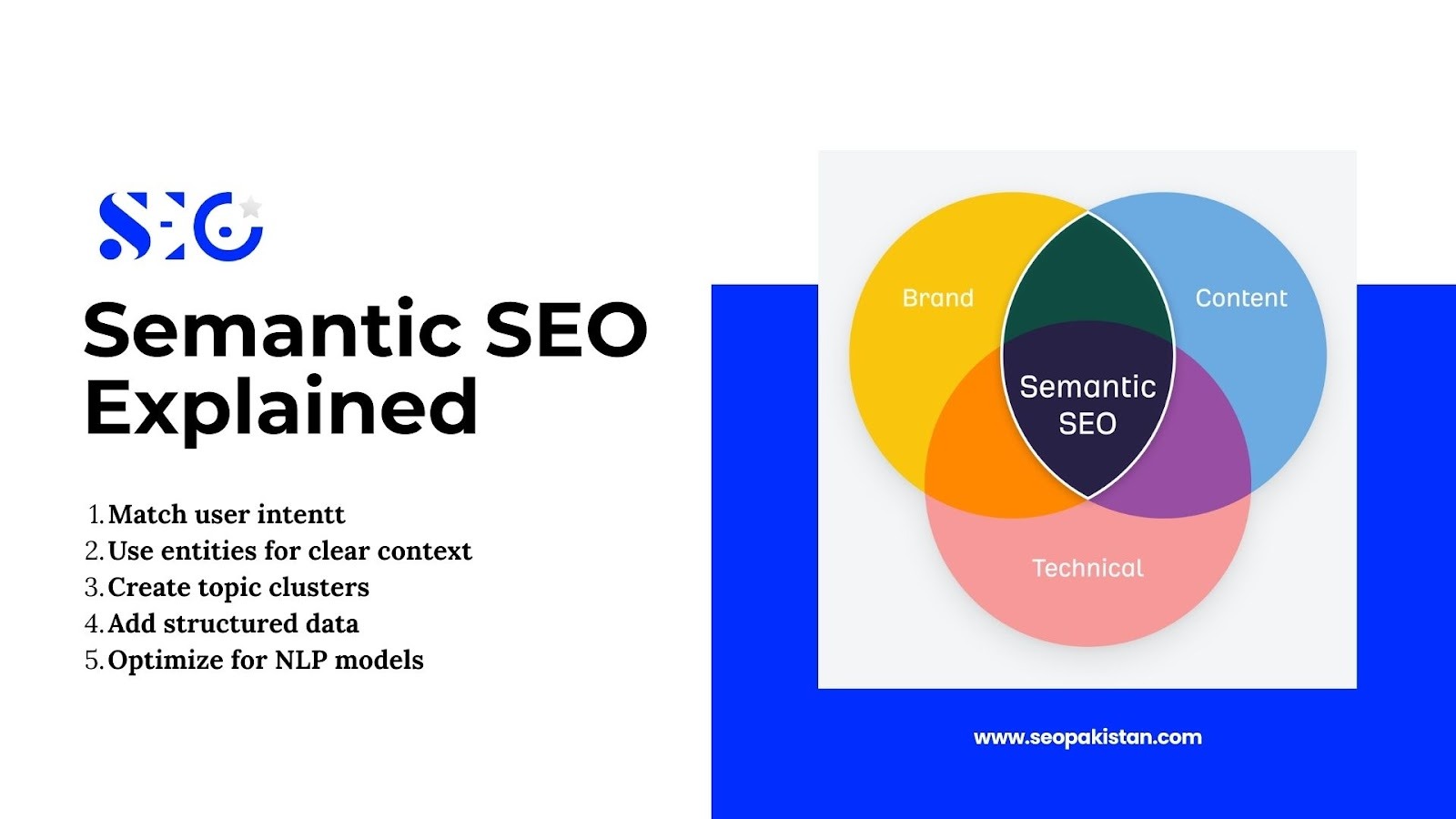
To master semantic SEO, you must understand the mechanisms that drive modern search algorithms.
Understanding User Intent
User intent is the goal behind a search query. Search engines categorize intent into four primary buckets: informational (wanting to know), transactional (wanting to buy), navigational (wanting to go), and conversational (engaging with AI). Semantic SEO requires you to tailor your content format and depth to match these specific intents.
Knowledge Graphs & Entities
Knowledge graphs are vast networks of data that map real-world entities and their relationships. An entity is not just a keyword; it is a known concept. When you write about “Apple,” semantic SEO ensures the algorithm knows whether you refer to the fruit or the technology company by analyzing the surrounding entities (e.g., “pie” vs. “iPhone”).
Topic Clusters & Content Mapping
Topic clusters organize content into a hub-and-spoke model. A “pillar page” covers a broad topic extensively, while “cluster pages” address specific subtopics. This structure signals to search engines that your site possesses deep expertise on a subject, reinforcing semantic relevance.
Structured Data & Rich Results
Schema markup is the language of semantic SEO. By adding JSON-LD code to your website, you define entities explicitly. This helps search engines understand your content with high confidence and qualifies your pages for rich results, such as star ratings, recipe cards, or event snippets.
Natural Language Understanding
Large Language Models (LLMs) and algorithms like Google’s BERT and MUM rely on Natural Language Understanding (NLU). They analyze the context of words within sentences. Your content must flow naturally and answer questions directly to align with how these models process information.
Holistic SEO Explained: Deep Dive
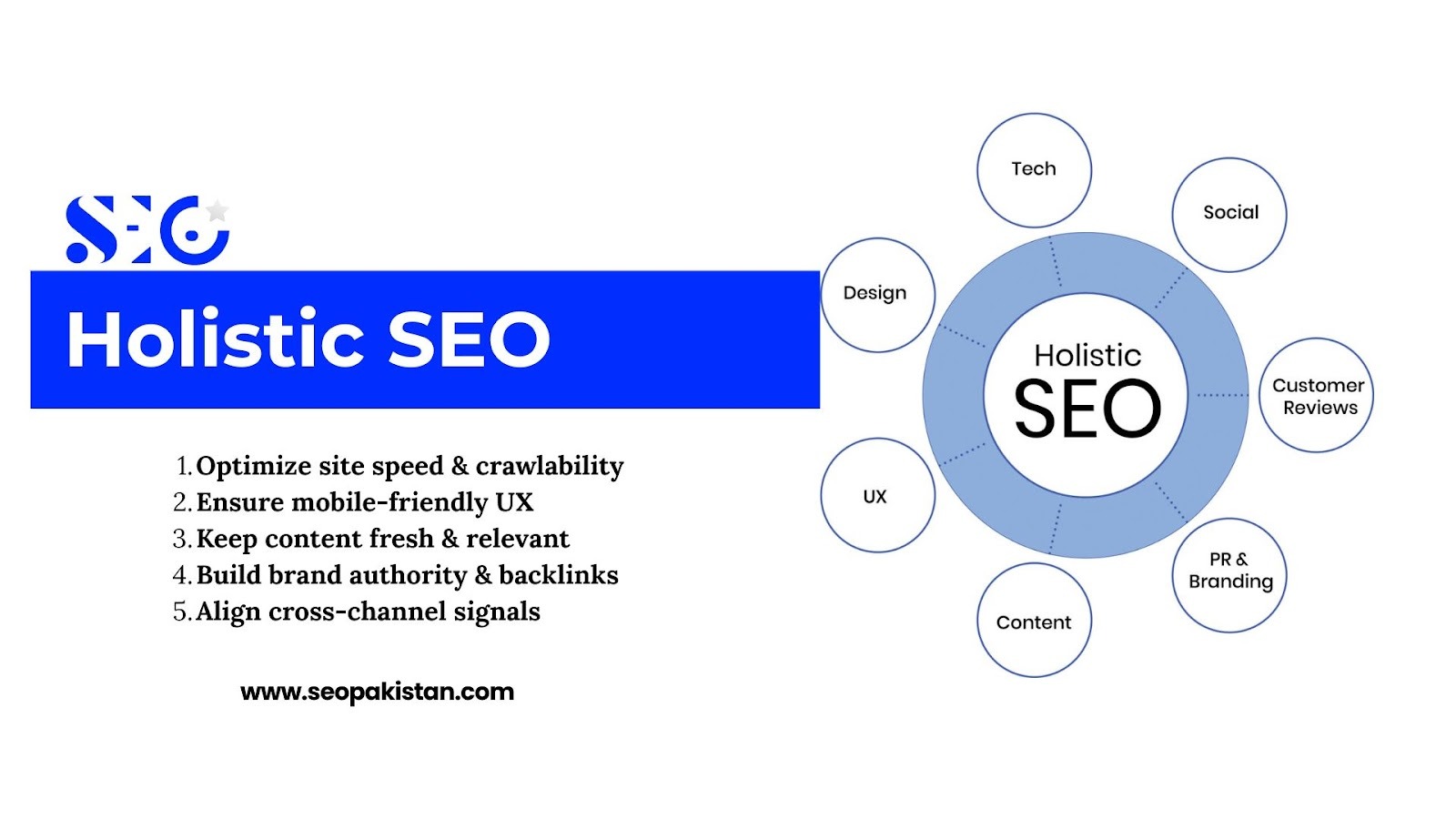
Holistic SEO looks at the broader picture. It ensures that every element of your digital presence contributes to your search performance.
Technical SEO Fundamentals
A technically sound website is the foundation of holistic SEO. This includes optimizing site speed to reduce bounce rates, ensuring mobile-first indexing compatibility, and maintaining clean crawl paths so bots can discover your content easily.
User Experience (UX)
Search engines prioritize sites that users love. Core Web Vitals measure loading performance, interactivity, and visual stability. Beyond metrics, good UX involves intuitive navigation and accessibility, ensuring all users can consume your content without frustration.
Content Strategy Integration
Holistic SEO views content as a lifecycle. It involves strategic planning, regular updates to maintain freshness, and auditing existing pages to ensure they remain relevant. It is not just about publishing new posts; it is about managing the entire library.
Brand & Authority Signals
Your brand’s reputation impacts your rankings. Holistic SEO fosters authority through high-quality backlinks, brand mentions in reputable publications, and building trust networks. A strong brand often ranks better because search engines view it as a reliable source.
Cross-Channel Signals
Search does not happen in a vacuum. Activity on social media, public relations efforts, and online reviews all contribute to your digital footprint. Holistic SEO aligns these channels to reinforce your brand’s authority and relevance.
Side-by-Side Comparison: Semantic vs Holistic SEO
The following table breaks down the key differences between semantic vs holistic SEO.
| Aspect | Semantic SEO | Holistic SEO |
| Focus | Meaning & intent | Entire optimization ecosystem |
| Core Signals | Entities, context, schema | UX, brand, technical quality |
| Primary Methods | Topic clusters, structured data | UX, performance, content, links |
| Goal | Better answer relevance | Overall search ecosystem strength |
| Best Used For | Content relevance and AI visibility | Long-term authority and site health |
When to Use Semantic SEO vs Holistic SEO
Choose your strategy carefully when comparing Semantic vs Holistic SEO, as it depends on your goals and website maturity. Semantic SEO is ideal for building topical relevance in new content hubs, while Holistic SEO focuses on balancing technical performance with user experience to future-proof rankings.
Semantic SEO is ideal for:
- Answering user intent at scale: When you need to dominate specific queries with precision.
- Rich snippets and AI overview visibility: When your goal is to appear in featured snippets or AI-generated answers.
- Deep topical relevance: When you want to establish your site as the go-to resource for a specific niche.
Holistic SEO is ideal for:
- Large sites with complex ecosystems: When technical debt and site structure are major hurdles.
- Long-term domain authority building: When you need to build a brand that withstands algorithm updates.
- Multi-channel, brand-heavy strategies: When your search presence relies heavily on PR and off-site reputation.
Implementation Strategies: Semantic SEO
Implementing semantic strategies means focusing less on individual keywords and more on researching broader topics. This approach helps create content that aligns better with user intent and improves search visibility.
Intent Research
Do not just look at search volume. Analyze the top-ranking results to see what questions they answer. Identify the “why” behind the search to ensure your content satisfies the user’s specific need.
Topic Mapping
Create a map of your niche. Identify the core topics you must cover and the subtopics that support them. Use this to build your topic clusters and internal linking strategy.
Schema Implementation
Implement schema markup on every relevant page. Use Article, Product, FAQPage, and Organization schema to give search engines a clear understanding of your content’s context.
Content Enrichment
Review your content to ensure it covers entities related to your main topic. If you write about “coffee,” ensure you mention related entities like “roast,” “beans,” “brewing,” and “caffeine” to demonstrate depth.
Evaluation Metrics
Track how well you answer questions. Look at your presence in “People Also Ask” boxes, featured snippets, and the depth of engagement on your pages.
Implementation Strategies: Holistic SEO
A holistic SEO strategy goes beyond just keywords and backlinks. It involves a complete website optimization that requires a methodical approach to both technical and experiential health. This means ensuring your site is not only technically sound for search engines but also provides a seamless and valuable experience for your users.
Technical Audit and Fixes
Run regular audits to identify broken links, slow pages, and crawl errors. Fix these issues promptly to ensure search engines can access and index your site without friction.
UX and Engagement Improvements
Analyze user behavior using tools like heatmaps. Improve page layout, simplify navigation, and ensure your site is fully responsive on mobile devices to keep users engaged.
Cross-Channel Signal Boosts
Encourage reviews and manage your online reputation. Coordinate your content releases with social media and email campaigns to drive diverse traffic sources to your site.
Content Ecosystem Management
Audit your content library annually. Prune outdated content, merge competing pages, and update high-performing articles to keep your ecosystem healthy.
Continuous Feedback Loop
Establish a system for monitoring performance. Use data from analytics, search console, and user feedback to make iterative improvements to your strategy.
Conclusion
The debate between semantic vs holistic SEO is not about choosing one over the other. It is about understanding that they serve different but complementary functions. Semantic SEO provides the depth and context required for machines to understand your content. Holistic SEO provides the structure and authority required for your site to thrive in a competitive ecosystem.
To achieve full-spectrum SEO, you must integrate both approaches. Build a technically sound, user-friendly platform and fill it with content that demonstrates deep semantic understanding. By combining these comprehensive SEO approaches, you position your brand for sustainable growth and long-term visibility.
Ready to put these strategies into action? Visit seopakistan.com to get expert tips and actionable insights delivered directly to your inbox, and start mastering both semantic and holistic SEO today.
Frequently Asked Questions (FAQs)
What is the difference between semantic and holistic SEO?
Semantic SEO focuses on the meaning, context, and intent behind content and queries. Holistic SEO focuses on the overall health of the website, including technical performance, user experience, and brand authority.
Is semantic SEO more important for AI search?
Yes. AI search engines rely heavily on understanding context and entities, which are the core components of semantic SEO.
How long does it take to see results from holistic SEO?
Holistic SEO is a long-term strategy. It can take several months to see significant improvements in authority and rankings, but the results are typically more sustainable.
Is semantic SEO part of holistic SEO?
Yes. Semantic SEO is a core component of holistic SEO. Holistic SEO includes semantic optimization along with technical SEO, UX, branding, and authority building.
Which is better: semantic SEO or holistic SEO?
Neither is better on its own. Semantic SEO improves content relevance and AI visibility, while holistic SEO ensures long-term rankings by maintaining site health and authority. The best results come from combining both.