


The digital risk landscape is increasingly complex, with underground markets driving the sale of stolen assets, leaked data, and exposed PII. Cybercriminals use hidden forums to discuss vulnerabilities, plan attacks, and share ways to bypass defenses—often before threats go mainstream.
Organizations must look beyond their networks for early warning signs. Dark web monitoring, once niche, is now essential for security strategies, allowing teams to anticipate and neutralize risks before they escalate into breaches or costly ransomware attacks.
Consequently, dark web monitoring has evolved from a niche investigative tool into a core component of modern security monitoring strategies. By observing threat intelligence chatter in these hidden corners, security teams can shift from a reactive posture to a proactive defense.
Understanding the Dark Web & How It Differs from Deep Web
Understanding the distinctions between the surface web, deep web, and dark web is crucial for anyone engaging in digital risk management. Accurately identifying these layers helps tailor appropriate monitoring strategies and ensures that you operate within legal and ethical boundaries.
To navigate this landscape effectively, you must first distinguish between the layers of the internet. Many people use the terms “deep web” and “dark web” interchangeably, but they represent vastly different environments with distinct accessibility rules.
- Surface Web: This is the portion of the internet indexed by standard search engines like Google or Bing. It represents the tip of the iceberg that the general public accesses daily.
- Deep Web: This layer comprises the vast majority of the internet. It includes medical records, academic databases, and corporate intranets. It is not indexed, but accessing it is generally legal and requires standard authentication.
- Dark Web: A small slice of the deep web intentionally hidden and inaccessible via standard browsers. It requires specific tools, such as Tor (The Onion Router) or I2P (Invisible Internet Project), to access.
Because the dark web relies on overlay networks that mask IP addresses, its content remains invisible to normal search engines. Conducting dark web research here requires specialized software and a strong understanding of anonymity protocols.
What Is Dark Web Monitoring?
Dark web monitoring is the systematic scanning, crawling, and analysis of hidden web content to find relevant security threats. It is not about casually browsing illegal marketplaces; it is a targeted, automated process designed to identify specific indicators of compromise before they result in financial or reputational damage.
The primary goals of this practice include:
- Detecting Leaked Credentials: Finding employee usernames and passwords for sale.
- Identifying Sensitive Data Exposure: Locating proprietary source code or customer lists.
- Tracking Threat Actor Chatter: Monitoring discussions about specific organizations or industries.
- Monitoring New Vulnerabilities: seeing which exploits hackers are trading or discussing.
For example, a security team might receive an alert that a database containing customer emails appeared on a hacking forum, allowing them to force password resets before account takeovers occur.
Legal Considerations: What Is Permissible vs Illegal
Navigating the legal challenges of dark web monitoring is no simple task. Professionals must interpret a patchwork of international and local laws, each with its own implications for data collection and surveillance.
Laws You Must Know
A thorough understanding of legal requirements is fundamental to any dark web monitoring initiative. Major regulations not only define the boundary between compliance and criminality but also protect organizations from unintended legal consequences.
Several major regulations dictate how organizations interact with data found online. Violating these can lead to severe penalties, regardless of intent.
- Computer Fraud and Abuse Act (CFAA): In the United States, this statute prohibits unauthorized access to computers and networks.
- GDPR & EU Privacy Regulations: These laws impose strict rules on how PII is handled, even if that data was found publicly on a leak site.
- Local Surveillance Laws: Different countries have specific statutes regarding the monitoring of communications.
- Data Handling Regulations: You must adhere to breach notification laws if you discover your own exposed customer data.
What Not to Do
When conducting dark web monitoring, understanding where legal boundaries lie is essential. Merely accessing hidden sites is not inherently illegal, but how you interact with these platforms can have serious legal repercussions.
Just because you can access a site does not mean you can interact with it freely. Certain actions will almost always cross the legal line.
- Active Interaction: Do not communicate with threat actors or negotiate for data.
- Downloading Illegal Content: Avoid downloading illicit materials, such as child exploitation material or prohibited software.
- Unauthorized Logins: Do not use stolen credentials to log into restricted forums, even for research.
- Participating in Transactions: Purchasing stolen data, malware, or illicit goods is illegal.
When Monitoring Becomes Illegal
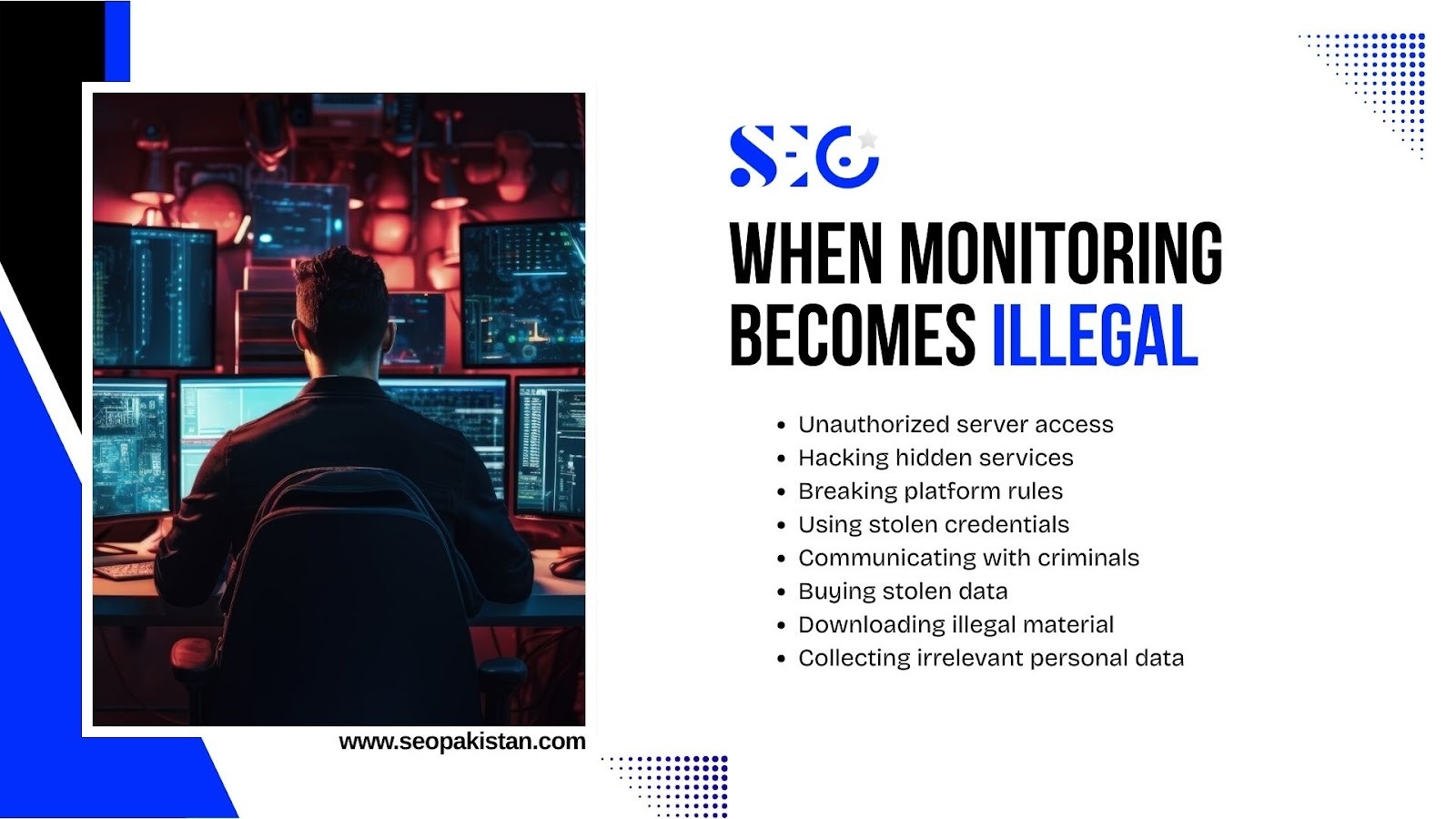
While defensive monitoring is permissible within legal boundaries, certain actions can quickly shift your efforts into illegal territory. It is essential to understand the clear line between passive observation and active engagement that violates laws or regulations.
Monitoring shifts from a defensive measure to a criminal act when boundaries are crossed. Illegal activities often involve:
- Unauthorized Access: Hacking into a dark web server to retrieve data.
- Breaking Terms of Service: violating the rules of the network or platform you are investigating.
- Non-Consensual Collection: Harvesting data on individuals who are not relevant to your security scope.
Ethical Dark Web Access: Principles and Best Practices
Legality is the baseline, but ethics provide the framework for responsible conduct. Ethical dark web access ensures that your intelligence gathering does not inadvertently support the criminal ecosystem you are trying to fight.
Ethical Access Policies
Before engaging in any dark web activities, it is crucial for organizations to define strict ethical access policies. These guidelines ensure that intelligence gathering operations do not inadvertently facilitate illegal acts or compromise organizational values.
Organizations must establish rigid policies before deploying any crawlers. These policies protect the researchers and the company’s reputation.
- Respect Terms of Use: Even on the dark web, adhering to site rules (where applicable) maintains professional standards.
- Avoid Illegal Engagement: Never provide financial support to criminal enterprises through subscriptions or purchases.
- Use Read-Only Methods: Configure tools to observe without leaving a digital footprint or interacting with server scripts.
Threat Intelligence Ethics
Collecting threat intelligence from the dark web comes with unique ethical responsibilities. Security teams must ensure their actions do not inadvertently harm individuals or violate their privacy, and should always prioritize minimizing intrusion and respecting boundaries.
Establishing clear principles for what data is gathered—and why—is essential to maintaining the trust and integrity of the process.
- Relevance: Only collect data that pertains to your specific security requirements.
- Data Minimization: Avoid harvesting personal data of unrelated third parties.
- Security: Store collected intelligence securely and restrict access to authorized personnel only.
- Privacy: Respect the confidentiality of victims whose data may be exposed in the dumps you analyze.
Organizational Governance
Establishing robust organizational governance is essential to ensure dark web monitoring efforts remain effective, compliant, and ethical over time. Governance frameworks align monitoring activities with both regulatory mandates and company values, offering a safeguard against accidental policy violations and legal pitfalls.
Strong governance structures ensure that monitoring activities remain compliant over time.
- Internal Policies: clearly define what constitutes acceptable research behavior.
- Approval Processes: Require authorization and audit trails for specific high-risk investigations.
- Training: Regularly educate analysts on the evolving legal and ethical landscape of security crawling.
Technical Architecture of Dark Web Monitoring
Effective monitoring requires a robust technical infrastructure capable of navigating unstable networks safely. It is not enough to simply open a Tor browser; you need an automated, scalable pipeline.
Crawling vs Passive Collection
Collecting intelligence from hidden services is critical for gaining visibility into emerging threats that are otherwise invisible to traditional monitoring tools. Organizations use a combination of automated and archival techniques to gather this data, enabling them to efficiently index, store, and analyze information from unstable or rapidly changing dark web environments.
Two primary methods exist for gathering data from hidden services.
- Ethical Crawling: Automated bots navigate links to index content, similar to Google bots but configured for Tor/I2P.
- Archival Mechanisms: Systems capture and store copies of pages, as dark websites frequently go offline.
- Indexing: The system organizes unstructured content to make it searchable for analysts.
Data Ingestion Pipeline
An effective data ingestion pipeline is essential for bridging the gap between hidden dark web forums and your security analysis environment. This layer captures, processes, and normalizes information in real time, ensuring that threat intelligence is both actionable and aligned with organizational workflows.
The ingestion layer is the bridge between the dark web and your analysis tools.
- Connectors: Specialized software handles the connection to Tor or I2P networks.
- Proxy Layers: These mask the origin of the crawler to prevent blocking or identification.
- Normalization: The system converts messy, unstructured data into a standardized format.
Parsing & Classification
Turning raw data into actionable intelligence is a critical step in any dark web monitoring process. Parsing and classification help security teams quickly identify relevant threats, filter out noise, and prioritize findings for response.
Without these processes, analysts would be overwhelmed by unstructured information and unable to extract timely, meaningful insights.
- Regex and NLP: Regular expressions and Natural Language Processing identify patterns like credit card numbers or hacking terminology.
- Entity Extraction: The system automatically pulls out emails, IP addresses, and specific credentials.
Alerting & Correlation
Timely detection of emerging threats is essential for an effective security strategy. The value of dark web intelligence is fully realized only when actionable alerts are delivered quickly and correlated with existing security systems.
Establishing seamless alerting and correlation mechanisms ensures that security teams can prioritize and respond to threats before they lead to major incidents.
- SIEM Integration: Alerts feed directly into Security Information and Event Management systems.
- Rule-Based Detection: The system triggers alerts based on predefined keywords or patterns.
- Risk Models: Algorithms assign a severity score to findings based on the credibility of the source.
- SIEM Integration: Alerts feed directly into Security Information and Event Management systems.
- Rule-Based Detection: The system triggers alerts based on predefined keywords or patterns.
- Risk Models: Algorithms assign a severity score to findings based on the credibility of the source.
Tools & Platforms for Dark Web Monitoring
Choosing between building an in-house dark web monitoring solution or purchasing a commercial tool is a significant strategic decision. Building allows for greater customization and control but often requires substantial investment in expertise, ongoing maintenance, and legal risk management.
Organizations must decide whether to build their own capabilities or buy established solutions. Each approach carries a distinct risk and resource profile.
Commercial Solutions
For most enterprises, commercial tools offer the safest path.
- Threat Intelligence Platforms: These vendors handle the crawling and legal risk, providing you with a clean feed of relevant alerts.
- Managed Services: Third-party experts conduct the analysis and only escalate verified threats.
Integrating Dark Web Monitoring into Security Operations
Integrating dark web monitoring into your security operations transforms raw intelligence into actionable steps. By weaving these insights into daily workflows, security teams can spot emerging dangers sooner, prioritize responses more effectively, and minimize the risk of critical threats slipping through unnoticed.
Intelligence is only valuable when it drives action. You must integrate these insights into your broader security operations center (SOC).
Threat Intelligence Framework
A structured framework ensures intelligence informs all levels of the organization.
- Tactical: Focuses on immediate indicators like bad IPs or email dumps.
- Operational: Profiles specific threat actors to understand their methods.
- Strategic: looks at long-term trends to forecast future risks to the industry.
Correlation with Internal Security Alerts
Correlating dark web findings with internal security alerts enhances your organization’s threat detection. This allows security teams to prioritize incidents, respond to genuine risks, and spot threats that might otherwise go unnoticed.
- SIEM and SOAR: Correlate external chatter with internal network logs.
- Endpoint Detection: Use indicators from the dark web to scan endpoints for compromise.
- Incident Response (IR): Integrate findings into IR workflows to speed up triage.
Response Process
A swift and structured response to dark web alerts is crucial for minimizing the impact of potential threats. When your team receives an alert, having a clear action plan ensures that sensitive information is protected and regulatory obligations are met.
When an alert triggers, the team must have a defined playbook.
- Confirmation: Verify the data is authentic and not a recycled dump.
- Credential Reset: Force password changes for affected users immediately.
- External Notification: Determine if legal or regulatory obligations require you to notify customers or authorities.
Conclusion
Dark web monitoring is critical for modern enterprises to identify threats before they escalate. With the power of security crawling comes the responsibility to follow legal frameworks and uphold ethical dark web access policies. By adhering to these standards, organizations protect their operations while reinforcing trust in the digital ecosystem.
Effective dark web research isn’t just about uncovering risks—it’s about addressing them proactively, balancing intelligence gathering with compliance and privacy. Integrating threat intelligence from the dark web into your security strategy helps shift from reactive to proactive threat prevention.
A responsible monitoring program strengthens resilience, ensures legal and ethical practices, and demonstrates a commitment to robust cyber defense. Stay vigilant, compliant, and secure in today’s evolving threat landscape.
Frequently Asked Questions
What exactly is dark web monitoring?
It is the process of searching the hidden part of the internet for stolen data or threats related to your organization.
Is it legal to monitor the dark web?
Yes, monitoring and observing public forums is generally legal, provided you do not engage in illegal transactions or unauthorized access.
How is dark web monitoring different from deep web crawling?
Deep web crawling accesses unindexed but public databases, while dark web monitoring requires specialized software to access hidden, anonymous networks.
What types of threats can it reveal?
It reveals stolen credentials, exposed PII, planned attacks, and intellectual property leaks.
Can companies do it themselves or should they use services?
Most companies should use commercial services to mitigate the legal and safety risks associated with direct access.