



The volume of information published daily is staggering. Digital publishing has created a landscape where news breaks every second, leaving content teams struggling to keep pace. Readers demand immediate updates, but sifting through thousands of articles to find relevant facts is an impossible task for humans alone.
Manual news summarization no longer scales effectively. Writers spend hours reading source material instead of creating value, which leads to bottlenecks and missed opportunities. This inefficiency is why modern newsrooms and marketing teams are turning to technology to bridge the gap between data volume and reader consumption.
AI news summarization is the solution for staying fast and relevant. It allows publishers to process vast amounts of information instantly, ensuring that their audience receives accurate and timely updates. This guide explores how these tools work, the benefits they offer, and how you can implement them to transform your content workflow.
What Is AI News Summarization?
AI news summarization is the process of using artificial intelligence to condense long articles or reports into concise, digestible formats. It leverages advanced algorithms to identify the most critical information within a text and present it clearly.
This technology enables content creators to produce summaries that retain the core message of the source without the fluff.
Manual Vs. Automated Summarization:
| Aspect | Manual Summarization | Automated Summarization |
|---|---|---|
| Speed | Slow | Very fast |
| Cost | High (labor/time) | Low (tools/software) |
| Scalability | Poor | Excellent |
| Accuracy | High (context-aware) | Medium–High (model-dependent) |
| Consistency | Can vary by person | Highly consistent |
| Context Understanding | Deep, nuanced | Limited to training/data |
| Bias Control | Human bias possible | Model/data bias possible |
| Customization | Highly customizable | Limited (prompt/settings based) |
| Handling Large Volumes | Difficult | Easy |
| Error Rate | Low but subjective | Can miss nuance or facts |
| Maintenance | Needs ongoing human effort | Needs tool updates |
| Language Support | Depends on human skill | Multi-language support |
| Creativity | High | Limited |
| Real-time Use | Not practical | Ideal |
| Use Cases | Legal, medical, research | News, videos, reports, social media |
| Dependency | Human expertise | Technology & internet |
| Learning Curve | Skill-based | Tool-based |
| Security & Privacy | More controllable | Depends on platform |
| Best For | Critical, sensitive content | High-volume, repetitive tasks |
How AI News Summarization Works
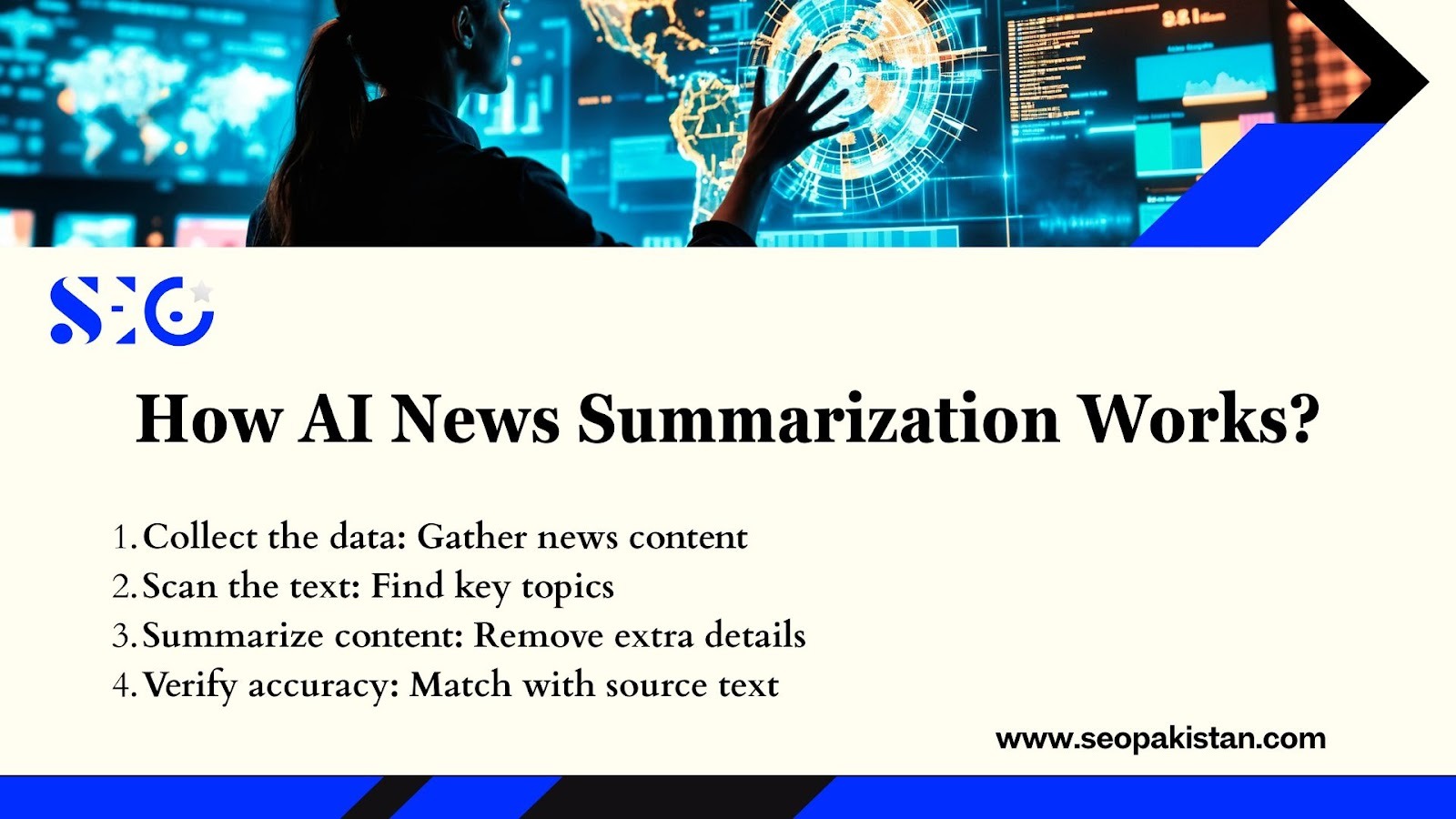
At the heart of this technology lie natural language processing (NLP) and machine learning (ML). NLP allows the computer to understand human language, while ML enables the system to improve its accuracy over time. Together, they create a powerful engine for processing text.
Understanding the mechanics of this process helps in selecting the right tools. How does the machine go from a raw feed of data to a polished summary?
Here is the step-by-step breakdown of the process:
- News data ingestion: The system gathers text from various sources, such as RSS feeds, websites, or documents.
- Key sentence and topic detection: Algorithms scan the text to identify proper nouns, main themes, and statistical data.
- Content condensation and summary generation: The AI removes redundant information and compiles the remaining facts into a coherent narrative.
- How accuracy and context are maintained: Advanced models compare the summary against the original text to ensure no critical nuance is lost.
Types of AI News Summarization
Not all summarization tools function in the same way. Depending on your needs, you might require a system that quotes directly or one that interprets and rewrites the content. Understanding these distinctions is vital for maintaining editorial standards.
Extractive Summarization
Extractive summarization functions like a highlighter pen. It identifies the most important sentences in a text and pulls them out exactly as they appear. The AI assigns a score to each sentence based on its relevance and assembles the highest-scoring sentences into a summary.
Best suited for:
- Breaking news
- Data-driven reporting
- Situations where wording and quotes must remain unchanged
Abstractive Summarization
Abstractive summarization mimics how a human writes. It reads the full text, understands the context, and generates new sentences to describe the main ideas. This is a more complex form of content condensation tools because it requires the AI to have a deep grasp of language generation.
This method works best for:
- Editorials: Where the flow and narrative are more important than rigid sentence structure.
- In-depth analysis: When complex ideas need to be simplified for a general audience.
Multi-Document Summarization
This approach combines information from multiple news sources into a single, unified summary. It is particularly valuable for news aggregation and trend monitoring.
Best suited for:
- Daily news digests
- Industry monitoring
- Research and analysis workflows
Why News Summarization Matters for Content Creation

Speed is the currency of the digital age. It allows content teams to publish faster cycles. Instead of spending the morning reading, writers can start their day with prepared briefs and focus on adding value through analysis.
- Faster publishing cycles: Writers start with ready-made briefs instead of raw material.
- Consistency across platforms: Summaries maintain a uniform tone and structure regardless of source.
- Improved content repurposing: Existing articles can be condensed into newsletters, social posts, or SEO snippets.
- Reduced editorial workload: Editors spend less time on research and more time on strategy and refinement.
When paired with AI writing assistants, summarization tools become a foundational layer in modern content pipelines.
Key Benefits
Adopting this technology is not just about keeping up with trends; it is about operational efficiency. Why should a business invest in these tools?
Here are the primary advantages of using news aggregation AI:
- Saves time and operational costs: Drastically reduces the hours spent on manual research by filtering out the noise. This allows your team to focus on high-value analysis rather than repetitive data collection, maximizing your ROI on every piece of content produced.
- Improves content consistency: Ensures a standardized format for all news briefs and reports, maintaining your brand voice across every channel. By removing human bias and formatting errors, you provide a reliable and professional experience for your readers every time.
- Enables large-scale news aggregation AI workflows: Allows teams to monitor hundreds of niche sources simultaneously without hiring more staff. This scalability means you can broaden your coverage and identify emerging trends before your competitors even see them coming.
- Supports multilingual and real-time reporting: Instantly translates and summarizes foreign news sources to give you a global perspective. Stay ahead of international developments without the need for expensive translation services or specialized regional analysts.
- Personalizes delivery for target audiences: Use AI to tailor news summaries specifically for different segments of your readership. Whether your audience needs deep technical dives or quick executive summaries, AI helps you repurpose the same core information for multiple demographics effortlessly.
Popular News Summarization Tools
The market is flooded with software claiming to solve your content problems. However, they generally fall into specific categories suited for different tasks. Knowing which category fits your business model is the first step toward successful implementation.
Which type of tool will best serve your editorial needs?
Consider these categories when choosing your software stack:
- Automated content summarization platforms: Standalone tools like Smmry and QuillBot dedicated solely to shrinking and paraphrasing text.
- News aggregation AI systems: Platforms like Feedly AI that gather news from the web and generate briefs from multiple sources.
- Content curation and newsletter tools: Software like UpContent is designed to curate content and summarize it for distribution.
- AI writing assistants with summarization features: Broader writing tools, such as Jasper AI, that include robust summarization as a built-in feature.
How to Choose the Right News Summarization Tool
Selecting the right tool depends on your specific workflow, not the latest trends or hype. What features are essential to streamline your tasks?
Consider these factors when making your choice:
- Content volume: Are you summarizing a few articles or thousands daily?
- Source type: Single-source analysis vs multi-source aggregation
- Output format: Bullet points, briefs, or narrative summaries
- Integration needs: CMS, APIs, or automation platforms
- Editorial oversight: Level of human review required
- Budget and scalability: Free tools vs enterprise solutions
Matching these criteria to your goals prevents overinvestment and poor adoption.
News Summarization Workflow (Checklist)
Implementing a robust workflow ensures your team isn’t just reacting to news but proactively shaping it.
Step 1: Identify content goals – blogs, newsletters, social posts, or internal briefs.
Step 2: Curate high-quality sources – RSS feeds, trusted news sites, and industry publications.
Step 3: Configure summarization tool – set length, tone, and format.
Step 4: Generate AI summaries – automate initial extraction and condensation.
Step 5: Human review – verify facts, maintain context, and adjust tone.
Step 6: Publish and repurpose – post to CMS, social media, newsletters, or SEO updates.
Step 7: Monitor performance – track engagement, clicks, and accuracy to refine workflow.
Best Practices
To get the most out of AI news summarization, you must adhere to strict quality control standards. Relying too heavily on automation can lead to generic or inaccurate content.
Keep these best practices in mind:
- Always review summaries before publishing: Catch errors that the AI might have missed.
- Avoid over-condensation that removes context: Ensure the “why” and “how” remain in the story.
- Maintain editorial voice and tone: Edit the AI output to match your brand’s specific style.
- Combine automated reporting with human oversight: Use the AI for the heavy lifting, but let humans add the polish.
- Use summaries as a foundation, not final output: Treat the summary as a first draft that requires expert refinement.
Common Challenges and Limitations
While powerful, AI is not flawless. Users must be aware of potential pitfalls to avoid publishing errors. What are the risks associated with automated reporting?
Be vigilant regarding these common issues:
- Risk of missing nuance or context: AI may misinterpret sarcasm or complex geopolitical subtleties.
- Potential bias from training data: The AI might unintentionally favor certain viewpoints based on how it was built.
- Accuracy concerns in fast-breaking news: If initial reports are conflicting, the AI may summarize incorrect information.
- Ethical considerations in automated reporting: Transparency about the use of AI is essential for reader trust.
Future Trends
The technology is evolving rapidly. We are moving toward a future where news is hyper-personalized and delivered in real-time. AI writing assistants will become deeply integrated into every CMS.
Watch for these developments in the near future:
- Personalized news summaries: Content tailored to the specific interests of the individual reader.
- Real-time automated reporting: Live summaries of events as they happen, without human intervention.
- Multilingual summarization growth: Instant global news accessible in any language.
- Deeper integration with AI writing assistants: Seamless workflows from research to publication.
- Smarter content condensation tools: Better handling of nuance and complex narrative structures.
Conclusion
AI news summarization is transforming the landscape of content creation. It offers a lifeline to publishers drowning in data and provides a strategic advantage to marketers looking to scale their output. By automating the tedious task of reading and condensing, businesses can focus on analysis and strategy.
However, success requires a balance. Automation must be paired with human editorial judgment to ensure accuracy and quality. The businesses that master this hybrid approach will dominate the information landscape.
Start exploring it today to keep your content strategy competitive and efficient. Ready to supercharge your content and conquer the search rankings? Visit seopakistan.com and let our experts craft a winning strategy that puts you ahead of the competition
Frequently Asked Question
What is AI news summarization?
It is the use of artificial intelligence to extract the most important information from news articles and present it in a condensed format. It helps readers and creators get the facts quickly without reading full documents.
Is AI news summarization reliable for publishing?
It is generally reliable for factual summaries but requires human oversight. You should always verify the output for accuracy, especially with complex or sensitive topics.
Can AI replace human journalists?
No, AI cannot replace human journalists. It functions best as an assistant that handles data processing and initial drafts, allowing journalists to focus on investigation, interviews, and storytelling.
Is AI news summarization good for SEO?
Yes. It allows you to publish content frequently and keep your site updated with relevant news. It also helps in repurposing content, which provides more opportunities for search engines to index your site.