


Is your guest posting strategy actually hurting your SEO? It might be if you’re not paying close attention to your anchor text. While guest posting is a powerful way to earn backlinks from authoritative domains, build topical relevance, and boost your site’s rankings, the anchor text you use is just as critical as the link itself.
But here is what many practitioners overlook: the anchor text attached to those links carries just as much weight as the link itself. A well-placed backlink with a poorly chosen anchor can dilute relevance, trigger algorithmic red flags, or get your submission rejected altogether.
Understanding anchor text best practices is not optional for serious guest post link building. It is the difference between a backlink that actively moves rankings and one that sits dormant—or worse, causes harm.
This guide is your masterclass in anchor text. We’ll give you the exact blueprint to follow, covering everything from anchor types and ideal distribution ratios to advanced placement strategies and the rookie mistakes that get even seasoned marketers penalized.
What is Anchor Text in SEO?
Anchor text is the clickable, hyperlinked text within a piece of content. It is the visible portion of a link that both users and search engines read to determine where it leads and why it exists.
Search engines like Google use anchor text as a contextual signal. When a page receives a backlink with the anchor “content marketing strategy,” Google interprets that as a relevance indicator—suggesting the linked page relates to that topic. Over time, patterns in anchor text help search engines determine how a page should rank for specific queries.
Anchor text serves three core functions in SEO:
What does anchor text actually communicate to Google? Why does it influence rankings beyond just the link itself? Here is what it signals:
- Context signal: It tells search engines what topic or keyword the linked page is relevant to
- Ranking factor: Consistent, relevant anchors reinforce a page’s authority for target keywords
- User navigation aid: Clear anchors help readers understand what they will find before clicking
Why Anchor Text Matters in Guest Posting
Guest posts sit in a unique position within link building. Unlike editorial mentions or directory listings, guest articles give you some level of influence over how your backlinks are constructed. That makes understanding anchor text best practices in guest blogging both an opportunity and a responsibility.
Here is why anchor text carries particular weight in the guest posting context:
- Relevance: Anchors connect the topic of the host article to the topic of your linked page, reinforcing thematic alignment
- Authority: A contextually relevant anchor strengthens the authority passed through the link
- Trust: Natural, varied anchor usage signals organic link acquisition to search engines
- Natural backlink profile: A diverse anchor strategy across guest posts contributes to a healthy, penalty-resistant link profile
Poor anchor choices can lead to editorial rejection, reduced link equity, or over-optimization penalties. Publishers increasingly scrutinize the links within submitted articles. Aggressive exact match anchors are a common reason guest posts get declined or links get removed. A smart guest posting anchor text strategy protects both your rankings and your outreach success rate.
Types of Anchor Text Used in Guest Posts
Not all anchors carry the same intent or risk level. Knowing each type allows you to build a more deliberate anchor text in a guest blogging strategy.
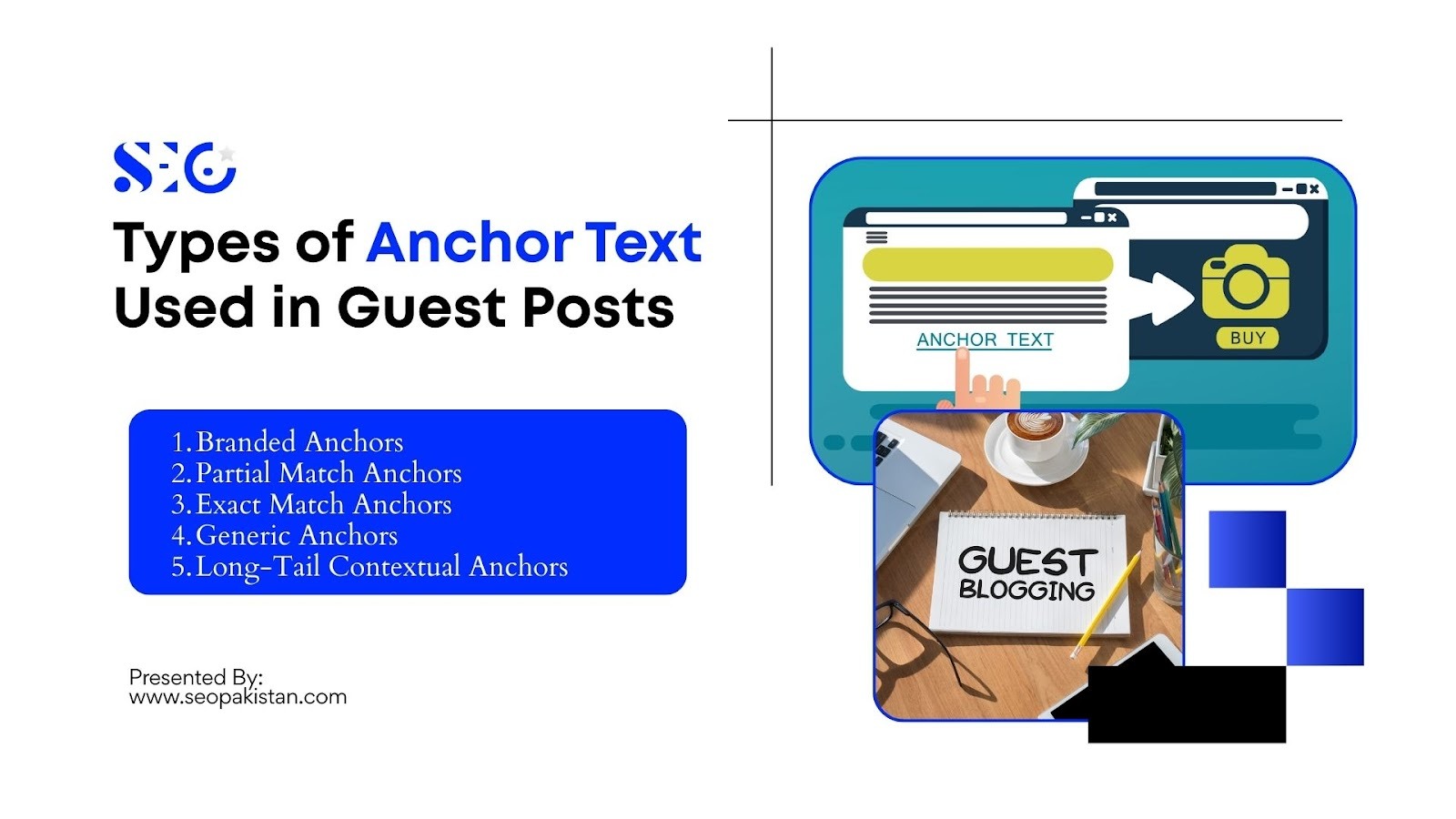
- Branded anchors use your brand name as the link text, such as “Ahrefs” or “Moz.” These are the safest anchor types and the most natural-looking to both editors and algorithms.
- Partial match anchors include a variation of your target keyword alongside other words. For example, “effective anchor text strategy for blogs” rather than “anchor text strategy.” These anchors feel natural and still carry keyword relevance.
- Exact match anchors mirror the precise keyword you are targeting, such as “anchor text best practices.” These carry strong ranking signals but must be used sparingly to avoid over-optimization.
- Generic anchors include phrases like “click here,” “read more,” or “this guide.” They contribute minimal SEO value but add diversity to your anchor profile.
- Long-tail contextual anchors are descriptive phrases that naturally emerge from the surrounding content, such as “how to optimize anchor text for guest articles.” These are highly valuable in guest posts because they blend seamlessly into editorial content.
Anchor Text Best Practices for Guest Blogging
Struggling to make your guest articles rank higher while keeping editors happy? Applying anchor text best practices is key! But how do you strike the perfect balance between SEO intent and editorial sensitivity?
Here’s how:
Prioritize Branded Anchors
Branded anchors are your safest and most effective option when guest blogging. Since they use your company or brand name, they appear natural to both publishers and search engines, virtually eliminating any risk of penalties. Building a strong foundation of branded links helps establish your brand’s authority and online presence.
- Universally accepted: Editors prefer branded links as they don’t seem overly promotional.
- Builds authority: Consistently using your brand name as an anchor strengthens its association with your niche.
- Low risk: Branded anchors are the least likely to be flagged as manipulative by search engine algorithms.
Limit Exact Match Usage
While exact match anchors (e.g., “startup recruitment tool”) are powerful for ranking specific keywords, overuse is a major red flag for search engines. A good rule of thumb is to limit yourself to one exact match anchor per target page across your entire guest posting campaign. Repeating the same keyword-rich anchor suggests an attempt to manipulate rankings rather than provide value.
- Set a ceiling: Aim for no more than one exact match anchor per target URL.
- Avoid repetition: Using the same match anchor across multiple guest posts can lead to penalties.
- Stay natural: A healthy backlink profile has a diverse range of anchor texts, not just exact match keywords.
Match the Anchor to the Article Topic
The anchor text you choose must be relevant to the content of your guest post. Forcing an unrelated anchor into an article creates a jarring experience for the reader and can seem out of place to editors. For example, using an anchor like “link building tips” in an article about technical SEO will feel misaligned and reduce the link’s credibility.
- Ensure relevance: The anchor text should logically connect to the surrounding content.
- Maintain context: A well-placed anchor enhances the article’s subject matter; it doesn’t detract from it.
- Think like a reader: Ask yourself if the link makes sense from a reader’s perspective.
Use Contextual Placement Within Body Content
Where you place your link matters just as much as the anchor text itself. Anchors that are naturally integrated within the main body of the article are more valuable than those shoehorned into introductions or conclusions. Contextual links appear more trustworthy to editors and are given more weight by search engine algorithms.
- Integrate naturally: Place your link where it adds value and flows with the paragraph’s narrative.
- Avoid forced placements: Don’t stick links at the very beginning or end of an article just for the sake of it.
- Enhance the flow: A good contextual link should feel like a natural extension of the sentence it’s in.
Avoid Forcing Anchors Unnaturally
Never construct a sentence just to fit in a specific keyword anchor. This practice goes against anchor text best practices and leads to awkward phrasing that reads as promotional and inauthentic. Editors are quick to spot sentences that have been twisted to accommodate a link, and it can harm your credibility and chances of publication.
- Write first, link later: Focus on creating high-quality content, then find natural opportunities to insert your link.
- Check for awkwardness: Read the sentence aloud without the link. If it sounds strange, you’re likely forcing it.
- Prioritize editorial quality: Your main goal is to provide value, not just to build a link.
Follow Publisher Guidelines
Before you even think about anchor text, carefully review the publisher’s contributor guidelines. Many websites have specific rules about the types of links and anchors they allow. Ignoring these rules is the quickest way to get your guest post rejected and potentially damage your relationship with the publisher.
- Do your homework: Look for a “write for us” or “contributor guidelines” page.
- Respect the rules: Adhere to any specifications on anchor types, link quantity, and placement.
- Build good relationships: Following the rules shows professionalism and respect for the publisher’s platform.
Align Anchor Text with Target Page Intent
Your anchor text sets an expectation for the user. It should accurately describe what they will find when they click the link. If your anchor is “how to run an SEO audit,” the linked page should deliver a guide or tool related to that topic, not a generic service page. This alignment ensures a good user experience and improves the link’s effectiveness.
- Be descriptive: The anchor should clearly signal the content of the linked page.
- Manage expectations: Ensure the destination page fulfills the promise made by the anchor text.
- Improve user journey: Proper alignment reduces bounce rates and increases user engagement on the target page.
Maintain readability above all else. If removing the hyperlink makes the sentence read better, the anchor is likely forced. Readability is your clearest quality signal.
Ideal Anchor Text Distribution
A safe and effective guest post link-building anchors strategy requires deliberate distribution across your backlink profile. Over-relying on any single anchor type, especially exact match, creates an unnatural pattern that search engines can identify.
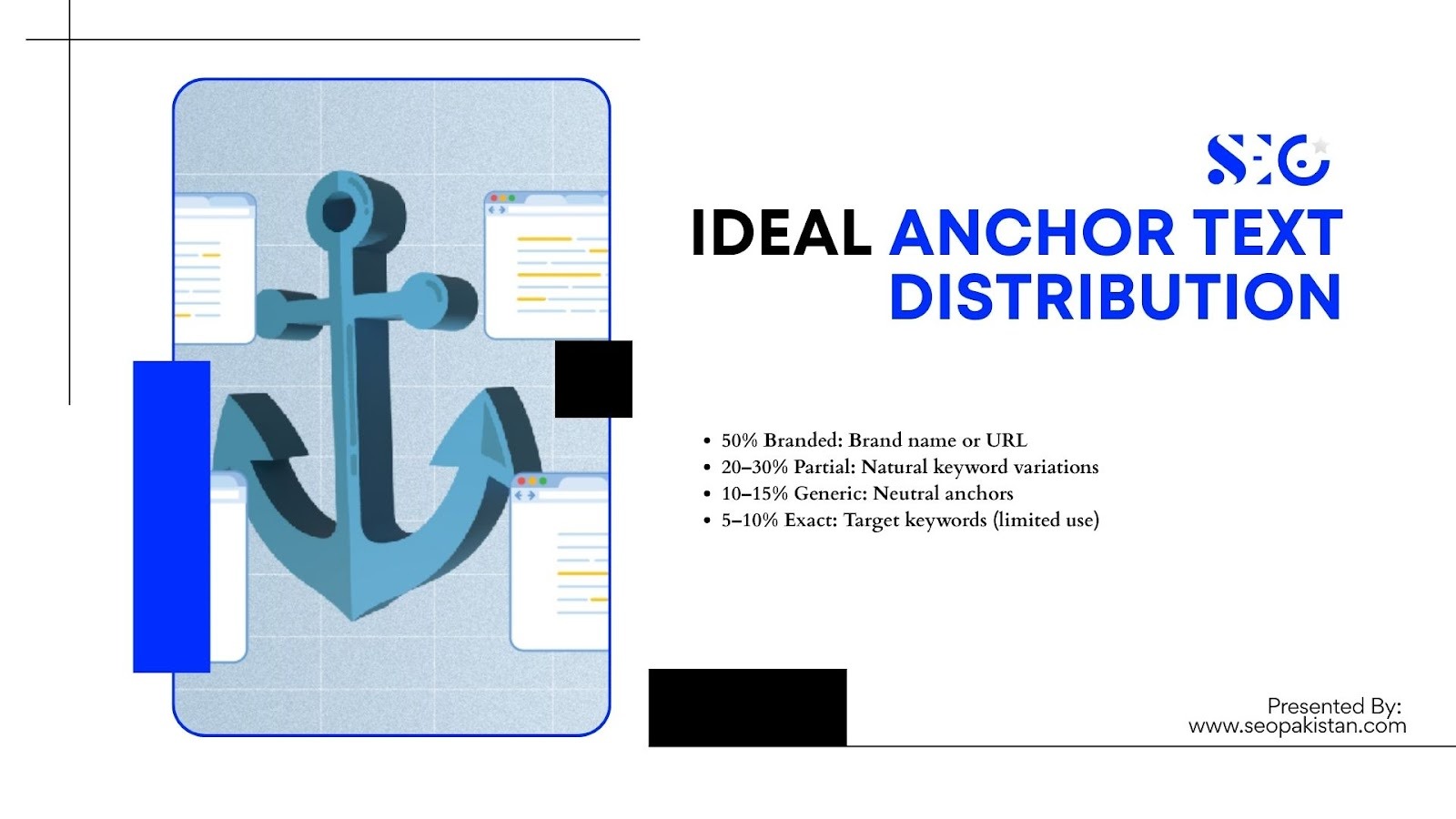
A conservative distribution model for guest posts looks like this:
- 50% Branded: Your brand name or URL variations
- 20–30% Partial match: Keyword variations woven into natural phrases
- 10–15% Generic: Neutral anchors like “learn more” or “this resource”
- 5–10% Exact match: Precise target keywords, used selectively
Guest posts require more conservative ratios than other link types because they are outreach-based and editorially controlled. Search engines know that guest posts often involve negotiated link placement.
A suspiciously high volume of exact match anchors across guest post backlinks triggers algorithmic scrutiny faster than it would with organic editorial mentions. Keeping your anchor distribution varied protects long-term ranking stability.
How to Place Anchor Text Naturally in Guest Articles
Placement determines whether an anchor reads as organic content or promotional insertion. Contextual backlinks in guest posts earn their value from the surrounding text, not just the anchor phrase itself.
Here is a straightforward comparison:
Weak placement: “If you want to grow your business online, you need the Best SEO Services to help you succeed.”
Strong placement: “Businesses that invest in a structured SEO strategy tend to see compounding returns over 6 to 12 months—particularly when they focus on technical foundations alongside content.”
The second example uses a descriptive anchor that flows naturally from the sentence’s logic. The reader gains value before and after the link.
How do you make sure every anchor you use strengthens the article rather than weakening it? Apply these principles:
- Integrate anchors into paragraphs where the linked topic adds genuine value to the reader
- Avoid inserting multiple keyword anchors into the same paragraph or section
- Use an educational tone that positions the link as a resource, not a promotion
Common Guest Post Anchor Mistakes to Avoid
Anchor text mistakes in guest posts can be disastrous, even for seasoned link builders. Getting this wrong doesn’t just look sloppy—it can trigger severe penalties from search engines and potentially tank your rankings overnight. Here are the most damaging errors you must avoid at all costs:
- Over-optimized exact match anchors are the most cited cause of manual penalties related to guest posting. Using your target keyword verbatim, repeatedly, across multiple posts points directly to manipulation.
- Repeating the same anchor across multiple domains creates an unnatural footprint. If 15 different guest posts all link to your page with the same anchor phrase, the pattern looks engineered rather than earned.
- Irrelevant linking occurs when the anchor and the linked page have no topical connection to the host article. This confuses search engines and frustrates editors.
- Over-linking in one article draws immediate editorial pushback. Most publishers accept one to two links per guest post. Inserting three or more, especially with keyword-rich anchors, signals promotional intent.
- Ignoring editorial context means placing a link where no genuine informational need exists. Every link in a guest article should serve the reader’s understanding, not just your backlink profile.
Build Authority the Right Way
Anchor text is not an afterthought in guest post link building—it is a strategic lever that shapes how search engines interpret, value, and act on every link you earn.
Applying anchor text best practices consistently means selecting anchors that serve the reader first, the algorithm second. It means distributing anchor types thoughtfully across your entire campaign, not just within individual articles. And it means treating every guest post as one piece of a greater, long-term authority-building effort.
The sites that rank sustainably are not the ones that optimize hardest in the short term. They are the ones that build contextual backlinks in guest posts through genuine editorial value, varied anchor profiles, and patient, methodical execution.
Audit your anchor distribution, plan guest posts with a deliberate anchor strategy, and follow these best practices for a trustworthy, algorithm-proof backlink profile. Ready to build a backlink profile that dominates the SERPs? Contact seopakistan.com today to start building your authority.
Frequently Asked Questions
How many anchor links should a guest post include?
Most publishers accept one to two links per guest post. In most cases, one contextual link to a relevant page is sufficient. Exceeding this often results in editorial rejection or link removal.
Is an exact match anchor safe in guest blogging?
Exact match anchors are safe when used infrequently and contextually. Limit exact match usage to no more than 5 to 10 percent of your total anchor distribution across guest posts. Concentration in a short timeframe increases penalty risk significantly.
What anchor text works best for guest posts?
Branded and partial match anchors perform best in guest posting contexts. They satisfy editorial standards, read naturally to audiences, and contribute to a healthy, varied backlink profile.
Can guest post anchors cause Google penalties?
Yes. Patterns of over-optimized, exact-match anchors across multiple guest posts can trigger Google’s link spam algorithms. Manual penalties are also possible if a site’s link profile appears manipulative upon human review.