

Hashtags for digital marketing work best when they help social media platforms categorize content, connect posts with the right audience, and support search visibility. In 2026, an effective hashtag strategy focuses on using specific, relevant hashtags rather than too many or generic trending ones.
Brands should combine niche, branded, and targeted hashtags based on platform, content type, and user intent. The right hashtags make social content more discoverable, improve hashtag performance, and increase engagement by placing posts into relevant conversations across Instagram, TikTok, LinkedIn, X, and other social platforms.
Table of Contents
- Introduction
- How Did Hashtags Evolve From Chat Rooms to Enterprise SEO Signals?
- What Are the Universal Hashtag Optimization Principles Every Brand Should Apply?
- The Multi-Tiered Selection Framework
- Branded Hashtags Create a Permanent Index
- The CamelCase Accessibility Mandate
- Algorithmic Negative Signals to Eliminate
- Platform Deployment & Optimization Matrix (2026–2027)
- Instagram Hashtags: The Post-30-Tag Era
- TikTok Hashtags: Spoken Words Are Search Signals
- What Are the Most Effective Digital Marketing Hashtags to Use in 2026?
- Category 1: Strategic Industry Pillars
- Category 2: Execution and Channel Performance
- Category 3: Creative Distribution and Authority
- Category 4: Dynamic Trend Tags
- How Do You Research High-Value Hashtags Using In-Platform and Third-Party Tools?
- In-Platform Search Intent Sourcing
- Competitive Intelligence Audits
- Social Listening and Analytics Integration
- How Should Teams Manage Hashtag Testing, Rotation, and Governance?
- The Asset Ledger Architecture
- Risk Management SOPs
- Why Is Strategic Content Quality the Real Optimization Factor?
- Conclusion
- Frequently Asked Questions (FAQs)
How Did Hashtags Evolve From Chat Rooms to Enterprise SEO Signals?
The hashtag symbol, also known as the pound sign (#), was not originally created for marketing purposes. In 2007, developer Chris Messina proposed using it on Twitter to sort group conversations, a method borrowed directly from IRC chat room taxonomy. Twitter adopted it. Instagram followed in 2010. The rest of the social network followed.
For over a decade, the prevailing strategy was simple: more hashtags equals more reach. Instagram allowed 30 hashtags per post. Marketers used all 30, every time, on every post.
That era is over.
Instagram formalized a 5-hashtag maximum in 2026, after years of internal data showing that fewer, specific, and relevant hashtags consistently outperformed high-volume sets. LinkedIn removed the hashtag-follow function entirely.
TikTok’s algorithm now transcribes audio and reads on-screen text, making caption keywords and spoken content more powerful discovery signals than hashtags alone.
Hashtags work as semantic coordinates today. They categorize content and tell the algorithm what category your posts belong to. They do not manufacture reach on their own. That distinction changes everything about how brands should approach finding hashtags and tag selection.
What Are the Universal Hashtag Optimization Principles Every Brand Should Apply?
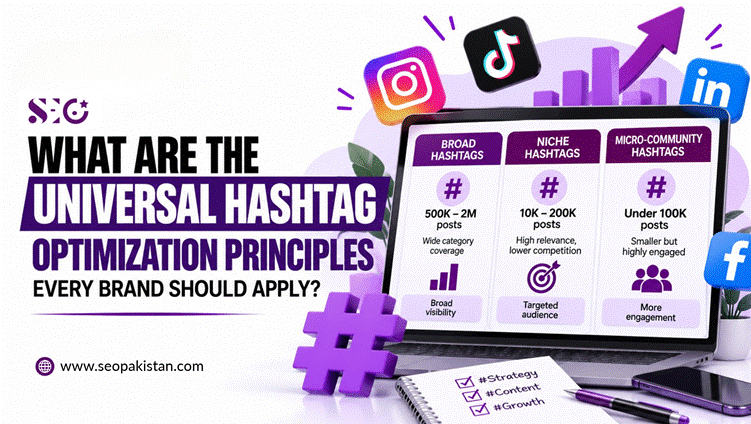
Before touching platform-specific tactics, establish the foundational principles that govern hashtag performance across every network.
The Multi-Tiered Selection Framework
Build every hashtag set using three tiers:
- Broad tags (500K to 2M posts). Wide category coverage. You won’t rank in top results, but you’ll appear in interest-graph matching for that category. These are your popular hashtags, useful for broad visibility but rarely where conversions happen.
- Niche hashtags (10K to 200K posts). High relevance, lower competition. These are the targeted hashtags where new content can actually surface and rank with the right targeted audience.
- Micro-community tags (under 100K posts). Smaller but deeply engaged audiences. These drive the saves, shares, and comments that tell the algorithm your content has value, and that your hashtags resonate with people interested in your topic.
Branded Hashtags Create a Permanent Index
Every brand should own at least one proprietary hashtag. Branded hashtags aggregate user-generated content, build community around a product or campaign, and give the algorithm a consistent signal that your brand is a coherent entity, building real brand recognition rather than a random account posting disconnected content.
When you create branded hashtags, you’re essentially building a searchable brand archive. Nike’s #JustDoIt is the textbook example. The hashtag functions as a brand archive, a UGC engine, and a sentiment tracker simultaneously, so a more targeted audience finds exactly what the brand stands for.
The CamelCase Accessibility Mandate
Write every multi-word hashtag in CamelCase. Use #ContentMarketingHashtags, not #contentmarketinghashtags. CamelCase makes tags readable for screen readers used by visually impaired audiences. It also improves readability in dense captions. Accessibility is no longer optional — it is a baseline professional standard.
Algorithmic Negative Signals to Eliminate
Certain behaviors consistently trigger spam filters across social platforms and create a negative user experience:
- Reusing identical hashtag sets on every post
- Using broad, unrelated popular hashtags on highly specific niche content, such as adding #love to a B2B SaaS post, weakens relevance and can confuse both the platform and the audience.
- Exceeding platform-recommended tag counts — too many hashtags is actively penalized
- Using tags that have been flagged, restricted, or shadowbanned
Run regular audits of your active hashtag library. Remove any tag that shows inconsistent reach performance. The algorithm treats sloppy tagging as a low-quality signal, and low-quality signals compound negatively over time.
Platform Deployment & Optimization Matrix (2026–2027)
Use this matrix as a standing reference for every content team. Review and update it quarterly as platform guidelines evolve across different social media platforms.
| Platform | Target Tag Count | Primary Algorithmic Signal | Native Placement Protocol | Critical Error to Avoid |
| Instagram Reels/Feed | 3–5 | Saves, Shares, Watch-Time | Woven at base of caption or in first comment | Exceeding 5 tags; using banned or mismatched tags |
| TikTok | 3–5 | Audio Transcript + Text Overlay Alignment | Embedded naturally in captions | Using identical tag sets on consecutive posts |
| 1–3 | B2B Category Indexing, Keyword Relevance | Formatted below main copy, end of post | Using 10+ generic tags; relying on hashtags as primary reach levers | |
| X (formerly Twitter) | 1–2 | Real-Time News Cycle Alignment | Placed naturally within post text | Forcing unrelated trending tags onto off-topic content |
| Threads & Bluesky | 1 | Inline Contextual Relevance | Single tag embedded inline within the sentence | Using multiple tags; these platforms penalize over-tagging |
| YouTube Shorts | 2–3 | Contextual Verification, Title-Caption Match | Added to description or title footer | Adding tags that contradict the video’s spoken or visual content |
Instagram Hashtags: The Post-30-Tag Era
Instagram’s post-30-tag era looks different in a few key ways:
- Instagram’s enforced 5-hashtag cap reflects a platform that no longer relies on user-supplied tags to classify content
- Instagram’s AI ranking system analyzes computer vision signals, audio, natural language in captions, and engagement patterns to determine content relevance
- According to analysis from social media analytics platforms cited by Digital Applied, posts using 3-5 relevant hashtags outperform posts with 20-30 hashtags by 30-40% on reach metrics
- Prioritize Reels. Platform benchmarks consistently show that Reels generate three times the reach of equivalent static posts
- The first two seconds of every Reel determine whether most users continue watching, and watch-through rate is the primary quality signal Instagram uses to determine algorithmic amplification, core to any real Instagram marketing effort in 2026, not just hashtag choice alone
- Caption keywords have become the new hashtag SEO. Instagram’s in-app search bar function, which more than 500 million social media users access monthly, returns search results based on caption text keywords
- Place your primary keyword in the first 125 characters of your caption, before the “more” truncation
TikTok Hashtags: Spoken Words Are Search Signals
TikTok’s algorithm transcribes audio. Keywords spoken naturally in a video contribute to content classification alongside hashtags and on-screen text.
A TikTok post that uses #ContentMarketingHashtags and reinforces the same phrase in both on-screen text and spoken audio gives the platform clearer context, helping it categorize the content more precisely and show it to a broader, more relevant audience than a post that depends only on hashtags.
Use a balanced mix:
- High-volume tags (100K+ uses) for broader category reach
- Medium-volume tags (5K–100K uses) for targeted community visibility
- Branded tags for UGC tracking and brand archive building
What Are the Most Effective Digital Marketing Hashtags to Use in 2026?
Choosing hashtags strategically means organizing your inventory into four operational categories. How hashtags work across each tier determines your overall social media strategy.
Category 1: Strategic Industry Pillars
These broad-to-mid-tier hashtags for digital marketing anchor social content within established industry conversations:
- #ContentMarketing
- #DigitalMarketingTips
- #OnlineMarketing
- #MarketingStrategy
- #SocialMediaMarketing
Category 2: Execution and Channel Performance
These relevant hashtags target practitioners actively searching for implementation guidance:
- #HashtagOptimization
- #SocialMediaSEO
- #ConversionRateOptimization
- #SEOTips
- #EmailMarketing
Category 3: Creative Distribution and Authority
These hashtags for digital marketing position brands as credible voices in social media marketing disciplines:
- #BrandingHashtags
- #B2BLeadGeneration
- #ThoughtLeadership
- #ContentDistribution
- #GrowthMarketing
Category 4: Dynamic Trend Tags
Trending hashtags offer short-term visibility spikes. Use them selectively and only when the trending topic aligns authentically with your content.
Forcing a trending tag onto unrelated content sends a negative signal to both the algorithm and your target audience. Treat trend tags as tactical additions — never the foundation of a hashtag strategy.
How Do You Research High-Value Hashtags Using In-Platform and Third-Party Tools?
Effective hashtag use and research do not begin with a Google search. It begins inside the platforms themselves.
In-Platform Search Intent Sourcing
Type any topic keyword into the search bar of Instagram, TikTok, LinkedIn, or YouTube. Note the autocomplete suggestions. These suggestions are derived from actual search volume on the platform — they represent what real users are actively looking for.
This gives you keyword data more accurate and current than most third-party estimates. It is one of the most reliable methods for finding hashtags that actually perform.
Competitive Intelligence Audits
Identify three to five market leaders in your category. Analyze their last 30 posts. Document:
- Which hashtags appear consistently
- Which posts generated the highest engagement relative to follower count
- Which tags appear on their top-performing content versus their average-performing content
This reverse-engineering process reveals which hashtags carry real signal value in your specific niche, and which ones your competing brands are wasting space on.
Social Listening and Analytics Integration
Tools like Keyhole and BuzzSumo allow brands to monitor hashtag performance at scale. Set alerts for branded hashtags to track sentiment and UGC. Monitor competitor hashtags to identify emerging content opportunities.
Target the 10K–500K engagement sweet spot: tags large enough to generate discovery traffic, small enough that new content on a single post has a realistic chance of surfacing in search results.
How Should Teams Manage Hashtag Testing, Rotation, and Governance?
Sustainable hashtag performance requires operational infrastructure — not just a list of tags.
The Asset Ledger Architecture
Build a master hashtag ledger organized into three to four content pillar rotation models. Each content pillar, for example, thought leadership, product education, company culture, and industry news, gets its own dedicated hashtag set.
Rotate sets across posts within each pillar. Never use identical tag combinations on consecutive posts. This prevents algorithmic spam signals and expands your discovery surface area over time. Keeping hashtags short, specific, and pillar-aligned is the key discipline here.
Risk Management SOPs
Every content team needs a standing process for hashtag risk management:
- Run monthly audits of all active hashtags to identify restricted or shadowbanned tags
- Remove any tag that shows sudden, unexplained drops in reach performance
- Never use trending tags from unrelated categories, political movements, or sensitive topics to capture unrelated traffic — social platforms detect and penalize this behavior.
- Document all tag removals and the reason for removal in the master ledger
Why Is Strategic Content Quality the Real Optimization Factor?
Every tactical framework in this guide rests on one non-negotiable foundation: content that earns genuine engagement.
Hashtags do not manufacture reach. They do not make mediocre content perform well. They categorize posts and function as metadata labels that help algorithm systems route strong social content to interested audiences faster.
The accounts that consistently outperform their competitors in 2026 are not using smarter hashtag lists. They are producing Reels with strong first-frame hooks. They are writing LinkedIn posts with clear, keyword-rich opening sentences. They are creating TikTok content that earns saves and shares because the information genuinely helps someone.
Hashtags accelerate that distribution. They do not replace it.
Your Next Steps
The path forward is straightforward:
- Audit every active social media caption format your team currently uses
- Strip all hashtag sets that exceed platform-recommended counts. Too many hashtags actively suppress reach
- Build a master hashtag ledger organized by content pillar
- Establish a quarterly review cycle for every tag in your library
- Redirect the time you spent stuffing 25 hashtags per post toward improving the first three seconds of every Reel and the first two lines of every LinkedIn post
The brands winning on social media in 2026 are treating hashtags the way expert taxonomists treat index terms, with precision, discipline, and a clear understanding that the label only works when the content behind it delivers real value.
Conclusion
In 2026, winning with hashtags for digital marketing is no longer about adding more tags to every post. It’s about using the right hashtags with purpose. When brands choose specific, relevant, and platform-aware hashtags, they improve content discoverability, strengthen social SEO, and reach the customers most likely to engage.
A smart hashtag strategy also supports brand recognition, cleaner categorization, and better long-term performance across Instagram, TikTok, LinkedIn, X, and other social media platforms, whether a brand is chasing national reach or focused local marketing in one city. The most effective approach combines quality content with precise metadata signals.
Start refining your hashtag strategy today with seo pakistan and turn every post into a stronger opportunity for reach, relevance, and conversion.
Frequently Asked Questions
Are hashtags still relevant for digital marketing in 2026?
Yes, but their function has changed. Hashtags now act as semantic metadata that helps AI-driven algorithms categorize and route content to people interested in that topic. They no longer generate reach independently. Brands using 3-5 precisely chosen, relevant hashtags consistently outperform those using 20-30 generic ones.
How many hashtags should a brand use on Instagram in 2026?
Instagram has formalized a 5-hashtag maximum in 2026. Posts exceeding this limit receive suppressed distribution. Platform data and third-party analytics show that 3–5 highly relevant hashtags outperform 20–30 hashtag sets by 30–40% on reach metrics. Too many hashtags is no longer a volume game — it is a precision game.
What is the best hashtag strategy for LinkedIn B2B marketing?
Use 1–3 hashtags placed at the end of your post. LinkedIn removed the hashtag-follow function, so hashtags now serve primarily as indexing signals, not reach drivers. The primary performance factors on LinkedIn in 2026 are your opening hook, keyword placement in the post body, and genuine engagement in the comments section.
What is the recommended hashtag count for TikTok in 2026?
Use 3–5 TikTok hashtags per video. Combine high-volume tags (100K+ posts) for broad category reach with medium-volume tags (5K–100K posts) for targeted community visibility. Align hashtag themes with your spoken keywords and text overlays — TikTok’s algorithm transcribes audio and reads on-screen text as additional classification signals.
How do branded hashtags support a long-term digital marketing strategy?
Branded hashtags build a searchable content archive that aggregates user-generated content, tracks brand sentiment, and signals to social platforms that your brand is a coherent, consistent entity. Brands should maintain one hashtag as a permanent identity tag and create branded hashtags separately for time-limited promotions or product launches on Facebook posts, Instagram, and other platforms.
What tools should social media managers use for hashtag research?
Start with in-platform search bar autocomplete the suggestions reflect actual user search volume. For competitive intelligence, analyze the hashtag patterns of three to five market leaders in your niche. For scaled monitoring and sentiment tracking, tools like Keyhole and BuzzSumo provide real-time hashtag performance data and allow brands to target the 10K–500K engagement sweet spot where discovery is viable.
What causes a hashtag to trigger a spam filter?
Four behaviors consistently trigger spam signals: using hashtags identically on consecutive posts, mixing irrelevant popular hashtags with niche content, exceeding platform-recommended tag counts, and using hashtags that have been restricted or shadowbanned. Monthly audits of your hashtag library, with documented removal of underperforming or flagged tags, protect your account’s distribution health across all social media platforms.