

AI Overviews now sit above the traditional organic results for many informational searches. If your page is not one of the cited sources, a competitor gets the first mention, even when you rank on page one. Google AIO ranking is about earning those citations and proving it with data. This guide explains how Google AI Overviews choose sources, what Google officially says, and gives you a practical monitoring workflow with a ready reporting template.
What Is Google AIO Ranking?
Google AIO ranking describes how visible and how often cited a website is inside Google AI Overviews. It is not a separate ranking system with its own position numbers.
AI Overviews are AI-generated summaries that appear at the top of Google’s search results. They started as the Search Generative Experience (SGE) in Search Labs and now use Google’s Gemini models.
Each AI Overview answers the user query in a summary and shows website links as supporting sources. When your page is one of those links, your brand appears inside the answer.
AI Mode is a related but separate feature. Google says AI Mode and AI Overviews may use different models and techniques, so the same query can show different responses and links in each.
How Google Builds an AI Overview
- Query fan-out: Google says its AI features may run several related searches across subtopics to build one response.
- Supporting links: while the answer is generated, Google identifies supporting web pages and shows a wider and more diverse set of links than a classic web search.
- Selective triggering: AI Overviews only appear when Google’s systems decide they add value beyond classic results, so many queries do not trigger one.
You can read the full explanation in Google’s documentation on AI features and your website.
What Recent AI Overview Studies Show
Third-party studies give useful benchmarks. Each uses its own sample and method, so treat the numbers as directional rather than fixed rules.
Surfer’s study of 405,576 AI Overviews found:
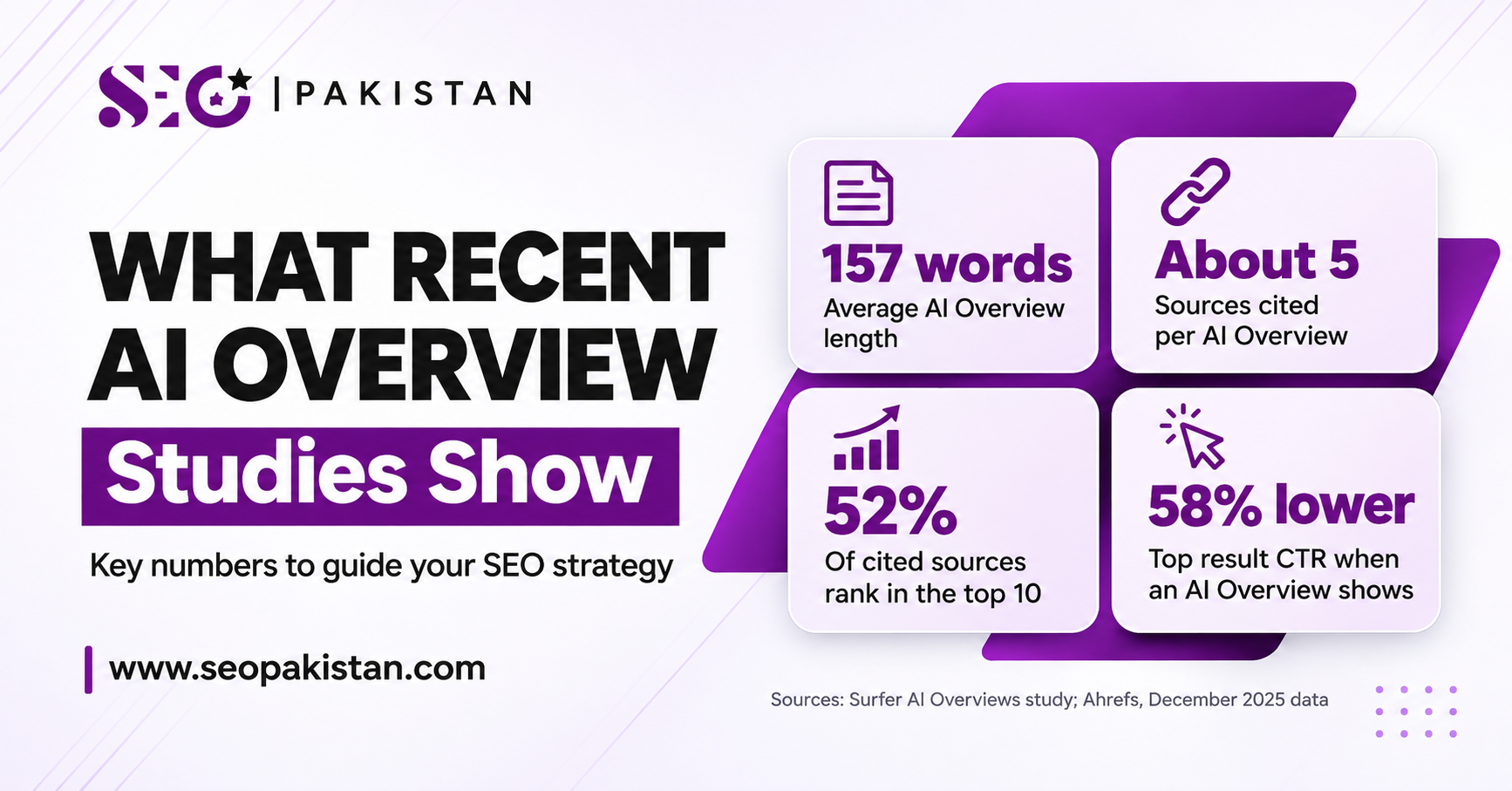
- AI Overviews average 157 words and cite about 5 sources per query.
- 52% of AI Overview sources also rank in the top 10 organic results, so the rest come from lower positions.
- 61% of AI Overviews contain an unordered list, and 78% contain at least one list type.
An Ahrefs update published on February 4, 2026 analyzed 300,000 keywords using December 2025 data. It found that the presence of an AI Overview correlated with a 58% lower average click-through rate for the top-ranking page.
Studies do not agree on exactly how many AI Overview sources rank in the top 10. Overlap figures vary with sample, date and method, which is why your own tracking matters more than any single statistic.
What These Numbers Mean for Your SEO Strategy
- Ranking in the top 10 helps, but it does not guarantee a citation.
- Pages outside the top positions can still be cited when they answer a specific part of the query well.
- Short, list-friendly answers match how AI Overviews tend to present information.
- Clicks may fall on AI Overview queries even when keyword rankings stay the same, so track citations and traffic data together.
Why AI Overview Visibility Matters
Brand Visibility Without a Click
Users interact with the AI summary before they reach the traditional SERPs. A citation puts your brand name and link in front of them at that first step.
That exposure has value even on searches where the user does not click any result.
Better-Qualified Visits
Google states that clicks from search results pages with AI Overviews tend to be higher quality, with users more likely to spend more time on the site.
Check this against your own analytics. Compare engagement from AI Overview queries with your usual organic traffic before concluding.
More Room for Different Sites
Because AI Overviews show a wider set of links, smaller and specialist sites have a chance to be cited next to large publishers.
A clear, focused answer on a narrow question can earn a citation that a broad page misses.
What Google Says About Appearing in AI Overviews
Google states there are no additional requirements to appear in AI Overviews or AI Mode, and no special optimizations are needed. The same SEO fundamentals apply.
| Area | What Google Says | What to Check |
| Eligibility | A page must be indexed and eligible to show with a snippet | URL Inspection in Google Search Console; no noindex or nosnippet on key pages |
| Crawling | Crawling must be allowed in robots.txt and by your CDN or host | robots.txt rules and server logs for Googlebot access |
| Content | Create helpful, reliable, people-first content | Clear answers, original information, and named authors |
| Structured data | No special schema is required; structured data should match visible text | Rich Results Test and markup that mirrors the page |
| Guarantee | Meeting every requirement does not guarantee crawling, indexing, or serving | Track citations instead of assuming them |
Google also lists practical best practices: internal links that make content easy to find, a good page experience, important content in text form, and supporting images and videos. For more detail, see Google’s guide on optimizing for generative AI search.
How to Improve Your Chances of AI Overview Citations

No tactic guarantees a citation. These steps make your pages easier for Google’s AI to understand and quote.
Answer the Exact Query Early
- Open each section with direct answers in one or two sentences.
- Provide concise definitions for key terms near the top of the page.
- Use the wording people actually search, found through keyword research and People Also Ask, and do this naturally near the top so the page can align with both AI Overviews and featured snippets.
Surfer’s study found that AI Overviews rarely repeat the exact query word for word, so clear, direct answers matter more than keyword frequency.
Use a Clear Content Structure
- Write descriptive headings that state what each section answers.
- Use bullet points for steps, features, and comparisons, since content appears in short paragraphs or lists in AI Overviews and clear structure makes extraction easier.
- Add tables where readers compare options or numbers.
- Keep paragraphs short so key information is easy to find, and use clear headings to support AI-generated responses.
Cover the Topic Completely
Because of query fan-out, one search can lead Google to look at several subtopics. Pages that answer the main question and its follow-up questions give the AI more to work with.
Build topic clusters around your core services instead of publishing unrelated posts. Our semantic SEO guide explains how entities and related topics support this kind of semantic completeness.
Add Original Data and Clear Sources
- Share your own data, examples, screenshots, or test results.
- Link to the original source for every statistic.
- Show author names and relevant experience to support E-E-A-T (experience, expertise, authoritativeness, and trustworthiness).
Content that repeats what every other page says gives Google little reason to cite it.
Keep Technical SEO Healthy
- Allow Googlebot to crawl important pages and fix indexing errors in Google Search Console, because clear technical accessibility helps search engines and AI systems crawl and interpret pages.
- Use structured data and schema markup only where it fits, and keep it identical to visible content so natural language processing and other machine interpretation signals stay consistent.
- Use nosnippet, data-nosnippet, or max-snippet only on content you do not want shown in Search, since these controls also limit AI features.
A regular technical SEO audit helps catch these problems early.
Earn Brand Mentions on Reputable Sites
- Publish useful data or expert commentary that industry sites want to reference.
- Keep company details consistent across profiles and directories.
- Encourage genuine reviews and user-generated content that describe real experiences with your brand.
Support Text With Images and Video
Google recommends supporting text with high-quality images and videos where they help. Use descriptive alt text and keep the main answer in text form.
How to Monitor Google AIO Ranking: A Practical Workflow
Most rank trackers report keyword rankings, not AI citations. Use this six-step workflow to measure AI Overview visibility in a repeatable way.
Step 1: Build a Fixed Query List
- Pick 20 to 50 queries tied to your services and best content.
- Include questions, comparisons, and “how to” searches, since informational queries trigger AI Overviews most often.
- Pull ideas from Search Console queries, People Also Ask, and competitor research.
Keep the list fixed for at least three months so results are comparable over time. Also account for search behaviour, since very niche queries with limited search activity may give Google too little evidence to determine intent and trigger stable AI Overviews.
Step 2: Check the Same Query the Same Way
- Use a private or incognito window while signed out.
- Record the device and location, because AI responses vary by both.
- Check on a set schedule, and track AI Overview results over time because they can change quickly for the same query.
- Save a screenshot of each AI Overview with the date visible.
That record becomes your historical data, which makes trend analysis easier when you compare repeated checks and dated screenshots.
Step 3: Record Who Gets Cited
- Note whether an AI Overview or AI answers appeared at all.
- List every cited domain and the exact URL where possible for any AI-generated answers.
- Mark whether your brand appears in the text, in the links, or both.
- Note your organic pages’ ranking position for the same query.
Step 4: Compare With Search Console and GA4
Google includes clicks and impressions from AI Overviews and AI Mode in the Performance report of Google Search Console, under the Web search type. There is no separate AI Overview filter.
Compare impressions, clicks, and CTR for your tracked queries before and after citations change. Review those shifts alongside organic search performance instead of treating them as separate channels. In GA4, check engagement and conversions on the cited landing pages.
Step 5: Scale With Tracking Tools
Manual checks work for a short list. For hundreds of queries, SEO platforms such as Ahrefs and SE Ranking help measure AI search visibility with AI Overview filters and tracking, with AI visibility as the broader reporting goal across tracked queries. Our overview of AI tools for SEO covers more options.
Spot-check tool data against manual results, since tools sample from fixed locations.
Step 6: Review Monthly and Act
Refine your content strategy based on the monthly review:
- Queries with an AI Overview but no citation for you: improve the key factors behind the answer, structure, or sources on the target page.
- Queries where you lost a citation: compare your page with the newly cited source and review the ranking factors it may be satisfying more clearly.
- Queries where you are cited but clicks fell: improve titles and add reasons to click, such as tools, templates, or examples, since AI summaries can keep the citation while reducing visits.
AI Overview Reporting Template
Copy this structure into a spreadsheet. One row per user query check keeps the history clean.
| Column | What to Record |
| Check date | Day, month, and year of the check |
| Query | The exact query from your fixed list |
| Device and location | Desktop or mobile, and city or country |
| AI Overview shown | Yes or no |
| Brand cited | Yes or no, and whether in text, links, or both |
| Cited URL | Your page that was cited, if any |
| Competitors cited | Other domains in the AI Overview |
| Organic position | Your ranking position for the same query |
| Clicks and impressions | Search Console data for the query in that month |
| Screenshot link | Link to the saved screenshot |
| Action | The change you will make, with an owner and due date |
At the end of each month, add a summary:
- Share of tracked queries that showed an AI Overview
- Share of those AI Overviews that cited your brand
- Citations gained and lost since last month
- Top competitors by number of citations
- Changes in clicks and CTR for cited pages
Common Mistakes in AI Overview Tracking
- Changing the query list every month, which breaks comparisons.
- Checking while signed in, so personal history affects results.
- Relying on one screenshot instead of repeated checks.
- Assuming special schema or AI files will earn citations.
- Judging success on keyword rankings alone.
How AIO Fits With GEO and Traditional SEO
Google AIO ranking is one part of a wider approach called generative engine optimization, which also covers tools such as ChatGPT and Perplexity. To see what that approach can and cannot deliver, read our guide on the benefits of GEO.
Traditional SEO still does most of the work. Crawlable pages, strong content, and earned links are what make a page eligible for AI citations in the first place. Our comparison of SEO vs GEO explains how the two fit together.
Conclusion
Google AIO ranking rewards pages that answer questions clearly, cover the topic completely, and give Google a reason to cite them. Google confirms there are no special requirements or markup, so the work comes down to solid SEO fundamentals.
The difference now is measurement. Track a fixed query list, record citations with dates, and compare them with Search Console and GA4 data every month.
If you want help improving AI Overview visibility for your key pages, talk to the SEO Pakistan team.
Frequently Asked Questions
What is Google AIO?
Google AIO (AI Overview) is a Google Search feature that shows an AI-generated summary at the top of results for some queries, with links to supporting sources.
How do I get featured in Google AI Overviews?
Make sure the page is indexed and eligible for a snippet, answer the question directly, use a clear structure and support claims with original information. Google says no special optimization is required, and no method guarantees inclusion.
Do I need schema markup for AI Overviews?
No. Google says there is no special schema.org structured data needed to appear in AI Overviews. Use standard markup only where it matches the visible page.
Can I track AI Overview clicks in Google Search Console?
Yes, but not separately. AI Overview clicks and impressions are included in the Performance report under the Web search type, combined with other search results.
Do AI Overviews reduce clicks?
Studies suggest they can. An Ahrefs study using December 2025 data found a 58% lower average click-through rate for top-ranking pages when an AI Overview was present.
Does Google rank AI-generated content?
Google focuses on whether content is helpful and reliable, not on how it was produced. Low-value content made mainly to manipulate rankings can violate Google’s spam policies.