

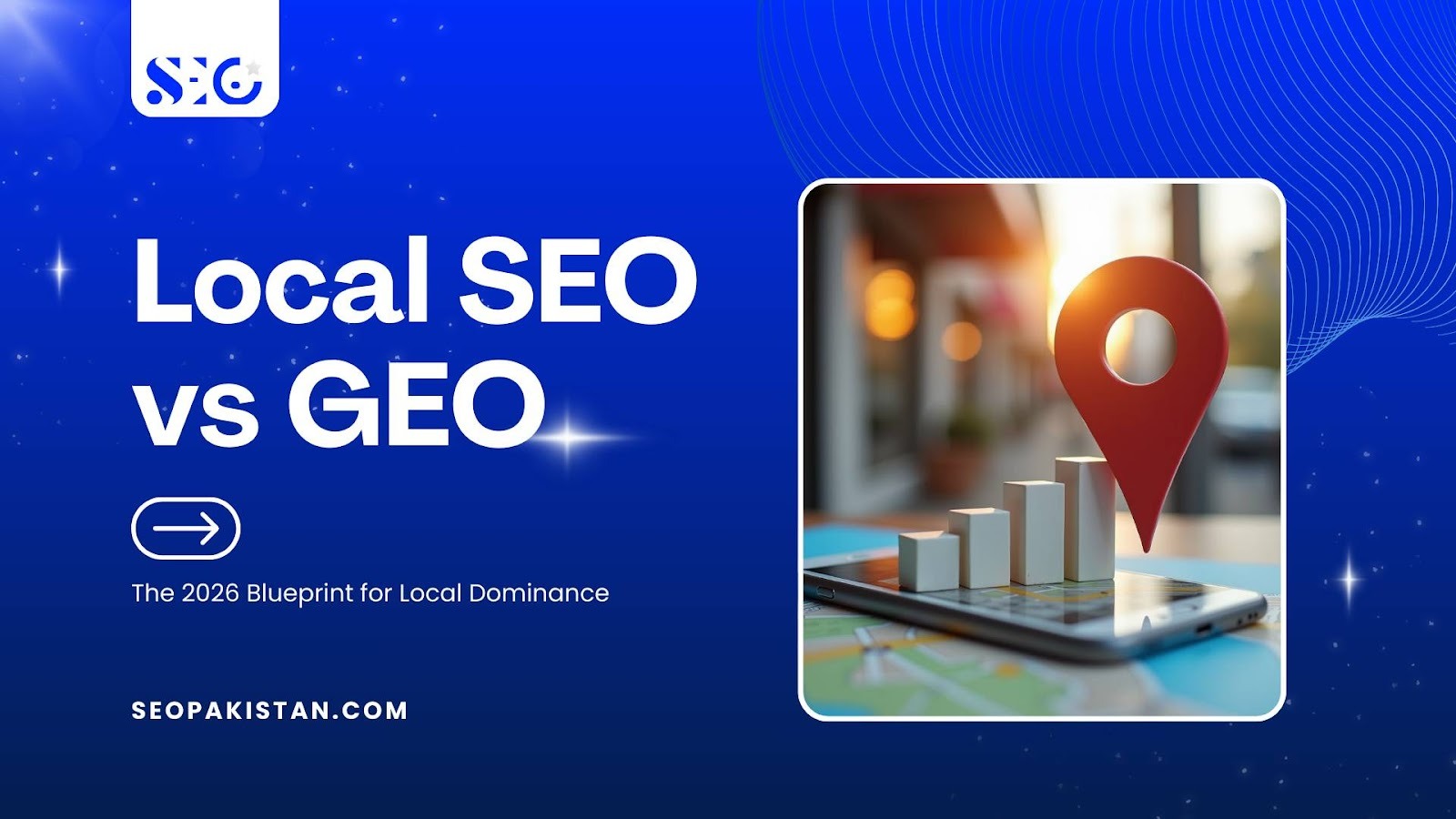
The main difference in local SEO vs GEO lies in how you reach your customers. Traditional local SEO optimizes your digital presence to rank in the Google Maps 3-Pack and drive direct website clicks. In contrast, Generative Engine Optimization (GEO) structures your business data to secure direct recommendations from AI models like ChatGPT and Perplexity.
To dominate your market, you must actively blend both strategies. Secure accurate local directory listings to capture traditional map traffic, and implement advanced schema markup to become the trusted, definitive answer for modern AI-powered search engines.
At SEO Pakistan, we recognize a critical shift in digital marketing. The industry must move away from simple traffic generation toward building absolute citation authority. This guide will help you navigate local SEO vs GEO, ensuring your brand remains visible across both traditional search engines and AI-powered platforms.
The Comparison Matrix: Local SEO vs GEO
| Feature | Traditional Local SEO | GEO (Generative Engine Optimization) |
| Primary Goal | Clicks to website & Map directions | AI Citations & Recommendations |
| Target Platform | Google Maps / Local SERPs | AI Overviews / Chatbots / Perplexity |
| Key Signal | Proximity, NAP, & Backlinks | Semantic Relevance & Factual Density |
| User Action | Click → Visit → Convert | Read → Trust → Search Brand Directly |
| Success Metric | CTR & Organic Traffic | Share of Model (SoM) & Mention Frequency |
Understanding the key differences between traditional local SEO and GEO requires a clear look at how each system operates. Both SEO focuses have distinct goals, target platforms, and success metrics.
Traditional Local SEO
- Primary Goal: Drive clicks to a website and generate map directions.
- Target Platform: Google Maps and local SERPs.
- Key Signal: Geographic proximity, NAP (Name, Address, Phone) consistency, and local citations.
- User Action: The user clicks a blue link, visits the website, and then converts.
- Success Metric: Click-through rate (CTR) and organic traffic.
Generative Engine Optimization (GEO)
- Primary Goal: Secure AI citations, direct answers, and AI-generated responses.
- Target Platform: Google AI overviews, chatbots, and generative AI platforms.
- Key Signal: Semantic relevance, factual density, and contextual relevance.
- User Action: The user reads the AI summary, trusts the AI models, and then searches for the brand directly.
- Success Metric: Share of Model (SoM) and mention frequency.
The Evolution of Local Search (2024–2026)
Local search evolution has fundamentally altered how customers search for local businesses. You can no longer rely solely on basic geographic optimization methods.
Moving Beyond the Map
AI engines prioritize “Entity Authority” over simple geographic proximity. When potential customers search for the “best Italian restaurant, “AI-powered search engines do not just look at distance. They evaluate the entire web footprint of that Italian restaurant to determine its quality and relevance.
The Rise of Agentic Search
Users are shifting their search behavior. Instead of typing fragmented keywords, people use natural language queries. They use voice search and conversational language to ask AI tools to find “the best services near me.” This AI-driven search requires businesses to answer specific user intent rather than just matching keywords.
Advanced Geographic Integration
Modern search platforms require context. Effective geographic optimization goes beyond listing city names. You must include landmark-based descriptions and neighborhood-specific context. This helps AI systems understand exactly where your business operates and who it serves.
GEO: The Citation Game for Local Brands
Winning in AI search means optimizing content for machine extraction. You must feed AI platforms the accurate business information they need to recommend to you.
The Atomic Answer Strategy
You should structure your content in 50-word, self-contained fragments. AI agents can easily extract and quote these clear, concise blocks of text. This approach directly improves your answer engine optimization by providing direct answers to common questions.
Review Sentiment Analysis
Search engines no longer just count your five-star ratings. AI now reads the specific tone and context of your customer feedback. If reviews consistently mention “fast delivery” or “reliable experts,” the AI models will associate those exact traits with your brand.
Third-Party Validation
To build trust with other AI platforms, your business must appear across the web. You need mentions on local news sites, industry lists, and community forums. This external validation feeds the “Trust Layer” of AI search, proving that your business is reputable.
Technical Foundations: The Frictionless Layer
Technical page optimization remains a crucial component of local search. You must provide a frictionless experience for both users and crawlers.
Advanced Schema 2026
Implementing structured data is mandatory. You must use advanced Schema markup, including LocalBusiness, ServiceArea, and FAQ JSON-LD. This provides the clean, organized data that AI agents require to formulate accurate AI responses.
Interaction to Next Paint (INP)
Website responsiveness is now a direct trust signal. Slow websites frustrate users and confuse AI crawlers. You must ensure your site reacts instantly to user inputs to maintain your competitive advantage.
Mobile-First Geo-Targeting
You must optimize your digital assets for mobile users. In major cities, mobile connection speeds vary greatly. A lightweight, fast-loading site ensures that your business appears quickly, regardless of the user’s connection quality.
The Synergy Strategy: Optimizing for Both Worlds
You do not have to choose between traditional search and AI visibility. The most effective optimization tactics combine both strategies.
Conducting an Entity Audit
Your brand identity must remain consistent. You should audit your brand name, address, and service offerings across the entire internet. This consistency forms your AI identity, ensuring that generative engines do not get confused by conflicting information.
Intent-Based Content Clusters
Creating content that solves problems is essential. You should build comprehensive “City Guides” and localized FAQ hubs. High content quality that answers specific pain points will generate organic traffic and capture zero-click searches.
Maintaining the Freshness Signal
Stale content hurts your keyword rankings. You must regularly update your Google Business Profile and website. Current pricing, recent projects, and accurate availability schedules help maintain your relevance in AI summaries.
Measuring Success in the Zero-Click Era
Tracking success requires new metrics. Traditional referral traffic does not tell the whole story when dealing with AI-generated results.
- Share of Model (SoM): You must track what percentage of AI answers in your niche mention your specific brand.
- Sentiment Tracking: You should monitor how AI platforms describe your business to potential customers. Are they emphasizing your quality and reliability?
- The Halo Effect: Look for increases in branded search volume. Users often see your business recommended by an AI tool and then open traditional search engines to look you up by name.
Conclusion: Future-Proof Your Local Brand
The digital landscape will continue to evolve. Traditional local SEO puts your business on the map, but generative engine optimization makes your business the ultimate destination. Relying on outdated methods will leave you invisible to the next generation of search tools.
You must adapt your strategies to meet the demands of natural language queries, AI systems, and shifting search behavior. By integrating technical schema, building authoritative citations, and focusing on contextual relevance, you can secure your position at the top of both traditional SERPs and AI answers.
Is your business ready for the AI revolution? Do not wait for your visibility to drop. Book a 2026 Local SEO vs GEO Audit with SEO Pakistan today. Take the necessary steps to optimize your Google Business Profile, align your content, and dominate your market before your competitors catch up.
Frequently Asked Questions
What is the main difference between local SEO vs GEO?
The primary difference in local SEO vs GEO lies in the target platform. Traditional search engine optimization focuses on ranking websites and maps in standard search results. Generative engine optimization, however, works to ensure your brand gets cited directly by AI-powered search engines. You optimize for clicks with traditional methods, while GEO builds trust and exact mentions within AI models.
How does generative engine optimization help local businesses?
Generative engine optimization helps local businesses become the direct answer in AI overviews. Instead of making users scroll through multiple links, AI-powered search engines provide immediate recommendations based on factual density and semantic relevance. By adapting your strategy, your business builds essential entity authority. This ensures AI systems cite your services as the top choice when local customers ask conversational questions.
Can I stop doing traditional search engine optimization?
You should never abandon traditional search engine optimization entirely. While generative engine optimization is crucial for future-proofing your digital presence, standard local SEO still drives significant traffic through local maps and traditional browser searches. The most effective strategy combines both approaches. You must maintain consistent directory listings while also feeding advanced AI platforms the clean data they require.
How do AI-powered search engines evaluate local brands?
AI-powered search engines evaluate local brands by reading the context of your entire online presence. They look far beyond simple star ratings or basic geographic proximity. These advanced models analyze customer review sentiment, third-party mentions on community forums, and structured website data. To succeed, local businesses must provide highly accurate, consistent information across the web to build strong trust signals.
What is the best first step to balance local SEO vs GEO?
The best first step to balance your local SEO vs GEO strategy involves conducting a comprehensive entity audit. You must ensure your brand name, address, and service details remain identical across all digital platforms. Next, update your website with advanced schema markup. This technical foundation gives both standard web crawlers and modern AI tools the exact factual data they need to recommend to you confidently.