

Search algorithm updates are regular modifications made by search engines to improve how they rank and display websites in search results. These system changes target specific issues like content quality or spam to ensure users receive the most relevant and helpful information.
Major core updates occur several times a year and can significantly shift website traffic. Site owners navigate these adjustments by publishing original, high-quality text and maintaining fast page load speeds. Continuous optimization keeps domains aligned with current ranking criteria to sustain consistent online visibility.
This shift moves focus from basic retrieval to providing helpful and reliable results. The SEO Pakistan team views these recent core updates as a massive opportunity. High-quality brands can now leapfrog low-quality content farms easily. You must adapt your strategy to align with these new ranking systems.
Timeline of 2025 to 2026 Major Algorithm Updates
| Date | Update Name | Impact Level | Primary Target |
| March 27, 2026 | March 2026 Core Update | High (Active) | Quality Recalibration & Information Gain |
| March 24, 2026 | March 2026 Spam Update | Critical | Scaled Content Abuse (Fastest rollout in history) |
| Feb 5, 2026 | Discover Core Update | Medium | First-ever update exclusive to Google Discover |
| Dec 11, 2025 | December 2025 Core Update | High | Hardening E-E-A-T across all niches |
| Aug 26, 2025 | August 2025 Spam Update | Medium | Parasite SEO & Site Reputation Abuse |
Understanding the history of Google updates helps you identify patterns in ranking fluctuations. The search giant constantly refines its search index. Knowing when a specific Google update began rolling out provides context for your website traffic analysis.
- March 27, 2026 (March 2026 Core Update): This highly active update recalibrated quality signals and prioritized information gain.
- March 24, 2026 (March 2026 Spam Update): This critical release targeted scaled content abuse. It represents the fastest rollout in history.
- February 5, 2026 (Discover Core Update): Google makes its first-ever algorithm update exclusive to Google Discover feeds.
- December 11, 2025 (December Core Update): This update hardened E-E-A-T requirements across all niches and penalized unhelpful content.
- August 26, 2025 (August Core Update / Spam Update): This medium-impact release targeted parasite SEO and third-party content abuse.
The Three Pillars of the March 2026 Core Update
Google understands that users demand original research and insightful analysis. The search algorithm now aggressively filters out repetitive information. You must adapt to these three foundational pillars to secure top search results.
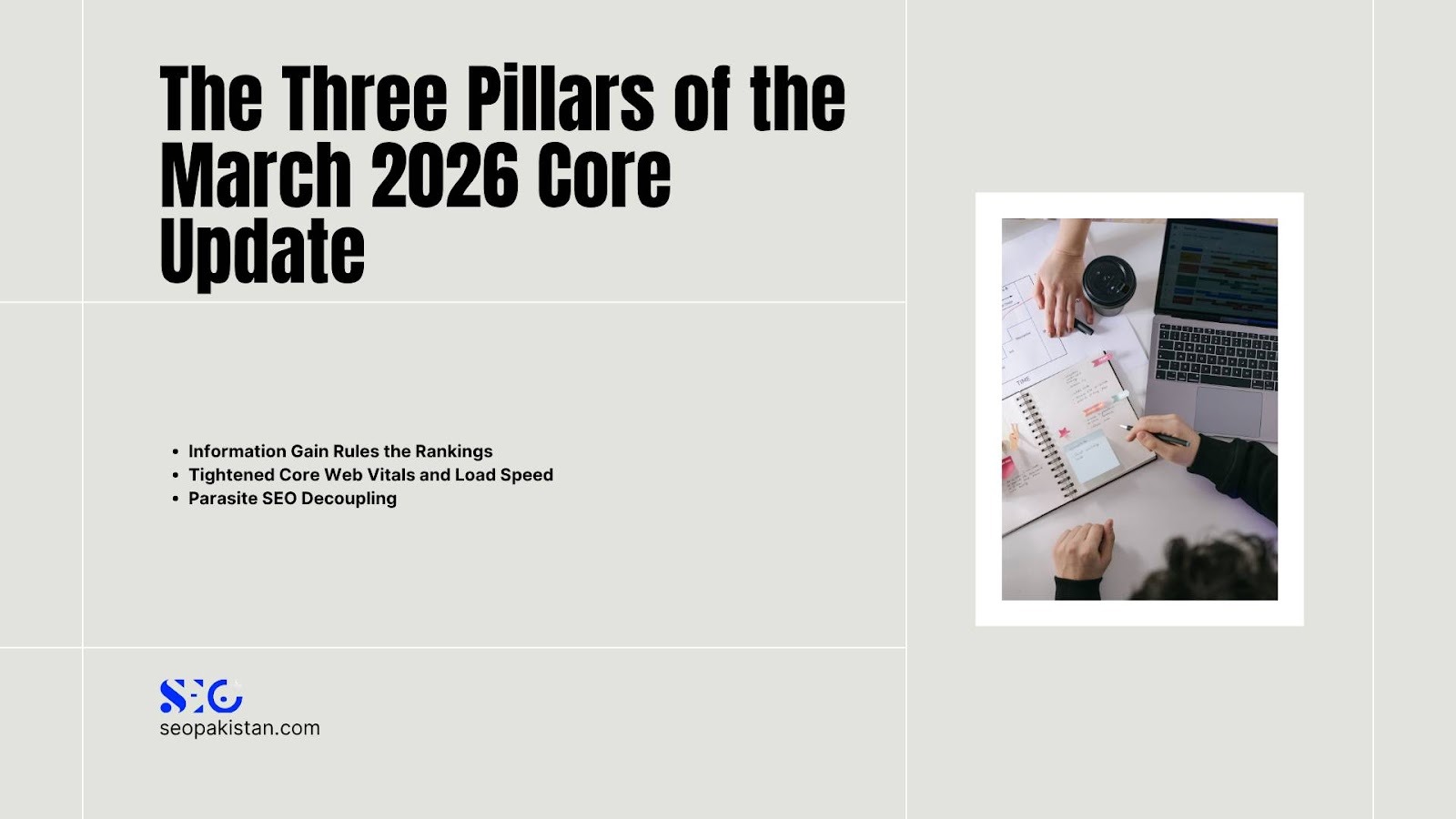
Information Gain Rules the Rankings
Summarizing existing search engine results pages no longer works. The algorithm actively penalizes the “echo chamber” effect. Google wants to see unique perspectives and original content.
You must add proprietary data and in-depth case studies to your articles. This “gap” content provides fresh value that competing sites lack. When you offer exclusive insights, you establish your platform as an authoritative source.
Tightened Core Web Vitals and Load Speed
Google tightened its performance standards significantly for 2026. Interaction-to-Next Paint (INP) now requires a response time under 150 milliseconds. Optimal load speed and mobile friendliness remain non-negotiable ranking factors.
You must optimize your scripts and streamline user interface responsiveness. Fast websites deliver the people-first content experience that the search engine demands.
Parasite SEO Decoupling
A high domain authority does not protect low-quality subfolders anymore. The new ranking systems decouple authoritative root domains from irrelevant sponsored posts. The algorithm now evaluates third-party content on its own merit.
If you host unhelpful content or unnatural links, expect manual actions or algorithmic demotions. You must maintain strict editorial control over your entire website.
Capturing Zero-Click Traffic in 2026
Artificial intelligence overviews have changed how users interact with Google search. These AI-generated snapshots reduced traditional organic click-through rates by 61 percent. You must master Answer Engine Optimization (AEO) to stay ahead.
Craft “atomic answer” fragments throughout your text. These 50-word blocks provide direct responses to non-navigational queries. Clear, concise answers increase your chances of becoming a cited source in Gemini and ChatGPT.
Furthermore, you must establish strong brand entity signals. Use Schema.org markup to verify your authors in the Knowledge Graph. Trustworthy entities consistently rank higher for local results and broad queries.
The Post-Update Recovery Playbook
When an algorithm update completes, many sites experience high volatility. You must approach recovery systematically. Do not panic and rewrite your entire site immediately.
Wait up to two weeks after an update finishes rolling before you make major changes. Use Google Search Console to conduct a volatility audit. Segregate site-wide traffic drops from isolated page declines.
Next, execute a content slop clean-up. Remove or rewrite automated pages that lack human value. Finally, verify your E-E-A-T credentials. Add verifiable author profiles to every high-value page, especially those featuring high-quality product reviews.
Future-Proofing Your Search Strategy
The SEO community faces a constantly changing environment. You must build topical vaults to secure long-term success. Create clusters of ten to fifteen pages focused on niche dominance rather than scattered keywords.

Integrate multimodal content into your strategy. Publish original video and audio assets that artificial intelligence cannot easily replicate. Finally, focus on hyper-local relevance. Leverage 2026 geographic optimization methods to boost local rankings for businesses in Lahore, Karachi, and Islamabad. Provide highly specific data that serves local businesses effectively.
Conclusion: Winning the Reasoning Engine Era
The search algorithm functions exactly as intended, and search algorithm updates continue to make it smarter and more refined across many languages. In 2026, the most effective SEO strategy requires a strict focus on human-centric content quality.
Stay informed about smaller core updates and adjust your strategy proactively. Does your website show a noticeable impact from the late March 2026 rollout? Do not wait for rankings to recover on their own. Book a 2026 Algorithm Recovery Audit with SEO Pakistan today and rebuild your digital authority.
Frequently Asked Questions
How do recent search algorithm updates impact my website traffic?
Recent search algorithm updates fundamentally change how search engines evaluate websites, shifting from simple indexing to advanced reasoning. If your traffic dropped, the engine likely found your pages lacking in original insights. To recover, you must provide unique data and expert perspectives. Prioritize adding distinct value to your pages, as modern algorithms actively reward proprietary information and penalize repetitive, unoriginal summaries.
What is the best way to prepare for future Google algorithm updates?
The most effective way to future-proof your site against Google algorithm updates is by building a human-centric strategy. Search engines continuously refine their systems to surface helpful, reliable results. Focus on establishing strong topical authority rather than chasing scattered search terms. Incorporate multimodal assets like original videos and audio, and consistently demonstrate verified expertise to build trust with both users and the search engine.
Why do major core updates cause so much volatility in search results?
Broad core updates involve comprehensive recalibrations of the entire search ranking system, rather than targeting one specific issue. When these rollouts occur, search engines reassess the overall helpfulness and relevance of every indexed page against new quality thresholds. This wide-scale reevaluation causes significant volatility. You should wait up to two weeks for the rollout to complete before making any major technical or structural changes.
How long does it take to recover my search rankings after a drop?
Recovering your search rankings depends entirely on how quickly you diagnose and fix the underlying issues. First, conduct a thorough volatility audit to separate site-wide drops from individual page declines. Once you identify pages that lost visibility, update them with verified credentials, faster load speeds, and fresh, proprietary insights. Full recovery typically requires waiting for the next major algorithmic refresh to evaluate your improvements.
How does the new AI answer engine measure content quality?
The new AI-driven answer engine measures content quality by looking for “information gain” the unique value your page adds beyond what already exists online. Exceptional content now requires verifiable human expertise, proprietary research, and excellent user experience metrics. To succeed, you must move beyond generic summaries and craft highly specific, authoritative answers that artificial intelligence cannot easily replicate on its own.