

The world of search engine optimization is changing dramatically. Professionals no longer rely entirely on manual tasks to rank websites. Today, SEO agent implementation shifts the focus from static rules to dynamic and intelligent actions. Artificial intelligence now handles complex workflows with incredible speed.
A successful AI SEO setup allows companies to automate repetitive tasks and focus on high-level strategy. Proper smart system deployment ensures these tools work seamlessly with your existing infrastructure. This guide explains how to build automated optimization systems from the ground up.
What Is SEO Agent Implementation?
SEO agent implementation is the process of integrating artificial intelligence agents into your search optimization strategy. These agents act as autonomous workers that handle specific optimization tasks. Traditional automation relies on rigid rules and basic triggers. AI agents use machine learning to understand context and make informed decisions.
They analyze large datasets to prioritize actions based on potential impact. An AI agent can execute technical fixes or content updates autonomously. This setup moves teams away from tedious manual labor. It allows systems to adapt to algorithm changes in real time.
How SEO Agents Work in Automated Systems
AI agents operate through a logical sequence of actions to optimize websites. They function similarly to human experts but process information much faster. Are you wondering how these agents process information? How do they decide what to optimize first? Here is a breakdown of their functionality.
Data Collection and Analysis
Agents gather massive amounts of information to understand the current search landscape. They pull keyword data and monitor competitor insights continuously. They also scan your website for technical SEO signals. This continuous data collection forms the foundation of all optimization efforts.
Decision-Making and Prioritization
Agents prioritize SEO actions using impact scoring and predictive insights. They do not just flag errors randomly. They calculate which actions will generate the highest return on investment. This impact-based decision-making ensures that resources go toward the most valuable tasks.
Execution and Optimization
AI systems take direct action on your website. They execute content updates to improve keyword relevance. They apply technical fixes to enhance site speed and crawlability. They also build internal linking structures to distribute page authority effectively.
Continuous Learning and Feedback
Agents monitor the results of their actions. They track performance metrics across all updated pages. They use this feedback to make adaptive improvements over time. The system becomes smarter and more effective with every cycle.
Core Components of an SEO Agent System
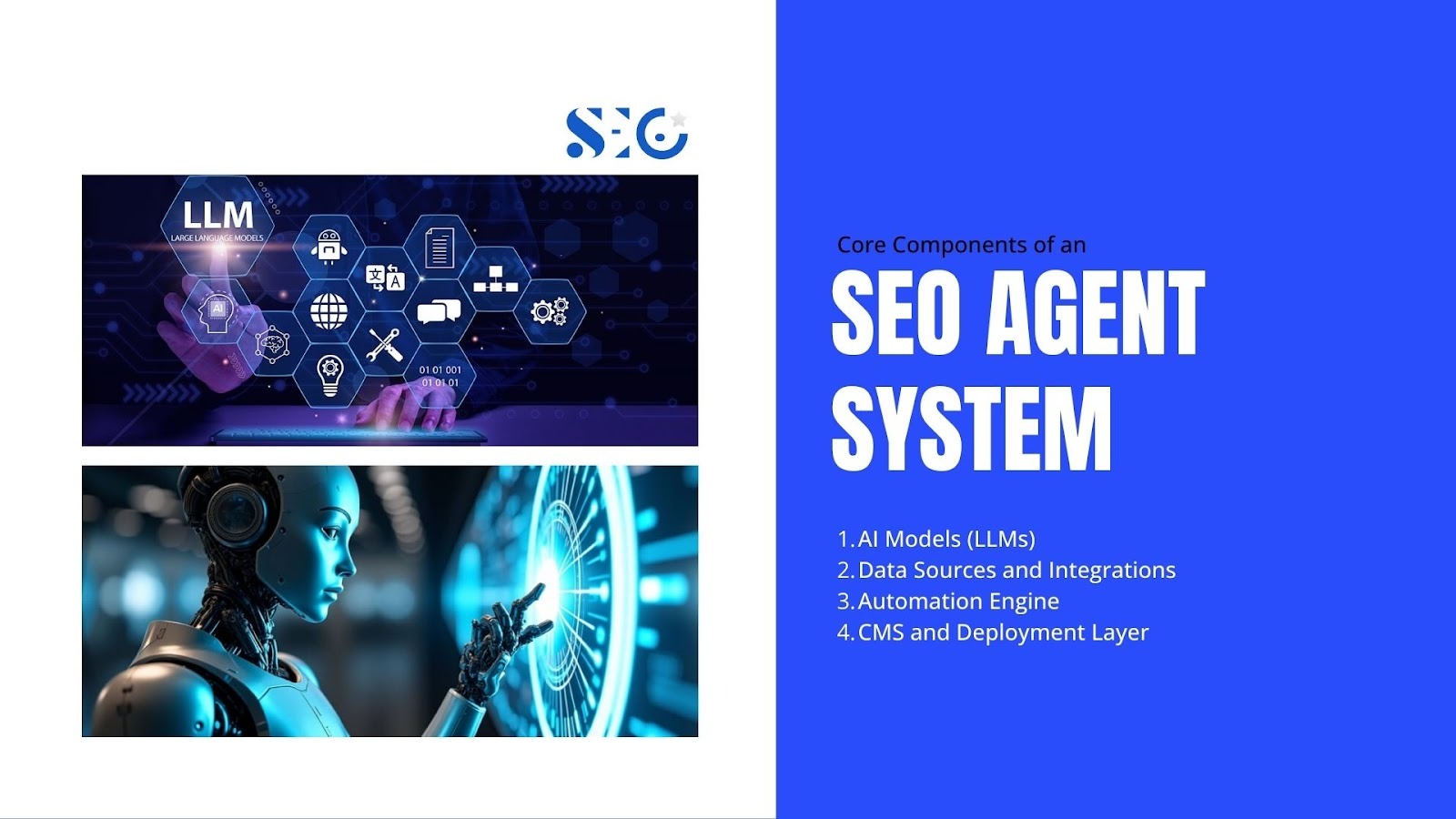
A robust architecture provides a massive ranking advantage. You need the right components to build an effective system. What exactly powers these intelligent agents? How do they connect to your website? Look at the core architecture below.
AI Models (LLMs)
Large language models serve as the brain of the agent. They handle content generation at scale. They also perform semantic analysis to ensure content matches search intent perfectly.
Data Sources and Integrations
Agents need accurate data to make good decisions. They connect directly to Google Search Console and other analytics tools. APIs feed real-time information into the automation system.
Automation Engine
The automation engine acts as the central nervous system. It handles workflow execution across different platforms. It also manages scheduling to ensure tasks happen at the optimal time.
CMS and Deployment Layer
AI agents integrate with your content management system and APIs. They automate audits, updates, and publishing workflows directly in your CMS. This layer allows the agent to push changes live without manual approval.
SEO Agent Implementation: Step-by-Step Guide
Building an automated system requires a structured approach. Do you know where to begin your implementation journey? What infrastructure do you need? Follow these five critical steps.
To build a robust AI SEO agent, a structured implementation plan is essential. From defining your objectives to continuous optimization, each phase builds upon the last to create a powerful, automated system. Here’s how to break down the process into five manageable steps.
Step 1: Define SEO Goals
First, establish clear, measurable objectives for your AI agent. These goals will guide its configuration and measure its success. Are you aiming for more organic traffic, better search engine rankings, or simply scaling your content production?
- Establish clear objectives for traffic growth and SERP rankings.
- Define your desired scale for content production.
- Set key performance indicators (KPIs) to track success.
Step 2: Set Up Data Infrastructure
Your agent needs reliable data to make informed decisions. This involves creating a solid foundation by connecting various data sources and ensuring the information is accurate and accessible.
- Connect essential APIs like Google Search Console and analytics platforms.
- Integrate internal and external tools to gather comprehensive data.
- Collect and clean keyword data, competitor insights, and performance metrics.
Step 3: Build AI SEO Workflows
With the data infrastructure in place, you can design the automated workflows the agent will execute. These processes will form the core of your SEO automation, handling tasks that are typically manual and time-consuming.
- Automate keyword research and topic clustering.
- Implement workflows for content generation, optimization, and internal linking.
- Schedule automated technical audits and competitor analysis.
Step 4: Deploy Automation Systems
Now it’s time to bring your agent to life within your existing ecosystem. This step involves integrating the AI with your content management system (CMS) and establishing the rules for how and when it can publish content.
- Finalize the integration with your CMS (e.g., WordPress, Webflow).
- Establish clear publishing and content update workflows.
- Set up monitoring and alert systems to track agent activity.
Step 5: Enable Continuous Optimization
An AI agent is not a “set it and forget it” solution. To ensure long-term success, you must create a feedback loop where the agent learns from performance data and adapts its strategies over time.
- Implement systems to track content performance and ROI.
- Use performance data to refine and update SEO strategies.
- Maintain consistent feedback loops for the agent to learn and improve.
Automated SEO Workflows Using AI Agents
Creating structured workflows maximizes the value of your agents. Different workflows handle different aspects of search optimization. How do you divide tasks among automated systems? Which workflows yield the best results? Consider the following configurations.
Content Automation Workflow
This workflow handles topic cluster creation and article drafting. The agent researches keywords and generates optimized content. It ensures that semantic relevance remains high across all pages.
Key tasks for this workflow:
- Generates content briefs based on target keywords and SERP analysis.
- Draft articles, meta descriptions, and title tags that adhere to on-page SEO best practices.
- Creates internal linking suggestions to strengthen topic clusters.
Technical SEO Automation Workflow
This workflow monitors website health continuously. The agent identifies broken links, slow pages, and crawl errors. It applies fixes or generates reports for developers automatically.
Key tasks include::
- Conducts regular site audits to check for 404 errors, redirect chains, and other issues.
- Monitors Core Web Vitals and flags pages with poor performance.
- Generates and updates XML sitemaps to ensure search engines can crawl the site efficiently.
Competitor Monitoring Workflow
This workflow tracks rival websites to identify new opportunities. The agent monitors competitor keyword rankings and content updates. It alerts your team to gaps in your own strategy.
Key tasks include:
- Identifies keywords where competitors are ranking but you are not.
- Tracks changes in competitors’ backlink profiles to find new link-building opportunities.
- Analyzes top-performing content from rivals to inform your own content strategy.
Reporting and Analytics Workflow
This workflow generates performance reports automatically. AI agents enable continuous monitoring, reporting, and optimization without manual effort. Stakeholders receive clear insights into traffic and conversion trends.
See it in action:
- Integrates with Google Analytics and Search Console to pull real-time data.
- Creates custom dashboards that visualize key metrics like organic traffic, keyword rankings, and conversion rates.
- Sends automated alerts for significant ranking drops or traffic spikes.
Multi-Agent SEO Systems (Advanced)
Advanced setups use multiple agents working together to achieve complex goals. One agent cannot always handle every aspect of search optimization efficiently. How do specialized agents collaborate? What does a multi-agent ecosystem look like? Here is an example of a collaborative system.
- Research Agent: This agent uncovers trending topics and valuable keywords.
- Content Agent: This agent uses the research data to generate high-quality articles.
- Optimization Agent: This agent refines the content and handles internal linking.
- Monitoring Agent: This agent tracks the performance of the published content over time.
This multi-agent approach streamlines the entire SEO workflow, from initial research to ongoing performance analysis. By dividing tasks among specialized agents, the system can handle complex SEO processes with greater speed and efficiency.
Why You Should Automate Your SEO With AI Agents
Adopting AI automation provides significant advantages over traditional methods. Businesses that implement these systems quickly outpace their competitors. Why should your company invest in this technology? What specific returns can you expect? Review these four primary benefits.
Scalability Without Hiring
Companies can multiply their output without increasing headcount. Agents handle the workload of entire teams. This scalability allows businesses to target thousands of keywords simultaneously.
Faster Optimization Cycles
AI agents execute tasks in real time. They do not wait for weekly meetings or monthly sprints. This speed allows websites to capture search traffic trends immediately.
Reduced Human Error
Manual optimization often leads to missed tags or broken links. Automated systems follow precise instructions without fatigue. This consistency reduces technical errors across large websites.
Continuous SEO Performance
Search engines evaluate websites constantly. AI agents ensure your website remains optimized around the clock. AI automation can significantly increase productivity and reduce manual workload.
Challenges in SEO Agent Implementation
Implementation comes with specific hurdles that organizations must overcome. You cannot simply plug in an agent and expect flawless results. What risks should you anticipate during deployment? How do these challenges impact your strategy? Keep these factors in mind.
- Data quality issues: Poor data inputs lead the agent to make incorrect optimization decisions.
- Over-automation risks: Automating too aggressively can result in robotic content that alienates readers.
- Lack of human strategy: Agents execute tasks well but struggle to define overarching brand strategies.
- Integration complexity: Connecting legacy systems to modern AI agents requires advanced technical expertise.
SEO Agent Implementation Checklist
| Step | Action | Outcome |
| Goal Setting | Define SEO objectives | Clear strategy |
| Data Setup | Integrate tools & APIs | Reliable data |
| Workflow Creation | Build automation pipelines | Efficiency |
| Deployment | Connect CMS & tools | Execution |
| Optimization | Monitor & improve | Growth |
Real-World Use Cases of AI SEO Systems
Companies across various industries use these systems to dominate search results. They apply the technology to solve specific business problems. How do publishers generate content at scale? How do large e-commerce brands maintain their sites? Observe these practical applications.
Automated content production:
Media sites deploy agents to generate and publish hundreds of optimized news articles daily. This allows them to cover niche topics and long-tail keywords that would be impractical to address manually. The result is a significant increase in organic traffic and audience engagement.
Backlink automation:
Digital marketing agencies leverage agents to automate the entire backlink acquisition process. These systems can identify relevant, high-authority websites, find contact information, and send personalized outreach emails at scale. This frees up human teams to focus on relationship-building and strategy.
Enterprise SEO scaling:
Global brands use agents to translate existing content and optimize it for local search intent in international markets. This includes adapting keywords, cultural nuances, and formatting for different regions. By automating this process, companies can expand their global footprint much more efficiently.
Final Thoughts
Building an intelligent search strategy requires a forward-thinking approach. Proper SEO agent implementation empowers your team to accomplish more in less time. When you prioritize automated workflow creation, you establish a foundation for sustained growth.
Companies that embrace AI marketing implementation will dominate the search landscape in the coming years. Start by defining your goals, setting up your data infrastructure, and deploying your first agent. The future of search optimization belongs to those who automate intelligently.
Ready to conquer the search rankings? Team up with seopakistan.com to harness the potential of smart automation for your business now.
Frequently Asked Questions
What is SEO agent implementation?
SEO agent implementation is the process of building autonomous AI systems to execute search optimization tasks. These systems analyze data, prioritize actions, and update websites without manual intervention.
How do AI SEO agents work?
AI SEO agents collect data from analytics platforms and use large language models to make decisions. They connect directly to content management systems to execute technical fixes and publish content automatically.
What tools are used for SEO automation?
Teams use custom Python scripts, API connections to Google Search Console, and large language models like OpenAI. They also integrate workflow automation platforms like Zapier or Make to connect various software tools.
Can SEO be fully automated?
You cannot fully automate high-level strategy and brand voice oversight. However, you can fully automate repetitive tasks like technical monitoring, keyword clustering, and basic content updates.
Is SEO agent implementation suitable for small businesses?
Small businesses benefit greatly from automation implementation because it allows them to compete with larger brands. It maximizes their limited resources.