

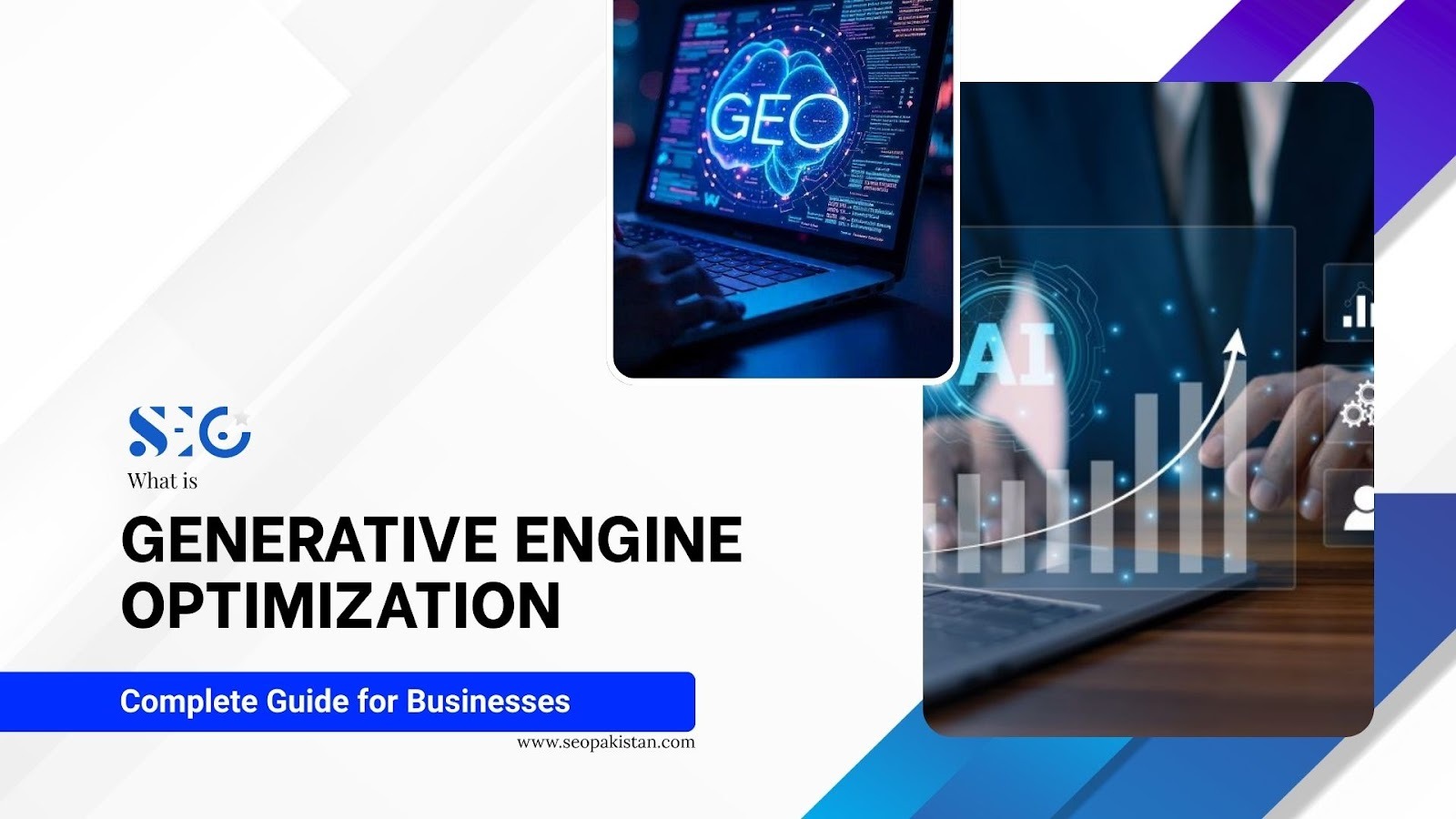
Generative Engine Optimization (GEO) is the practice of optimizing content so that AI-powered search engines select it as a trusted source when generating answers. AI search optimization has changed how users find information—AI engines now synthesize content and deliver direct answers. Businesses that understand GEO can appear in those AI-generated responses, gaining visibility where it matters most: at the point of the answer.
What is Generative Engine Optimization?
Generative Engine Optimization is a digital marketing discipline focused on making content eligible for citation within AI-generated search results.
Traditional search engines return a list of links. AI-powered search engines—such as Google’s AI Overviews, Microsoft Copilot, and Perplexity—read, evaluate, and synthesize content from across the web. They then present a single, structured answer directly to the user.
GEO ensures your content is the source that AI engines draw from.
When a user asks an AI search engine a question, it synthesizes information from dozens of sources to construct a single, authoritative response.
- If your content isn’t clear, credible, or well-structured, it won’t be included in the AI-generated answer.
- GEO aligns your content with how AI engines evaluate and use information.
- For businesses, this means becoming a trusted source within the AI answers that users rely on, going beyond traditional search rankings.
How Generative Engine Optimization Works
Understanding the mechanics behind GEO helps businesses make smarter content decisions. Here is how the process unfolds.
AI Search Engines and Generative Results
AI search engines use large language models (LLMs) to generate responses. When a user submits a query, the engine retrieves relevant content from indexed sources, processes it through the language model, and produces a synthesized answer. This process is known as retrieval-augmented generation (RAG).
The engine does not always direct users to a website. Instead, it constructs an answer and may include a citation. For businesses, appearing as that citation is the goal of generative search results optimization.
How AI Selects Trusted Sources
AI systems do not select sources randomly. They apply a set of evaluative criteria to determine which content is trustworthy and relevant enough to cite. These criteria include:
- Topical authority: Does this source consistently cover the subject in depth?
- Content structure: Is the information organized in a way the AI can easily extract?
- Credibility signals: Does the content cite sources, demonstrate expertise, and reflect real-world experience?
- Entity recognition: Is the brand or author recognized as a known, trusted entity within a subject area?
The Role of Structured and Authoritative Content
Structured content gives AI engines a clear framework for understanding what a page is about. Using schema markup, FAQ sections, and well-organized headings helps AI interpret the relationships between topics and answers.
Authoritative content, written by experts and backed by evidence, is more trustworthy for AI.
- Expert-driven content: Demonstrates genuine expertise, which helps it rank higher in AI trust assessments.
- Conversational search optimization: Writing in a question-and-answer format aligns with how AI engines process natural language and retrieve information.
Generative Engine Optimization vs Traditional SEO
GEO and traditional SEO share foundational principles, but they serve different objectives. Understanding the distinction helps businesses allocate their efforts effectively.
| Feature | Traditional SEO | Generative Engine Optimization |
| Primary Goal | Rank in search results | Be cited in AI-generated answers |
| Focus | Keywords and rankings | Context, authority, and answers |
| Content Strategy | Optimized for search engines | Optimized for AI understanding |
| User Interaction | Click-through traffic | Direct answers and citations |
| Future Role | Foundation of search visibility | Next evolution of SEO |
Why Your Business Can’t Afford to Ignore GEO
As AI-powered search becomes the default for millions of users, the stakes for businesses are rising. Here is what GEO delivers.
Increased Visibility in AI Search
AI Overviews and conversational search interfaces are now appearing at the top of search results for an expanding range of queries. Users often receive their answer directly from these AI-generated summaries without clicking further.
Businesses that implement AI search optimization position their content to be cited in these summaries. This creates a new, high-visibility channel that operates independently of traditional click-through rankings.
Authority and Brand Trust
When an AI engine cites your content, it functions as an implicit endorsement. Users associate cited sources with credibility. Repeated citation across different queries reinforces brand authority and builds long-term trust with prospective customers.
Entity-based SEO supports this outcome by establishing your brand as a recognized entity within AI knowledge systems—making consistent citation more likely over time.
Better User Experience Through Direct Answers
Businesses that structure content to answer user questions clearly and concisely improve the experience for potential customers at every stage of the funnel. When a user receives a helpful, accurate answer attributed to your brand, the relationship starts on a strong footing.
Competitive Advantage in Emerging AI Search
Most businesses have not yet adapted their content strategies for AI answer engine optimization. Early adopters gain an advantage that compounds over time. As AI search behavior becomes more entrenched, the cost of catching up will increase. Acting now secures visibility before the space becomes saturated.
How to Build a Winning GEO Strategy
A well-executed GEO strategy rests on a set of consistent, measurable principles.
Create Authoritative and Expert Content
What separates content that AI engines cite from content they ignore? The answer is depth, accuracy, and demonstrated expertise.
AI engines favor content that covers a topic thoroughly, references credible information, and is produced by identifiable experts or reputable organizations. Thin content, generic overviews, and unsupported claims rarely make it into AI-generated answers.
Optimize for Natural Language Queries
Users interact with AI search engines conversationally. They ask full questions, not just keywords. Content that mirrors this behavior—using natural phrasing, complete answers, and clear sentence structures—aligns with how AI engines retrieve and evaluate information.
Demonstrate Experience and Expertise (E-E-A-T)
Google’s E-E-A-T framework (Experience, Expertise, Authoritativeness, Trustworthiness) is central to how AI systems evaluate content quality. Practical ways to demonstrate E-E-A-T include:
- Publishing content under named authors with clear credentials
- Linking to primary sources and verified data
- Including case studies, firsthand examples, and original research
- Displaying trust signals such as reviews, certifications, and industry affiliations
Provide Direct and Structured Answers
AI engines reward content that answers questions immediately and clearly. Leading with the answer, followed by supporting detail, matches the structure these systems are designed to extract. FAQ sections, numbered lists, and concise definitions all perform well in AI evaluations.
Build Strong Topical Authority
Topical authority means covering a subject comprehensively across multiple interconnected pieces of content. A business that publishes a pillar page on a core topic and supports it with detailed articles on related subtopics signals to AI engines that it is a reliable, complete resource on that subject.
How to Implement Generative Engine Optimization
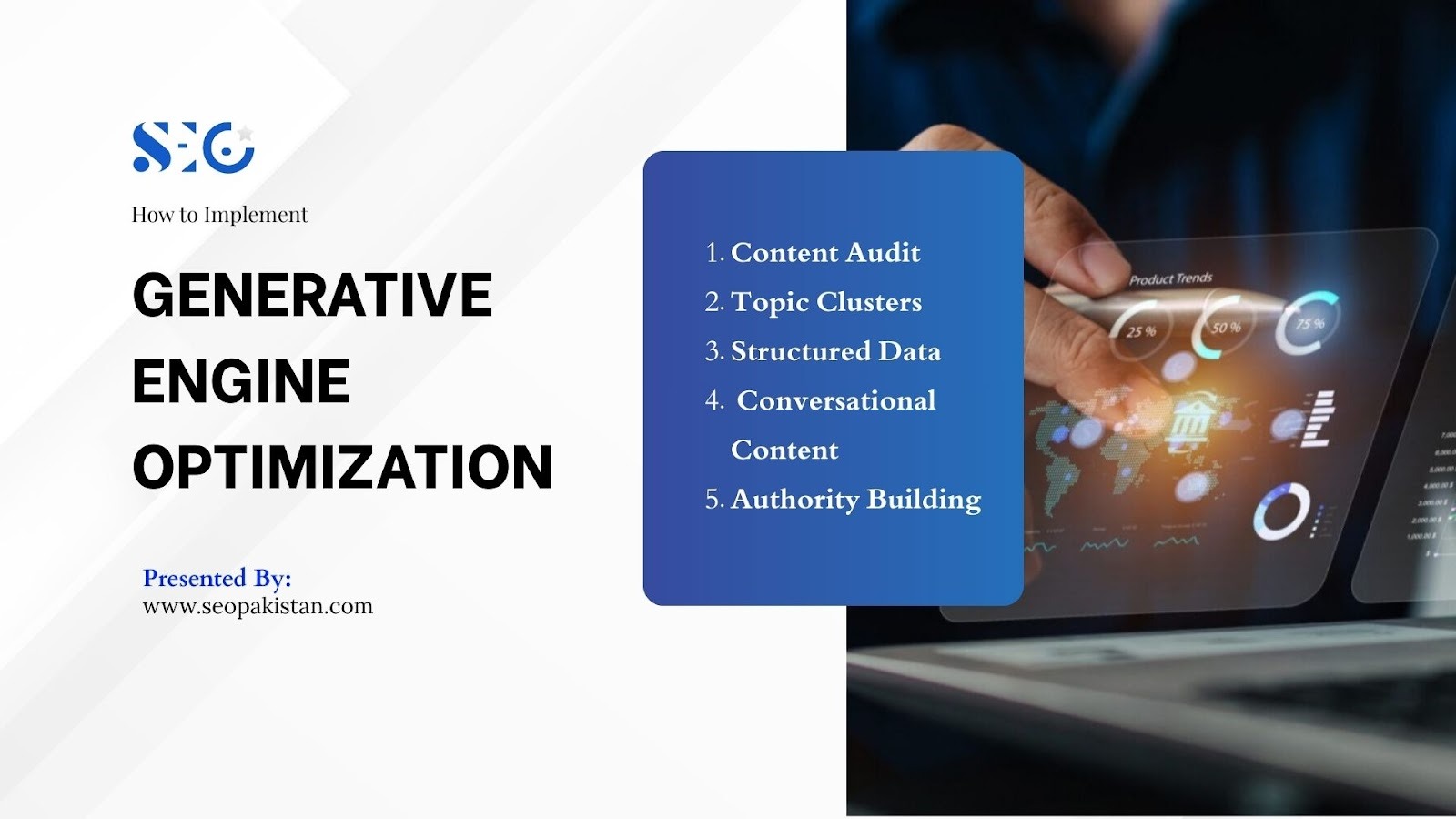
Step 1 – Content Audit:
Review your existing content and assess which pages currently answer questions directly, which are too shallow to earn AI citations, and which could be restructured for better clarity. Identify high-value topics where your brand has genuine expertise.
Step 2 – Topic Clusters:
Develop a pillar page for each core topic in your industry, supported by a network of related articles. This cluster structure signals topical depth to AI systems and strengthens entity-based SEO by establishing your brand as a recognized authority on specific subjects.
Step 3 – Structured Data:
Implement schema markup across key pages, particularly FAQ schema, how-to schema, and article schema. Structured data allows AI systems to parse your content with precision, increasing the likelihood that it will be extracted and cited accurately.
Step 4 – Conversational Content:
Rewrite key sections of your content in a question-and-answer format. Use the exact phrasing your audience is likely to use when speaking to an AI assistant. This alignment between user language and your content language is a core driver of AI answer engine optimization.
Step 5 – Authority Building:
Earn backlinks from credible, relevant sources. Seek citations in industry publications and directories. Encourage reviews and testimonials that reinforce brand credibility. Each of these signals contributes to the trustworthiness score that AI systems factor into their source selection process.
A structured implementation process makes GEO achievable for businesses of any size.
| Step | Action | Purpose |
| Content Audit | Review existing content for AI search optimization | Identify opportunities |
| Topic Clusters | Create pillar pages and supporting articles | Improve topical authority |
| Structured Data | Add schema markup and FAQ sections | Help AI understand content |
| Conversational Content | Write in question-answer format | Align with AI search queries |
| Authority Building | Earn backlinks and citations | Increase trust signals |
Common GEO Mistakes to Avoid
Even well-intentioned strategies can fall short. These are the most common errors businesses make—and why they undermine AI content visibility.
- Focusing only on keywords instead of user intent: Keywords signal a topic, but AI engines evaluate whether content actually satisfies the underlying intent of a query. Content that is keyword-dense but fails to answer a question clearly will not perform well in generative results.
- Writing shallow content without authority: Surface-level articles that cover a topic briefly do not provide the depth AI engines look for when selecting citations. Comprehensive, well-researched content outperforms short, generic alternatives every time.
- Ignoring structured data: Without schema markup, AI engines must infer the structure and meaning of your content. Adding structured data removes ambiguity and makes it significantly easier for AI systems to extract and use your information.
- Not building brand credibility: AI engines assess how an entity is perceived across the web. A business with minimal third-party mentions, no author profiles, and no industry presence will struggle to appear in AI-generated answers regardless of content quality.
- Treating GEO as a replacement for SEO: GEO without a traditional SEO foundation is unstable. Technical performance, backlink authority, and indexation all remain prerequisites for AI search visibility.
Build Your GEO Strategy Before Your Competitors Do
Generative Engine Optimization represents the next significant shift in how businesses earn digital visibility. The fundamentals are clear: authoritative content, structured data, topical depth, and AI-powered search engines that reward credibility over keyword density.
Businesses that act now will establish the trust signals, topical authority, and conversational search optimization that AI engines require—before most competitors recognize what is happening. The window for early adoption is open, but it will not stay open indefinitely.
Start by auditing your existing content, identifying gaps in topical coverage, and implementing structured data across your key pages. These are the first steps toward becoming the source that AI engines consistently trust and cite.
The time to act is now. Secure your competitive edge and lead your industry in the new era of search. Contact SEOPakistan.com today to build your GEO strategy and ensure your brand becomes the trusted authority AI engines prefer.
Frequently Asked Questions (FAQs)
What is Generative Engine Optimization?
Generative Engine Optimization (GEO) is the process of optimizing content to be selected and cited by AI-powered search engines for direct answers. Unlike traditional SEO, which focuses on keyword rankings, GEO prioritizes making content authoritative, structured, and clear enough to be used directly in AI-generated search responses.
How is Generative Engine Optimization different from SEO?
While traditional SEO focuses on ranking in search results via keywords and backlinks, GEO focuses on making content a direct source for AI-generated answers. GEO complements SEO by adding layers of structured data, natural language, and authority signals that AI systems specifically seek when creating direct user responses.
Can businesses rank in AI search results without GEO?
While some well-structured content might appear in AI answers by chance, it’s unreliable. Without a focused GEO strategy, businesses leave their AI visibility to luck. Deliberate optimization is required to ensure consistent citation across relevant AI-generated answers and build brand authority within this new search paradigm.
How can companies start implementing GEO?
Begin with a content audit to identify material for restructuring. Then, build topic clusters, add schema markup, and rewrite content in a question-and-answer format. Focusing on high-value pages first provides the quickest returns, while gradually incorporating GEO principles across all digital assets for long-term success.
Does Generative Engine Optimization improve website traffic?
GEO changes traffic quality more than quantity. While direct clicks may decrease as users get answers from the AI, consistent citation builds brand trust. This drives higher-quality traffic over time from users who recognize your authority and are more likely to engage and convert when they do visit.