

Link Building 2026 demands a value-first approach focused on brand trust, topical authority, and strict editorial standards. Modern search engines easily identify and devalue automated link schemes, instead rewarding natural, in-content backlinks earned through digital PR, original research, and collaborative industry networking.
Additionally, as AI search engines prioritize trustworthy brand entities, securing high-quality citations and unlinked brand mentions across reputable platforms is just as critical as traditional hyperlink acquisition. The quality, relevance, and real human traffic of your link sources define success.
Table of Contents
Introduction
What is Link Building
The Evolution of Link Building
Are Backlinks Still the King of SEO?
Backlinks as Trust Signals
Driving Referral Traffic
Impact on Domain Authority
Enhancing Content Indexation and Discoverability
Signifying Topical Relevance
Link Building Trends You Can’t Ignore in 2026
AI-Assisted Link Prospecting
Brand Mentions and Entity SEO
Editorial Links Over Paid Links
The Modern Link Building Framework That Actually Works
Step 1: Authority-Focused Content Creation
Step 2: Link Opportunity Research
Step 3: Outreach and Collaboration
Step 4: Content Promotion and Distribution
High-Authority Link Acquisition Methods
Guest Posting on Industry Publications
Broken Link Building
Resource Page Link Placements
Link Reclamation
Digital PR and Content-Driven Link Building
Publishing Data-Driven Research
Newsworthy Campaigns
Expert Commentary and Media Outreach
Evaluating Backlink Quality and Authority
Final Thoughts: Focus on Authority, Not Volume
Frequently Asked Questions
What is Link Building
Modern off-page SEO requires shifting focus away from raw backlink volume and prioritizing contextual placement, niche relevance, and brand entity authority. Rather than buying cheap links or deploying automated outreach templates, successful campaigns rely on digital PR, original data studies, and genuine relationship-building with authoritative publications. Additionally, search engine crawlers and AI search platforms evaluate your overall brand footprint, meaning unlinked brand mentions and citations from highly trusted industry seed sites play an active role in dictating organic visibility.
The Evolution of Link Building
Link building began as a straightforward concept: the more links pointing to your website, the higher it ranked. Early SEO practitioners capitalized on this by acquiring links in bulk, regardless of quality or relevance. Private blog networks, low-quality web directories, and manipulative paid schemes dominated the landscape.
- 2012: Google’s Penguin algorithm update marked a major turning point. It penalized websites for manipulative link practices, forcing the SEO industry to change its approach to building links.
- Post-2012: Subsequent updates continued to reward earned, editorially placed links while devaluing or penalizing artificial ones. Traditional link building began its slow decline.
- Mid-2020s: The focus shifted entirely toward trust signals and brand authority. Search engines started evaluating the overall credibility of the brand, not just its links. Entity recognition, brand mentions, and digital PR became key factors in assessing authority.
- Today: In 2026, modern link building is brand-driven. Organizations that consistently produce quality content, build genuine industry relationships, and earn media coverage naturally accumulate the kind of link profiles that sustain rankings over time.
Are Backlinks Still the King of SEO?
Despite every algorithm change, backlinks remain one of the most powerful ranking signals in existence. Their role has evolved, but their importance has not diminished—it is not just rankings on a SERP that matter anymore, but overall brand authority.
Backlinks as Trust Signals
When a reputable website links to your content, it signals to search engines that your page is a valuable and trustworthy resource, deserving of higher rankings for competitive keywords.
- Builds Credibility: The more authority sites link to your content, the more search engines will see your website as a credible authority in your niche.
- Creates a Defensible Moat: This trust compounds over time, building a strong competitive advantage that is difficult for competitors to replicate quickly.
Driving Referral Traffic
Beyond SEO, backlinks serve as a direct source to drive traffic to your domain. A link from a high-traffic, relevant website can send a steady stream of engaged visitors to your page, generating leads and sales independent of search engine rankings.
- Qualified Audience: Visitors arriving from a relevant link are often highly qualified and more likely to convert, as they are already interested in the topic.
- Brand Exposure: Each link acts as a brand mention, increasing your visibility and introducing your business to new, untapped audiences.
Impact on Domain Authority
Domain Authority (DA) is a metric that predicts a website’s ranking potential based on its backlink profile. High-quality links from relevant, authoritative sources boost this score, making it easier for all pages on your site to rank.
- Site-Wide Lift: A strong domain authority creates a “rising tide” effect, lifting the organic performance of your entire content library.
- Long-Term Asset: Unlike paid ads, a strong backlink profile is a long-term asset that continues to deliver value over time.
Enhancing Content Indexation and Discoverability
When established sites link to your new pages, search engine crawlers follow those external links, ensuring your content gets indexed and ranked more quickly.
- Faster Visibility: This is especially valuable for time-sensitive articles or for new websites trying to establish an initial foothold in search results.
- Deeper Crawling: A robust link profile encourages search engines to crawl your site more frequently and deeply, ensuring even older content remains visible.
Signifying Topical Relevance
Backlinks help search engines understand what your content is about. This helps you rank for related keywords and is a foundational concept that remains crucial for link-building success in 2026.
- Contextual Signals: The contextual links and anchor text used in the backlink provide a strong contextual clue to search engines about the linked page’s content.
- Niche Authority: Earning relevant links from multiple sites within a specific niche solidifies your website’s authority on that subject in the eyes of search engines.
Link Building Trends You Can’t Ignore in 2026
Understanding these trends is essential for anyone developing a link-building strategy, as it helps focus efforts where they will generate the most impact.
AI-Assisted Link Prospecting
Artificial intelligence has transformed the way link builders identify link opportunities. AI tools can now analyze vast datasets to surface relevant websites, assess link quality, and predict which prospects are most likely to respond positively to outreach.
This shift has made prospecting faster and more precise. Rather than manually combing through search results, teams can use the best tools and AI-driven platforms to build targeted, high-quality prospect lists in a fraction of the time.
Brand Mentions and Entity SEO
Search engines have developed the ability to recognize brands as entities—distinct subjects with reputations, associations, and credibility signals. This means unlinked brand mentions now carry SEO value, even when no hyperlink is present.
This is a game-changer for SEO because it shifts the focus from simple link-building to holistic brand-building:
- Reinforce Authority: Establishing a strong brand presence across various platforms (publications, social media, industry communities) strengthens your brand’s authority as a recognized entity and ensures excellent AI visibility as search engines deploy AI search tools and AI-generated answers to users.
- Boost Credibility: Over time, this widespread recognition directly influences how search engines perceive and rank your website’s credibility, treating your brand as a trusted source.
Editorial Links Over Paid Links
Buying links and participating in paid link schemes have become increasingly risky and ineffective. Editorial links, which are earned naturally through high-quality content or media coverage, carry the strongest ranking signals in 2026.
- Trust Signals: When authoritative creators link to your work within a natural editorial context, it sends high-value “trust signals” to search engines.
- Organic vs. Paid: Algorithms can now differentiate between organic citations and paid links, systematically devaluing low-quality links.
- Votes of Confidence: Editorial links act as endorsements from established voices, passing maximum link juice—a powerful signal that paid link-building can’t replicate.
- Long-Term Strategy: A focus on great content, original research, and digital PR offers a better ROI and sustained ranking improvements.
The Modern Link Building Framework That Actually Works
Random outreach and common link building mistakes—like automated template blasting or using exact match anchor text unnaturally—rarely produce lasting results. A strategic, relationship-based link building approach is essential for consistent progress in your link building efforts.
[Create Linkable Assets] ➔ [Identify Relevant Sites] ➔ [Build Relationships] ➔ [Promote & Distribute]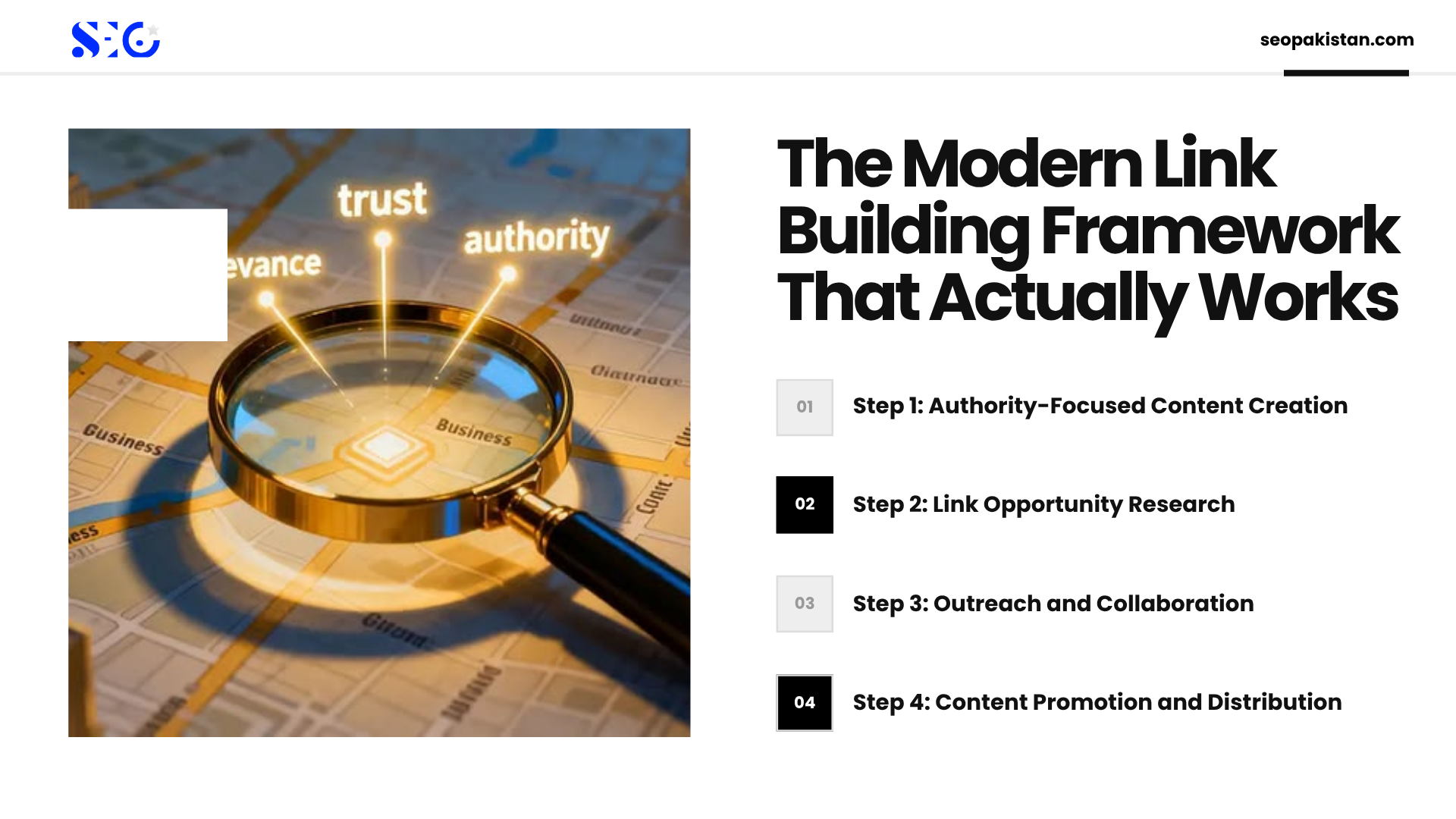
Step 1: Authority-Focused Content Creation
A successful backlink campaign relies entirely on a solid starting point: high-caliber content that naturally deserves to be shared. What resources does your target audience actually need? Start by identifying gaps in your industry’s content landscape based on user intent.
Create content that serves as a definitive resource—original research, comprehensive guides, in-depth analysis, or interactive tools. This type of content helps you attract links and link naturally because other publishers want to reference it.
- Focus on topics with genuine search demand and linking potential.
- Prioritize depth and accuracy over the volume of content produced.
- Update existing high-performing content on your own site regularly to maintain relevance.
- Develop proprietary data or insights that cannot be found elsewhere.
Step 2: Link Opportunity Research
Before launching outreach, identify the websites most likely to link to your content. Relevant sites in your industry are far more valuable than high-authority sites with no topical connection.
To conduct effective research, you need a clear understanding of your content’s purpose and audience. Match your outreach targets to that purpose, and prioritize sites that already link to similar content in your space.
- Use SEO tools to analyze competitor backlink profiles and identify patterns.
- Search for resource pages, roundups, and industry publications covering your topic using advanced search operators in Google Search.
- Evaluate each prospect for domain authority, organic traffic, and topical relevance.
- Prioritize quality over quantity in your prospect list to target the best links.
Step 3: Outreach and Collaboration
Personalized outreach outperforms generic templates because it focuses on demonstrating value and helping you build relationships with content creators and the site owner. While this approach takes time, a single strong relationship can lead to multiple high-quality links across various publications.
- Research each prospect before reaching out to personalize your message.
- Lead with the value your content provides to their audience and their target page.
- Follow up once, respectfully, if you do not receive a response from the website owners.
- Build ongoing relationships rather than treating outreach as a one-time transaction.
Step 4: Content Promotion and Distribution
Great content does not earn links simply by existing—it earns links by reaching the right people. Promotion is as important as creation. A multi-channel distribution strategy ensures your content reaches journalists, bloggers, and industry influencers who may reference it.
Distribute content through email newsletters, social platforms, industry communities, and PR channels. The broader your content’s reach, the higher the probability of driving organic traffic and earning organic, editorial backlinks.
High-Authority Link Acquisition Methods
Certain link-building tactics have proven consistently effective as algorithm sophistication increases. These approaches prioritize quality, relevance, and editorial merit.
Guest Posting on Industry Publications
Contributing valuable content to authoritative industry publications is a reliable, effective link-building tactic. Approach guest posting as a chance to offer real value to a new audience, not just to place a link. Target publications your customers read and pitch fresh topics that align with their editorial focus.
- Identify publications with strong domain authority and genuine readership.
- Pitch original ideas on a fresh blog post rather than repurposing existing content.
- Avoid mass guest posting on low-tier blogs, and ensure the content you contribute meets or exceeds the publication’s quality standards.
- Include a natural, contextually relevant link to your own website resource.
Broken Link Building
Broken link building involves identifying outdated or dead links on relevant websites and proposing your content as a replacement. This approach creates mutual value—you help the webmaster fix a problem while earning a backlink.
This tactic works particularly well for resource-heavy pages and long-standing industry websites where link rot is common.
- Use tools like Ahrefs or Screaming Frog to identify broken links on target sites.
- Match broken links to content on your site that serves the same purpose.
- Reach out to the webmaster with a helpful, non-pushy message pointing out the dead external links.
- Offer your resource as a natural replacement rather than a sales pitch.
Resource Page Link Placements
Many websites maintain curated resource pages—lists of tools, articles, or references relevant to their audience. Securing placement on these pages can deliver both backlink value and referral traffic.
Finding and evaluating relevant pages in your niche requires methodical research, but the links earned tend to be editorially placed and contextually relevant.
- Search for resource pages using queries like [topic] + resources or [topic] + useful links.
- Assess whether your content genuinely fits the page’s focus and audience.
- Reach out with a concise pitch explaining why your resource adds value.
- Avoid pages that appear to accept any submission indiscriminately, including those with blog comments or comment spam.
Link Reclamation
Link reclamation focuses on recovering backlink value that already exists but is not being fully captured. Unlinked brand mentions, outdated links pointing to moved pages, and lost links from content updates all represent reclamation opportunities.
These are among the highest-ROI activities because the groundwork has already been done—someone has already referenced your brand or content.
- Reach out to authors of unlinked mentions and request a hyperlink addition.
- Use redirect audits to ensure backlinks pointing to old URLs still pass authority.
- Review your backlink profile regularly to identify and recover lost links.
Digital PR and Content-Driven Link Building
Digital PR strategies represent one of the most powerful and scalable approaches to link building available in 2026. When executed well, a single campaign can generate links across dozens of high-authority backlinks from major publications.
Publishing Data-Driven Research
Original research attracts links because it gives journalists, bloggers, and analysts something new to report on. Survey data, industry benchmarks, proprietary studies, and trend analyses are all examples of content that earns natural media coverage.
Data-driven content positions your brand as an authoritative source in your field. Over time, it becomes a reference point that other content creators return to repeatedly.
- Conduct original surveys or analyze proprietary data sets relevant to your industry.
- Present findings clearly with visualizations that make the data easy to share.
- Promote your research directly to journalists covering your industry at major news sites.
- Update studies annually to maintain their relevance and attract recurring links.
Newsworthy Campaigns
Some of the most effective digital PR campaigns are built around ideas rather than products. Campaigns that tap into cultural moments, industry debates, or social trends generate media interest that translates into editorial backlinks.
The goal is to create something worth talking about. Newsworthy campaigns succeed when they are genuinely interesting to an audience beyond your existing customers.
- Identify angles that connect your brand expertise to current industry conversations.
- Partner with PR professionals who have existing journalist relationships.
- Time campaigns to align with industry events, trending topics, or local media.
- Measure earned media coverage and the resulting backlinks to refine future campaigns.
Expert Commentary and Media Outreach
Journalists regularly seek expert sources to provide context and commentary on industry news. Positioning yourself or your organization as a go-to expert in your field generates ongoing opportunities for editorial backlinks.
Platforms like Qwoted and HARO (Help a Reporter Out) connect journalists with expert sources in real time. Consistent participation in these platforms builds both media relationships and a steady stream of link opportunities.
- Register as an expert source on journalist query platforms.
- Respond quickly and with genuine insight when relevant queries appear.
- Build direct relationships with journalists covering your industry beat.
- Offer exclusive commentary or early access to research to increase pickup rates.
Evaluating Backlink Quality and Authority
Not all backlinks deliver equal value. Understanding how to assess link quality helps you prioritize your link-building strategies and avoid wasting resources on low-impact placements. Knowing what makes a backlink valuable protects you from chasing the wrong metrics or risking penalties on entire websites.
| Factor | Why It Matters |
| Domain Authority | Indicates site credibility and the weight it carries as a ranking signal. |
| Relevance | Links from topically related industries and relevant sites carry significantly more value. |
| Traffic Potential | High-traffic pages send referral visitors in addition to ranking signals. |
| Anchor Context | Natural, descriptive anchor text improves ranking signal strength over over-optimized matches. |
| Editorial Placement | Links embedded within content are stronger than footer, sidebar, or niche directory links. |
| Link Attribute | While nofollow links pass traffic, dofollow links are essential for passing search authority. |
Integrate this evaluation scorecard into your standard workflow whenever you vet potential outreach targets, review incoming link-exchange requests, or audit your website’s current backlink profile.
Final Thoughts: Focus on Authority, Not Volume
Link building in 2026 rewards organizations that prioritize credibility over convenience. The era of bulk link acquisition is over. What replaces it is a more rigorous, more rewarding discipline built on content quality, genuine relationships, and strategic digital PR strategies.
The best link-building strategy combines authority-focused content, targeted outreach, genuine relationships, media engagement, and consistent monitoring. By integrating these tactics, you can build compounding domain authority that competitors can’t challenge.
Start by auditing your backlink profile to understand your valuable links. Then, create a content and outreach strategy to replicate that success using modern link-building 2026 authority techniques. Organizations adopting this approach will gain a significant competitive advantage.
To effectively implement these digital PR strategies and master link building in 2026, visit seopakistan.com for expert guidance and tools.
Frequently Asked Questions
What is link building in SEO?
Link building is the process of earning hyperlinks from other websites that point to your own. Search engines treat these links as signals of trust and authority, using them to evaluate which websites deserve to rank for competitive search queries.
Is link building still effective in 2026?
Yes. Backlinks remain one of the strongest ranking signals in search engine algorithms. The approach has evolved significantly—quality, relevance, and editorial merit now matter far more than volume—but earning high-quality links continues to produce measurable improvements in organic rankings.
What are the safest link-building strategies?
The safest strategies are those that earn links through genuine value. Guest posting on reputable publications, earning editorial coverage through digital PR, creating linkable content assets, and building industry relationships all produce links that search engines reward and do not penalize.
How long does it take to see results from backlinks?
Results vary depending on the authority of the linking domains, the competitiveness of your target keywords, and the current strength of your domain. In most cases, new backlinks begin influencing rankings within a few weeks to three months.
What makes a backlink high-quality?
A high-quality backlink comes from a website with strong domain authority, topical relevance to your content, genuine organic traffic, and editorial placement within the body of the content. Natural anchor text and a clean overall link profile on the referring domain further increase the value of the link.