

Imagine this: it’s 2026, and you’re searching for “best pizza near me.” Instead of a list of websites, Google gives you a direct answer: “Luigi’s Pizzeria is the best in your area, known for its authentic Neapolitan-style pizza and a 4.8-star rating.” You’ve got your answer without a single click.
This isn’t science fiction; it’s the new reality of search. The game has changed more in the last two years than it did in the previous ten. Google has evolved from a search engine into an answer engine, and it’s summarising information directly on the results page.
This shift has serious consequences for local businesses. Zero-click search results are rising. Organic traffic is falling. And the businesses that used to dominate page one are watching their click-through rates drop—even when they still rank highly.
Local SEO in 2026 is not about chasing algorithm updates or stuffing keywords into web pages. It is about building the kind of structured, verifiable, consistent digital presence that AI systems trust enough to recommend. This guide breaks down exactly how to do that.
The Evolution of Local Search
Local SEO did not always look the way it does today. Understanding where it started helps clarify how dramatically the landscape has shifted.
Traditional Local SEO Model
For years, local search ranking factors followed a predictable formula. Businesses competed on a handful of well-established signals.
What did ranking well actually require? Here are the core factors that drove local search success:
- Keyword optimization: Matching exact search terms across website content, titles, and meta descriptions
- Backlinks: Earning links from external websites to signal authority to Google
- Google Maps rankings: Optimizing a Google Business Profile to appear in the local “3-pack”
- Directory listings: Getting listed on platforms like Yelp, Yellow Pages, and industry-specific directories
These tactics worked well in an era where Google’s job was to surface relevant links. Businesses that mastered them consistently attracted traffic and leads.
How AI Changed Search Behavior
The introduction of AI-powered search features disrupted this established model at its foundation. Search behavior shifted quickly and in ways that traditional SEO was not designed to handle.
Several changes redefined what users expect from search:
- Conversational queries: Users now search using full sentences and natural language questions rather than short keyword strings
- AI-generated summaries: Google synthesizes answers from multiple sources and presents them directly on the results page
- Fewer organic clicks: When users find answers without clicking, website traffic from search drops significantly
- Answer-based search: The goal of search is shifting from “show me results” to “give me the answer.”
These changes did not happen overnight, but their cumulative effect on local businesses has been significant. The old model rewarded visibility. The new model rewards authority.
How AI Is Transforming Local SEO
This isn’t just a minor update—AI has fundamentally changed how search engines work. It has transformed the way they understand, rank, and display information to users.
AI Overviews
Google AI Overviews appear at the very top of search results, above all organic listings. They summarize answers to user queries using information pulled from trusted web sources, structured data, and verified business information.
The impact on organic traffic is direct. When a user sees a complete answer at the top of the page, the motivation to scroll down and click a link drops sharply. Studies tracking post-AI Overview search behavior consistently show lower click-through rates for queries where an overview appears.
AI Mode Search
Google’s AI Mode takes conversational search even further. Users interact with search more like a dialogue—asking follow-up questions, refining requests, and receiving synthesized recommendations.
Instead of just showing a list of businesses, AI Mode actively recommends specific ones based on trust, relevance, and entity data. If a business lacks a strong, structured digital presence, it won’t be recommended—even if its website was previously well-optimized.
Why Traditional Rankings Matter Less in 2026
When Google AI Overviews appear above organic results, the top-ranked page often receives fewer clicks than it did before AI search features existed. Users read the summary and move on. The ranked page still exists, but fewer people reach it.
What matters more now:
- Citations inside AI Overviews: Being referenced as a source inside an AI-generated summary delivers visibility regardless of ranking position
- Entity trust signals: AI systems evaluate whether a business is a credible, well-documented entity before recommending it
- Mentions over positions: Being cited by AI as the answer to a query outperforms holding a top organic ranking that users scroll past
The core principle of Local SEO in 2026 has shifted. Being mentioned by AI carries more value than ranking first in a list that users never reach.
The New Trust Signals AI Uses to Select Businesses
AI search systems do not select businesses based on keyword density or domain authority alone. They evaluate a broader set of signals that collectively indicate whether a business is trustworthy, well-established, and relevant.
Which signals does AI actually use to decide which businesses to recommend? The key decision factors include:
- Verified information: Data that matches across multiple authoritative sources, including Google Business Profile, directories, and the business website
- Entity authority: How well-documented and consistently represented a business is across the web as a recognized entity
- Brand mentions: References to the business by name across news sites, blogs, social media, and other digital platforms
- Review sentiment: The quality and content of customer reviews, not just the star rating
- Consistent data: Uniformity of business name, address, phone number, and service information across every platform
Businesses that score well across these signals are far more likely to be cited in AI-generated answers and recommendations.
Google Business Profile as Your AI Data Source
Google Business Profile optimization has always mattered for local visibility. In 2026, its importance has increased significantly. AI systems read GBP data as a primary source of verified business information.
Google Business Profile now functions as a structured data feed that AI directly queries. Every field in a GBP listing contributes to how AI understands and represents a business.
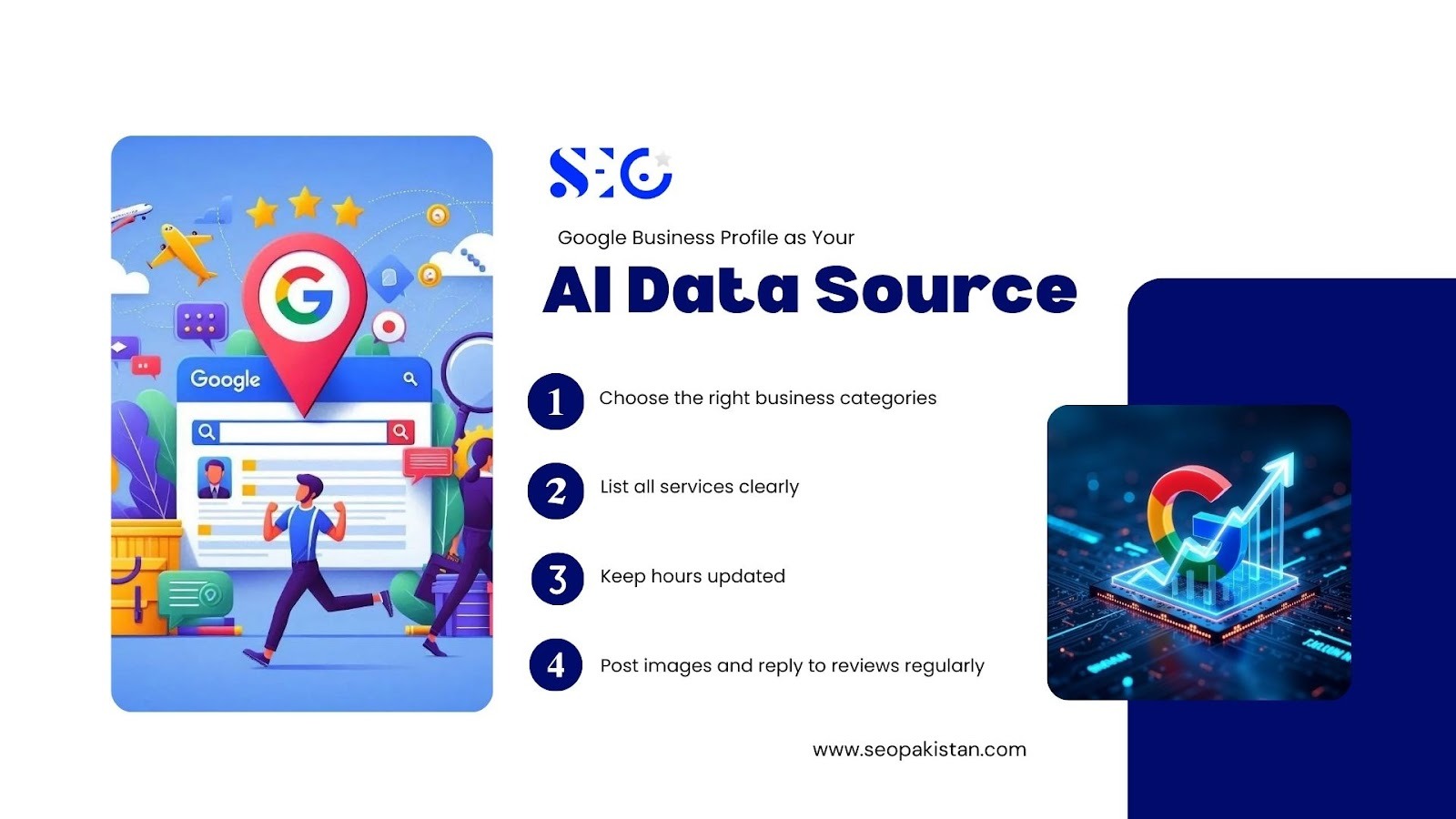
Critical optimization factors include:
- Correct business category: Selecting the most accurate primary and secondary categories helps AI match the business to relevant queries
- Accurate services: Listing every service clearly ensures AI can recommend the business for specific service-related searches
- Updated hours: Outdated operating hours reduce trust signals and create negative user experiences
- High-quality images: Visual content signals an active, legitimate business presence
- Weekly posts: Regular GBP posts indicate an engaged, active business and feed fresh content to AI systems
- Active review replies: Responding to reviews signals professionalism and boosts engagement metrics that AI considers
Businesses that treat their GBP as a passive listing will struggle with Local SEO in 2026, as they miss the opportunity to feed AI systems the accurate, rich, and current information needed to rank.
Structured Data and Schema Markup
AI cannot recommend what it cannot clearly understand. Structured data gives AI systems a direct, machine-readable format to process business information accurately and efficiently.
Which schema types matter most for local businesses? The highest-impact schema types include:
- LocalBusiness schema: Identifies the business type, location, contact details, and operating hours
- Service schema: Describes individual services the business offers in structured, crawlable format
- Review schema: Marks up customer review content so AI can read and evaluate it
- AggregateRating schema: Communicates overall rating data in a format AI systems can pull into summaries
- Geo coordinates: Provides precise location data that supports map-based and proximity searches
When structured data is implemented correctly, AI does not have to interpret or guess. It reads clean, organized information and can cite it with confidence. Businesses without schema markup force AI to work harder—and AI will often default to a competitor with cleaner data.
NAP Consistency and Entity Authority
NAP stands for Name, Address, and Phone Number. It sounds simple. Its impact on entity SEO is profound.
AI systems build an understanding of a business by cross-referencing information across multiple platforms. When that information is consistent, AI confidence in the entity increases. When it conflicts, AI trust in the business as a reliable entity drops.
NAP consistency must be maintained across every platform where the business appears:
- Website: The contact page, footer, and any location pages must display identical information
- Google Business Profile: The primary source AI references first
- Local directories: Yelp, Yellow Pages, Apple Maps, and industry-specific directories must all match
- Social platforms: Facebook, Instagram, LinkedIn, and any other active profiles must reflect the same business information.
AEO vs Traditional SEO
Answer engine optimization represents a fundamental shift in how businesses should approach content strategy. Traditional SEO and AEO are not opposites—but they prioritize different outcomes.
Traditional SEO
Traditional SEO focuses on a well-established set of ranking signals:
- Keywords — identifying and targeting search terms users enter
- Rankings — competing for visible positions on the results page
- Backlinks — earning external links that transfer authority to the website
These tactics still carry value. However, relying on them exclusively in 2026 leaves a significant portion of AI-driven search visibility untapped.
AEO Strategy
Answer Engine Optimization (AEO) redefines the goal of SEO. Instead of just ranking on a results page, the new objective is to become the definitive source cited directly within an AI’s generated response.
An effective AEO strategy includes:
- Question-based content: Creating pages and articles structured around the specific questions users ask in conversational search
- FAQs: Including clearly formatted FAQ sections that AI can pull directly into generated summaries
- Structured answers: Presenting information in clean, direct formats that require minimal interpretation
- Concise explanations: Giving AI usable, citable sentences rather than vague paragraphs full of qualifying language
Businesses that optimize for AI citations rather than just rankings are positioning themselves to appear inside AI Overviews—which is where attention now concentrates at the top of search.
Brand Mentions and Digital Authority
Backlinks were the currency of traditional SEO. In 2026, brand mentions are becoming equally—and in some contexts, more—valuable. AI systems use mentions to build a picture of how recognized and trusted a business is across the broader digital landscape.
Where do brand mentions actually influence entity credibility? The platforms and channels that matter most include:
- News websites: Coverage by local or industry news outlets carries significant authority weight
- Industry blogs: Mentions within relevant professional content signal topical expertise
- YouTube: References in video content reach large audiences and create indexed, searchable entity signals
- Podcasts: Audio mentions, especially in transcribed episodes, contribute to brand recognition signals
- Forums: Organic discussions on Reddit, Quora, and niche community platforms demonstrate real-world reputation
- Social media: Consistent brand references across active social channels reinforce entity presence
Each mention reinforces to AI systems that this business exists, operates in a specific space, and is recognized by others..
Technical Accessibility for AI Crawlers
AI systems cannot recommend content they cannot read. Technical SEO in 2026 focuses heavily on ensuring that business information is fully accessible to AI crawlers—not just traditional search bots.
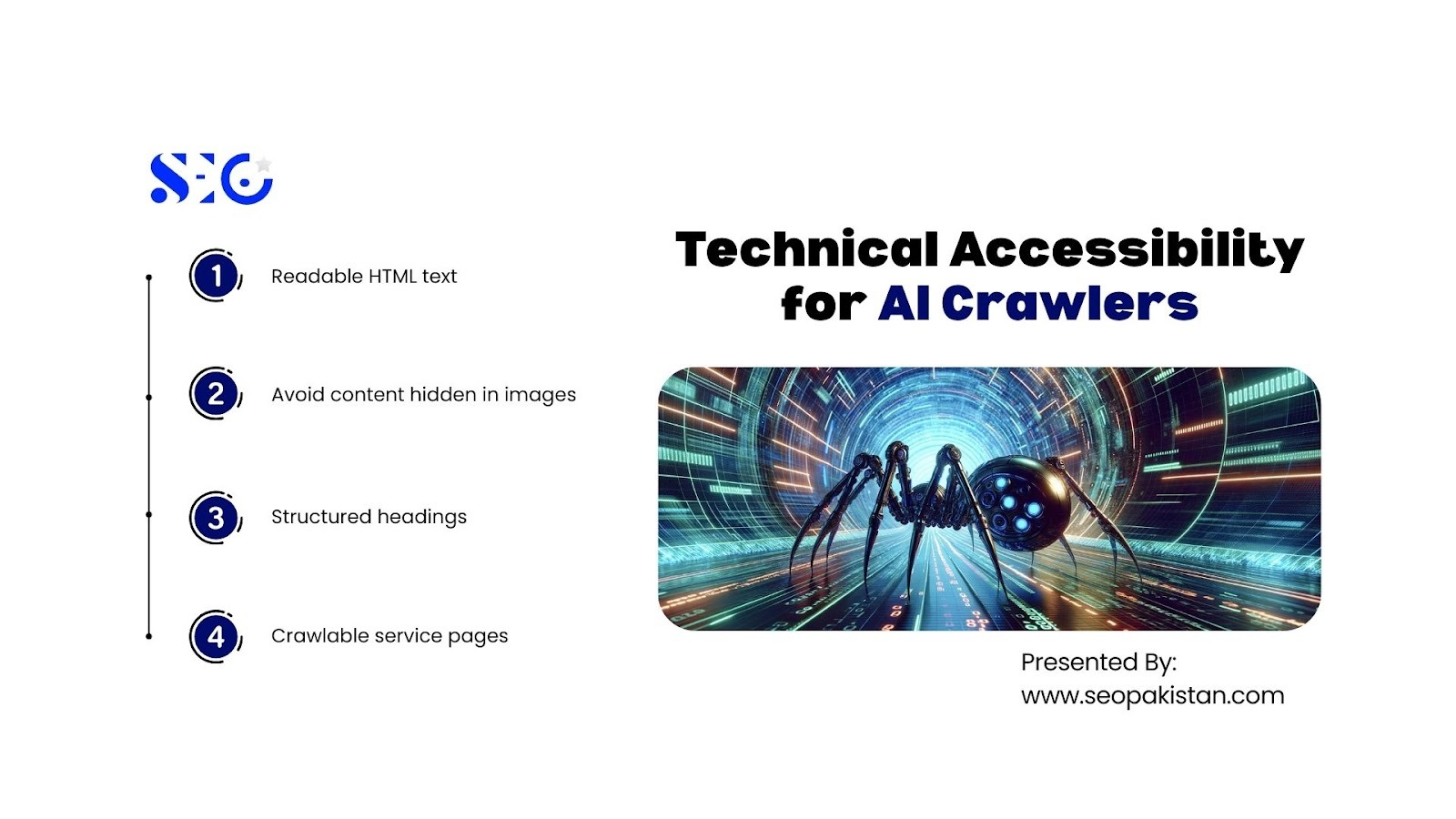
What technical factors determine whether AI can effectively read and cite a website? The critical elements include:
- Readable HTML text: All important business information must exist as crawlable text, not as images or embedded graphics
- Avoid content hidden in images: Phone numbers, addresses, and service descriptions placed inside image files are invisible to AI crawlers
- Structured headings: Clear H1, H2, and H3 heading hierarchies help AI understand content organization and priority
- Crawlable service pages: Each major service should have a dedicated, indexable page with clear, structured content
- Structured data markup: Schema implementation makes content machine-readable at the deepest level
AI systems cannot cite what they cannot process. A technically inaccessible website creates a hard ceiling on AI visibility, regardless of how strong every other signal is.
The Winning Formula for Local SEO in 2026
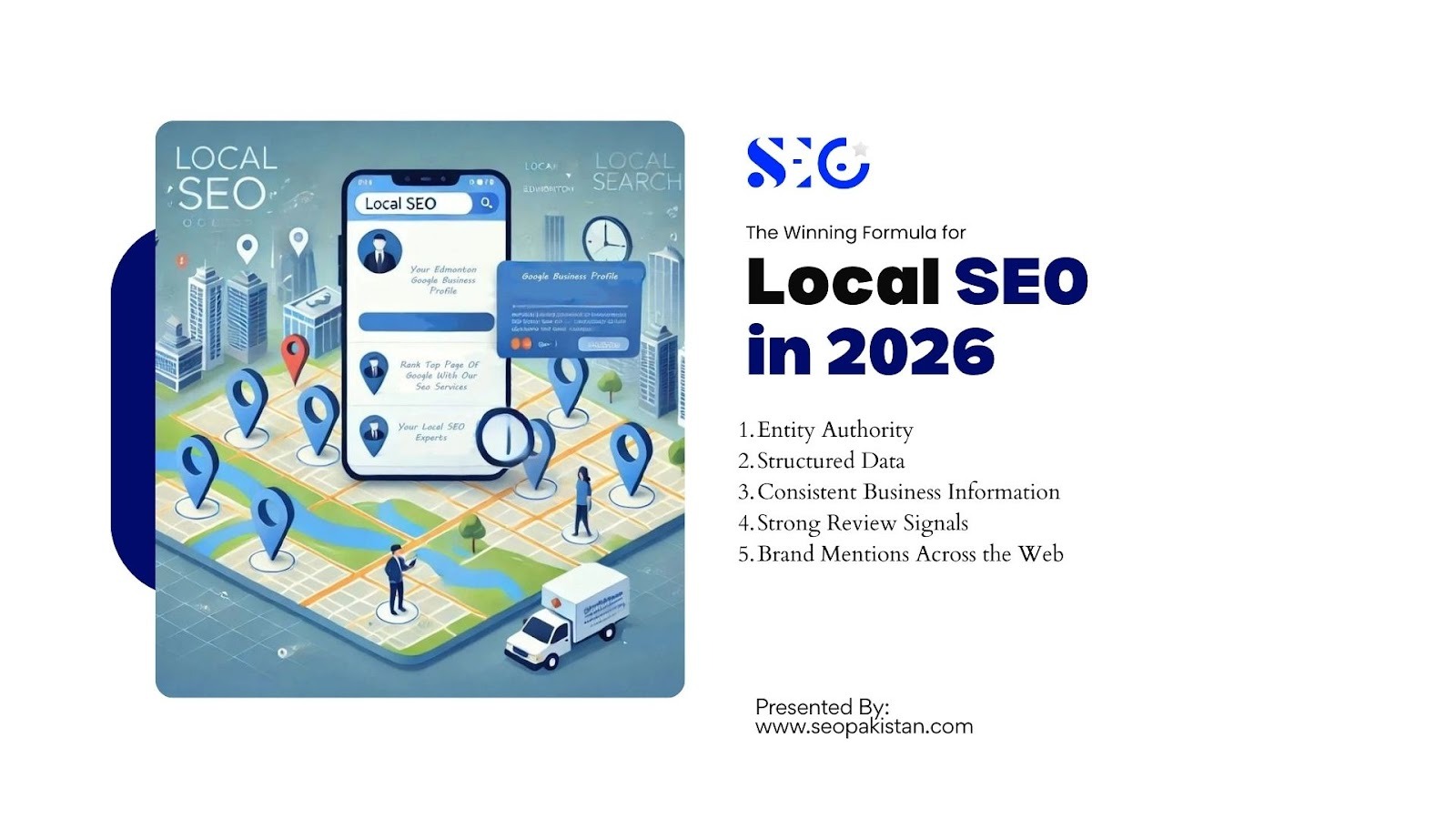
Every strategy discussed in this guide connects back to five core pillars. Businesses that build strength across all five will position themselves to win in AI-driven local search optimization.
The complete formula for Local SEO in 2026:
1. Entity Authority: Build a consistent, well-documented, and widely recognized digital presence across every relevant platform. AI recommends entities it understands and trusts.
2. Structured Data: Implement schema markup across all key pages. Give AI clean, machine-readable business information that it can cite directly without interpretation.
3. Consistent Business Information: Maintain perfect NAP consistency across the website, GBP, directories, and social platforms. Conflicting data reduces AI confidence in the business as a trustworthy entity.
4. Strong Review Signals: Encourage detailed, content-rich customer reviews that describe specific services, staff, and experiences. AI reads review content, not just star ratings.
5. Brand Mentions Across the Web: Build a presence beyond the website. Earn mentions in news, industry blogs, video content, podcasts, and forums to establish broad digital authority.
These five pillars work together. Weakness in any one area creates a gap that competitors with a more complete strategy will fill.
Conclusion
Local SEO in 2026 requires businesses to think beyond keywords and positions. The businesses that will dominate AI search results are those that invest in entity authority, structured data, and consistent, verifiable information across every digital touchpoint.
Answer engine optimization is essential, determining whether AI recommends your business. Similarly, Google Business Profile optimization is now a primary data source for AI. As zero-click searches rise, businesses that adapt will capture user attention at the most critical moments.
Strengthen your entity signals. Make your data consistent. Earn mentions across the web. Local search optimization in the AI era rewards preparation—and the time to prepare is now. Ready to future-proof your local business for the AI era? Visit seoakistan.com to build a digital presence that stands out.
Frequently Asked Questions
What is Local SEO?
Local SEO is the process of making your business more visible in local search results and on services like Google Maps. It involves optimizing your digital presence to attract more customers from relevant local searches.
How does AI affect local search rankings?
AI impacts local search through features like Google AI Overviews, which provide direct answers and reduce clicks to websites. To rank, businesses must now aim to be cited directly within these AI-generated summaries.
What is Answer Engine Optimization?
Answer Engine Optimization (AEO) involves structuring your content to be easily understood and cited by AI for user queries. This means focusing on providing clear, direct answers rather than just targeting keywords.
Why is Google Business Profile important for AI search?
Your Google Business Profile is a key data source for AI search systems when they recommend local businesses. An optimized profile ensures AI accurately understands and represents your business in its results.
How can businesses improve local search visibility in 2026?
Businesses can improve local search ranking factors by building entity authority through consistent NAP data, implementing structured data and schema markup, optimizing their Google Business Profile, encouraging detailed customer reviews, earning brand mentions across diverse digital platforms, and ensuring their website is technically accessible to AI crawlers.