

Voice search optimization is the process of updating your website content to answer spoken questions effectively. Users now rely on AI assistants like Google Assistant, Alexa, and Siri to find immediate answers. This shift requires websites to adopt robust voice SEO strategies and prioritize conversational search optimization.
By 2026, experts predict that over half of all online queries will be spoken. Mastering voice query ranking ensures your business remains visible in this new era of digital discovery.
What Is Voice Search Optimization? (And Why It’s Rewriting SEO Rules)
Search engines continually update their algorithms to match human behavior. Voice search optimization forces webmasters to rethink how they present information.
Voice Search vs Traditional Search: What’s Really Different?
People type differently than they speak. A typed query might be “weather New York,” but a spoken query becomes “What is the weather like in New York today?” How can you adapt to this change? What steps ensure your content captures these longer queries? Consider these adjustments:
- Target long-tail keywords and natural language phrases instead of fragmented keywords.
- Focus on user intent and provide immediate, direct answers, often in a question-and-answer format.
- Structure your content with clear headings and subheadings to mimic a real human conversation.
- Ensure your website is mobile-friendly, as most voice searches are performed on mobile devices.
- Optimize for local search by including location-specific keywords and maintaining an updated Google Business Profile.
How Voice Assistants Actually Understand Your Content
AI voice assistants do not just read words. They analyze natural language processing (NLP) signals and match them with entity-based understanding. Why does this technical detail matter? How can you structure your data for AI?
- Use schema markup to define entities clearly for search engines.
- Write comprehensive answers that cover related subtopics.
- Ensure your site architecture supports logical information retrieval.
Now the real question is: how does this shift change rankings entirely?
Why Voice Search Is Exploding (And Why Most Websites Are Not Ready)
People love things that make their lives easier, and voice search is the perfect example. It’s much quicker to speak a question into a device than it is to type it out, especially on a tiny mobile keyboard.
This demand for speed and convenience is a major reason why voice search is becoming so popular.
The Rise of AI Voice Assistants in Everyday Search
Smart speakers and mobile devices dominate modern households. Users rely on these devices for daily tasks, shopping, and research. What devices are driving this trend? How do they impact search volume?
- Smartphones remain the primary driver of voice searches on the go.
- Smart speakers like Amazon Echo handle home-based queries.
- Wearable technology integrates voice search into everyday activities.
Users Are Asking, Not Searching
Spoken queries naturally form complete questions. This conversational behavior changes the keywords you must target. Are you answering the right questions? How do you find what users are actually asking?
- Analyze your search console data for question words like “who,” “what,” “where,” “when,” “why,” and “how.” For example, a bakery might see queries like “where can I find the best sourdough near me?”
- Use public forums like Reddit or Quora to identify common customer inquiries. A skincare brand could search for “what’s the best routine for oily skin?” to find questions to answer.
- Check the “People Also Ask” section on Google search results for related questions.
- Create content that directly answers these questions in the first paragraph, making it easy for search engines to pull it for a featured snippet.
Local + High-Intent Voice Queries = More Conversions
People frequently use voice commands to find local businesses. These “near me” searches carry a high purchase intent.
| Factor | Traditional SEO | Voice Search SEO |
| Query Length | Short keywords | Long conversational queries |
| Intent | Mixed | Highly specific |
| Content Style | Keyword-focused | Natural language |
| Results | SERP list | Single answer (Position Zero) |
| Optimization Focus | Keywords | Questions + intent |
| User Behavior | Browsing | Immediate answers |
Notice how voice search removes options and rewards only the best answer, not just optimized content.
How Voice Search Is Changing SEO (What Google Doesn’t Tell You)
Search engines now prioritize the meaning behind queries over exact keyword matches. This evolution, known as semantic search, completely alters the traditional SEO playbook.
From Keywords to Entities and Intent (Core Ranking Shift)
Semantic SEO moves beyond keywords to connect related concepts, allowing search algorithms to reward comprehensive topical coverage. Building this topical authority is essential for signaling expertise to search engines. But how do you go beyond the basics?
Advanced strategies for building topical authority include:
- Build a Knowledge Graph: Map out the relationships between key concepts in your industry. Use structured data (like sameAs and about schema) to explicitly define these connections for search engines.
- Strategic Internal Linking: Guide users from informational content to product pages. Use descriptive anchor text, such as linking an article on “choosing running shoes” to a page for “best trail running shoes for flat feet.”
- Focus on Entities: Instead of targeting broad keywords like “best coffee maker,” create comprehensive content around specific entities like “Breville Barista Express,” including reviews, comparisons, and guides.
The Rise of Answer Engines (AEO) and Featured Snippets
“Position zero” is prime real estate in search, especially for voice queries, as assistants like Siri and Alexa often read the featured snippet aloud. Capturing this spot drives significant traffic and establishes your brand as an authority.
Here’s how to secure it:
- Provide a Concise Answer: Immediately after a heading, give a direct answer to the query in 40–50 words. This “answer-first” format is highly effective.
- Use Structured Data: Organize information with bullet points, numbered lists, and tables. This makes your content easy for search engines to parse and feature.
- Optimize HTML Structure: Use a logical tag hierarchy (H1, H2, H3) to structure your content clearly.
AI Overviews and GEO: The Future of Search Visibility
Generative Engine Optimization (GEO) involves formatting content so AI models can easily extract it. Search engines use AI overviews to summarize complex topics. How can you optimize for AI extraction? What structural changes help?
- Write highly scannable content with descriptive headings.
- Include objective facts and cite authoritative sources.
- Use bullet points to break down complex procedures.
Voice Search Ranking Factors You Can’t Ignore in 2026
To rank high in voice queries, you need effective voice search optimization. This involves refining specific technical and content elements.
Featured Snippets: The #1 Voice Search Opportunity
Winning featured snippets directly translates to winning voice search. Search engines pull voice answers almost exclusively from these snippets. What is the secret to securing them? How should you format your paragraphs?
- Identify keywords where a snippet already exists.
- Write a better, more accurate answer than the current ranking page.
- Place the target question in an H2 or H3 tag.
Conversational and Question-Based Keywords
Long-tail queries dominate voice search. Users speak in full sentences and expect accurate responses. How do you integrate these phrases naturally? What tools help identify them?
- Use keyword research tools to filter for question modifiers.
- Listen to customer service calls to capture exact phrasing.
- Include these phrases in subheadings and FAQ sections.
Mobile Speed and Technical SEO Signals
Voice searches primarily occur on mobile devices. A slow website will never rank for voice queries. How fast does your site need to be? What technical elements require attention?
- Optimize images and use modern formats like WebP.
- Minimize JavaScript execution time.
- Ensure your server response time is under 200 milliseconds.
Structured Data and Schema Markup
Schema markup translates your content into a language that AI easily understands. It provides explicit context about your business, products, and articles. Which schemas are most important? How do you implement them?
- Apply the FAQ schema to your question-and-answer sections.
- Use the Local Business schema to highlight your address and hours.
- Implement the Article schema to define your main content clearly.
Local SEO Signals and “Near Me” Optimization
Your local presence is crucial for voice search. Voice assistants rely on GPS and local signals to answer location-based queries like “coffee shop near me.” To dominate local voice search, you need to go beyond the basics.
- Optimize your Google Business Profile (GBP) for voice: Use the Q&A section to answer common voice search queries and add attributes to highlight features like “outdoor seating” or “wheelchair accessible.”
- Build hyper-local citations: Get listed on niche local directories, neighborhood blogs, and community websites to reinforce your local relevance.
- Encourage keyword-rich local reviews: Prompt customers to mention specific services or products in their reviews to match your business to specific voice queries.
- Create location-specific content: Develop service pages or blog posts for each neighborhood, embedding a local map and mentioning nearby landmarks to strengthen geographic signals.
Advanced Voice Assistant SEO Strategies (Where You Beat Competitors)
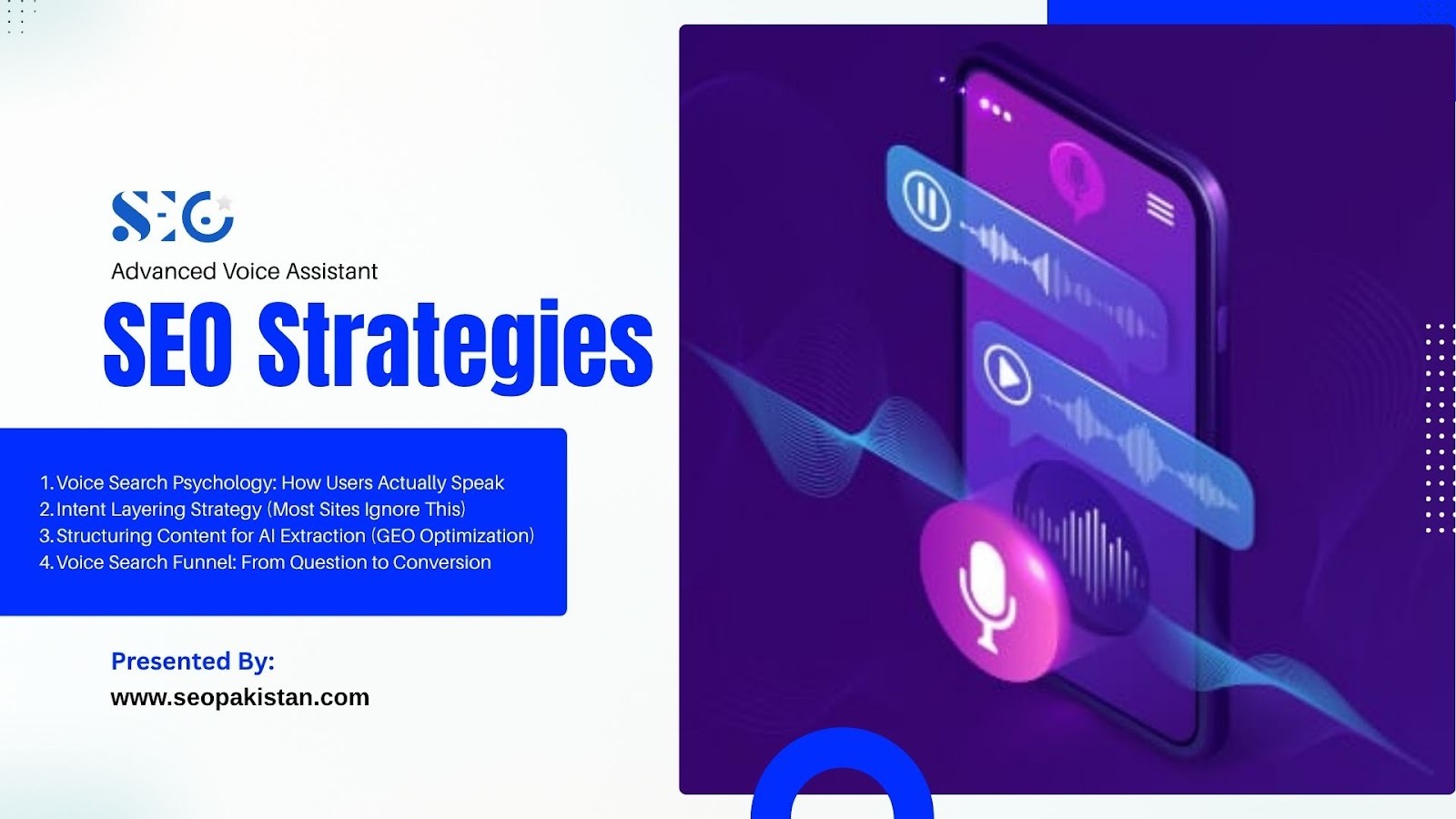
Basic strategies will only get you so far. To gain a real competitive edge, you need advanced voice search optimization tactics.
Voice Search Psychology: How Users Actually Speak
Understanding natural phrasing helps you anticipate queries. Users often add context or conditions to their spoken searches. How do you capture these nuances? What psychological triggers matter?
- Analyze the emotional intent behind the query.
- Use modifier words like “best,” “easiest,” or “fastest.”
- Match the urgency of the user’s spoken request.
Intent Layering Strategy (Most Sites Ignore This)
Multi-intent content addresses several stages of the buyer journey on one page. This strategy satisfies broad and specific queries simultaneously. How do you layer intent? What structure supports this?
- Start with a broad definition at the top of the page.
- Move into specific comparisons or actionable steps.
- End with a clear transactional call to action.
Structuring Content for AI Extraction (GEO Optimization)
Scannability allows AI to parse your content quickly. Headings and lists are your best tools for GEO optimization. How do you design for AI? What elements are strictly necessary?
- Use a logical H1, H2, and H3 hierarchy.
- Summarize key points at the beginning of major sections.
- Ensure tables have clear header rows and concise data points.
Voice Search Funnel: From Question to Conversion
Voice search often starts with awareness and moves quickly to action. You must guide the user through this funnel seamlessly. How do you transition from an answer to a sale? What steps bridge the gap?
- Provide the informational answer first to build trust.
- Introduce your product or service as the logical solution.
- Offer an easy, mobile-friendly way to contact you or purchase.
Voice Search Optimization Checklist (Quick Wins You Can Apply Today)
Implement these steps immediately to improve your voice search visibility. Are you ready to optimize your site? Where should you begin?
- Use conversational keywords.
- Add FAQ sections.
- Optimize for featured snippets.
- Improve site speed.
- Add schema markup.
- Focus on local SEO.
Key Takeaways
To dominate voice search, focus on understanding user intent and providing direct, concise answers. Securing featured snippets is crucial, as they are the primary source for voice assistant responses. By structuring your content for AI and optimizing for local search queries, you build a powerful, future-proof SEO strategy.
This dual approach ensures that whether a user is asking for directions or product information, your brand is the one providing the answer. Mastering voice search optimization isn’t just about keywords; it’s about becoming the definitive authority in your niche.
Ready to make your brand the voice of your industry? Visit seopakistan.com now to start your journey to the top of voice search results
Frequently Asked Questions
What is voice search optimization?
Voice search optimization is the process of structuring content to answer spoken queries clearly and quickly. It works by using conversational keywords, question-based headings, and direct answers so AI assistants can easily extract and deliver your content.
How can I rank my website for voice search in 2026?
To rank for voice search, focus on answering questions directly, targeting long-tail conversational keywords, optimizing for featured snippets, improving mobile speed, and adding schema markup. These factors help search engines select your content as the best spoken answer.
What are the best keywords for voice search SEO?
The best keywords for voice search are long-tail, conversational phrases that reflect how people speak. These include question-based queries starting with who, what, where, when, why, and how, often combined with local intent like “near me.”
How can I optimize my content for conversational search queries?
To optimize for conversational queries, write in a natural tone, include full-sentence questions, and provide direct answers. Use headings that match spoken queries and ensure your content flows like a real conversation to align with user behavior.
How is voice search different from traditional SEO?
Voice search focuses on conversational queries and direct answers, while traditional SEO targets shorter keywords and multiple results. Voice search prioritizes intent, natural language, and featured snippets instead of just ranking positions on a results page.
How do AI assistants understand and select content?
AI assistants use natural language processing and entity recognition to analyze content. They prioritize well-structured pages with clear answers, relevant context, and schema markup to deliver accurate and reliable spoken responses to users.