


Manufacturing SEO for industrial parts is a specialized strategy focused on ranking for the specific, technical search terms used by engineers, procurement teams, and B2B buyers. It requires deep industrial machinery keyword research, structured data for complex components, and content that matches high-value search intent.
By optimizing for how technical decision-makers look for solutions, manufacturers can improve supply chain visibility and drive OEM lead generation. This approach transforms a website from a simple digital catalog into a powerful tool for securing high-value contracts by capturing buyers with precise purchasing needs.
Why Manufacturing SEO Requires a Different Strategy
Industrial SEO operates on entirely different principles because the target audience is highly technical, the search queries are extraordinarily specific, and the financial stakes are massive. Traditional consumer tactics fail in this environment. You must adapt to the rigid logic of the industrial buyer.
These buyers search with distinct patterns that demand a tailored approach. Consider these critical factors that separate industrial optimization from standard retail strategies:
- Low search volume combined with exceptionally high purchase intent defines the traffic.
- The buying cycles remain notoriously long and technologically complex.
- Multiple technical decision-makers require different types of validating information.
A core principle of manufacturing SEO for industrial parts is that ranking for fewer, highly relevant keywords consistently generates a better return on investment than capturing broad, unqualified traffic.
How Industrial Buyers Actually Search for Components
To rank effectively, you must align your content with how engineers and procurement teams search in real operational scenarios. They rarely use generic terms when sourcing critical infrastructure. Their queries look more like technical specifications than traditional search phrases.
Understanding this search behavior allows you to capture buyers at the bottom of the funnel. Review these common search patterns used by procurement teams:
- Searching by Exact Part Names and Specifications: Buyers use precise part numbers, model names, and detailed dimensional data in their searches.
- Including Application Context: Queries often contain the specific use case, such as the equipment or environment where the part will be used.
- Using Technical Long-Tail Keywords: Engineers use highly specific, multi-word phrases that read like technical requirements rather than simple keywords.
For example, a buyer will skip “industrial gearbox” and search directly for “high torque gear reducer 15 HP” or “industrial gearbox for cooling tower.”
The Keyword System Behind High-Performing Manufacturing SEO
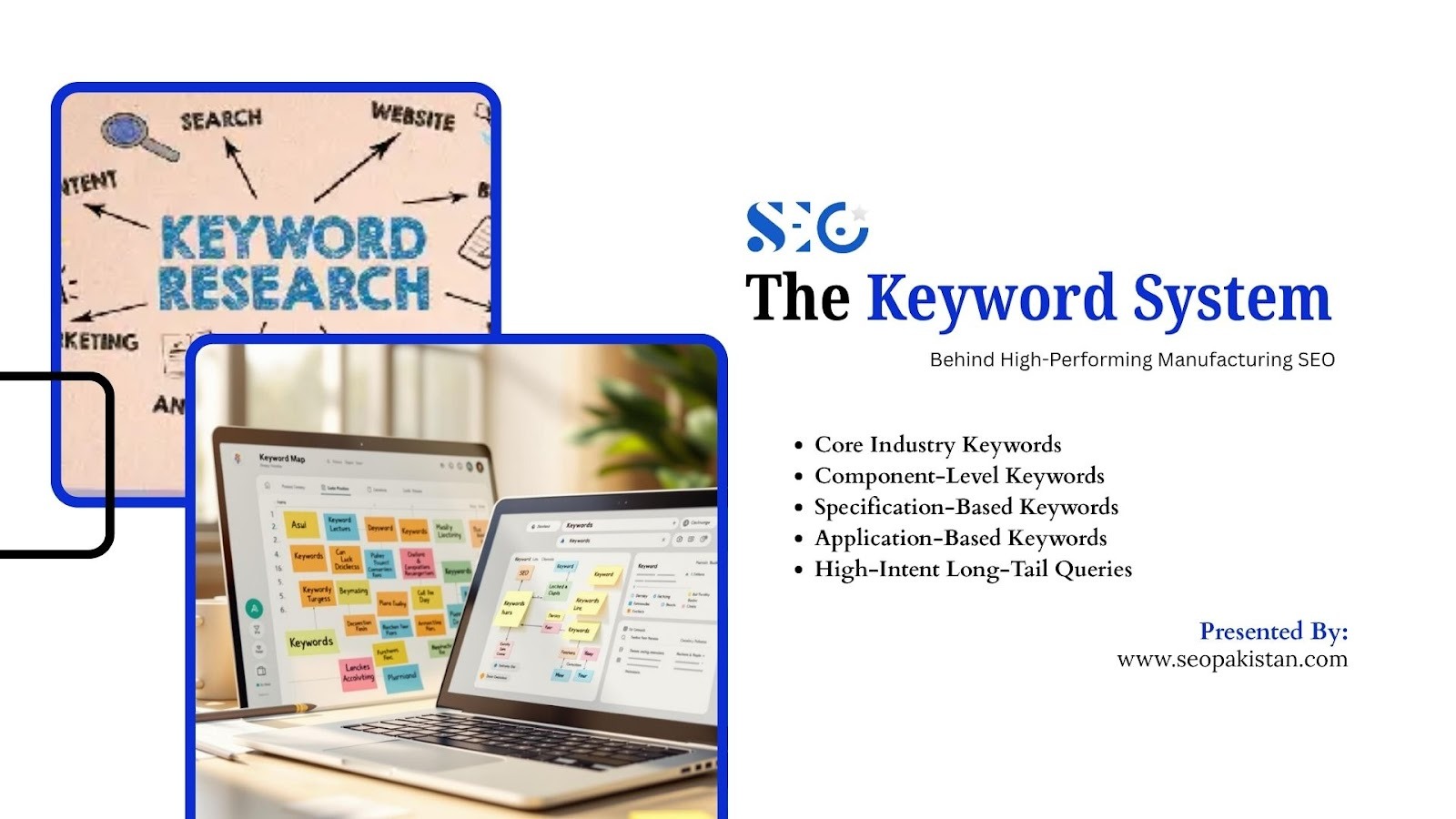
Winning in manufacturing SEO for industrial parts requires a structured keyword system. Random keyword placement will not yield sustainable rankings. You must categorize your targets to match different stages of the engineering lifecycle.
Core Industry Keywords
Core keywords define your overarching market position. They capture high-level searches from project managers exploring broad capabilities.
- Manufacturing SEO for industrial parts establishes your primary digital foundation.
- Heavy equipment SEO targets users looking for large-scale machinery optimization.
- Industrial machinery keywords anchor your content in the manufacturing sector.
Component-Level Keywords
Component-level queries focus on the actual products you manufacture. These terms connect you with buyers actively sourcing specific assemblies.
- Industrial gearboxes keywords connect you with buyers looking for mechanical power transmission solutions.
- Cooling tower components keywords attract facility managers responsible for maintenance and repairs.
- Hydraulic pump manifolds keywords put you in front of engineers designing new fluid power systems.
Specification-Based Keywords
Specification-based queries indicate extreme purchase intent. The user knows exactly what they need and only wants to find a capable supplier.
- Power rating specifications (e.g., “100 HP gearbox”) attract searches for precise mechanical output requirements.
- Material type keywords (e.g., “stainless steel hydraulic manifold”) capture buyers needing specific environmental or corrosion resistance.
- Performance specifications (e.g., “gearbox with 20:1 ratio”) connect your products to buyers with strict engineering tolerances.
Application-Based Keywords
Application-based keywords capture buyers trying to solve a problem within a specific industry. They might not know the exact part number, but they know the environment.
- HVAC systems terminology like “commercial air handler unit” or “VAV box actuator” targets buyers involved in large-scale climate control projects.
- Chemical processing keywords such as “sulfuric acid-resistant pump” or “hazardous location motor” attract buyers from chemical plants who require equipment that can withstand corrosive and volatile environments.
- Power generation terms like “high-pressure steam valve” or “turbine generator parts” connect you with procurement managers in the energy sector who need reliable components for power plants.
High-Intent Long-Tail Queries
High-intent long-tail queries represent the final step before a buyer requests a quote. These highly specific phrases often include commercial modifiers.
- OEM lead generation searches indicate a desire for a direct manufacturing partner.
- Supplier searches combined with location data target regional procurement needs.
- Exact part number queries reflect immediate replacement requirements.
The One Framework That Maps Keywords to Buyer Intent
This framework helps you align keywords with the industrial buyer journey. Mapping intent ensures every page on your site serves a distinct purpose. You will stop wasting budget on traffic that never converts.
| Buyer Stage | Search Intent | Keyword Type | Example Query |
| Awareness | Problem identification | Informational | cooling system efficiency issues |
| Consideration | Solution research | Technical / comparison | types of industrial gearboxes |
| Decision | Supplier selection | Transactional | OEM gearbox supplier USA |
| Purchase | Final validation | Branded / specification | buy 15 HP industrial gearbox supplier |
Building a Content Structure That Ranks Industrial Components
SEO success in manufacturing comes from covering entire topics thoroughly. Isolated keywords on thin pages will not rank in modern search engines. You must build a comprehensive architecture that proves your topical authority.
A strong architecture is foundational to Manufacturing SEO for Industrial Parts, guiding both search engine crawlers and human engineers through your technical catalog.
Implement these structural elements to dominate your niche:
- Pillar Pages: Create in-depth pillar pages for your main product categories. These serve as central hubs, providing comprehensive overviews that establish your authority on core topics.
- Detailed Product Pages: Go beyond basic descriptions. Your product pages must include the exact specifications, CAD models, and performance data that engineers need to make purchasing decisions.
- Technical Blog Content: Develop a technical blog that addresses complex engineering challenges, maintenance procedures, and application-specific questions. This will attract organic traffic and position your brand as a problem-solver.
- Strategic Internal Linking: Build a robust internal linking strategy that connects your pillar pages, product pages, and blog posts. This distributes “link equity” across your site, boosting the ranking potential of every page.
Optimizing Industrial Product Pages for Rankings and Conversions
When it comes to Manufacturing SEO for Industrial Parts, your product pages must serve both search engine algorithms and highly technical buyers. Balancing keyword optimization with rigorous engineering data is key, as a page with great SEO but missing specifications will bounce visitors instantly.
Transform your static product listings into powerful conversion assets. Implement these essential elements on every component page:
- Include detailed specifications, dimensional drawings, and tolerance data.
- Explain practical applications and proven industry use cases clearly.
- Add descriptive headings and structured data to organize complex information.
- Include strong calls to action, such as dedicated Request for Quote (RFQ) forms.
Common Manufacturing SEO Mistakes That Limit Rankings
Avoiding critical setup mistakes can significantly improve your search performance. Many manufacturers waste time deploying consumer SEO tactics on industrial catalogs. This mismatch destroys both rankings and credibility.
Watch for these specific pitfalls that commonly plague industrial websites:
- Targeting broad, irrelevant keywords drains your budget without generating sales.
- Ignoring technical details in the content frustrates engineers and increases bounce rates.
- Weak or thin product pages fail to rank for specification-based queries.
- A lack of structured keyword architecture prevents search engines from understanding your catalog.
Conclusion
Mastering manufacturing SEO for industrial parts remains the most effective way to secure a steady pipeline of high-value technical contracts. As procurement increasingly shifts to digital channels, your website must serve as your most capable sales engineer. You must provide the exact data, specifications, and trust signals that buyers demand.
By prioritizing B2B manufacturing optimization, you ensure your components surface when buyers need them most. Invest in structured content to improve your supply chain visibility and dominate your specific engineering niche. Implement these strategies consistently, and you will transform your technical catalog into a relentless engine for growth.
Ready to dominate the digital supply chain? Contact us today to learn how our specialized manufacturing SEO services can drive high-value leads and secure your market position.
Frequently Asked Questions
What is manufacturing SEO?
Manufacturing SEO for Industrial Parts is the practice of optimizing a manufacturer’s website to appear in search results when engineers, procurement managers, and B2B buyers search for specific industrial parts, components, or services. The goal is to attract high-value technical traffic and generate qualified leads.
How is SEO for manufacturers different from regular SEO?
Unlike traditional SEO, which often targets a broad consumer audience, manufacturing SEO focuses on a niche B2B audience with highly technical search queries. It involves a much longer sales cycle and prioritizes detailed product specifications and trust signals over general content.
What are the most effective keywords for industrial parts?
The best keywords are highly specific and reflect a buyer’s technical needs. This includes model numbers, part numbers, material specifications (e.g., “316 stainless steel ball valve”), and application-focused terms (e.g., “high-pressure hydraulic fittings”).
How does SEO help generate manufacturing leads?
By ranking for high-intent technical keywords, you attract qualified buyers who are actively sourcing parts. SEO drives them to optimized product pages with clear data, spec sheets, and prominent calls-to-action (like “Request a Quote”), converting website traffic directly into sales leads.
Why focus on long-tail keywords in industrial SEO?
Long-tail keywords (e.g., “NEMA 4X rated electrical enclosure 24x24x12”) are extremely valuable because they signal precise buyer intent. A user searching with this level of detail is often close to making a purchase, resulting in higher conversion rates.