


Medical device manufacturers often lose high-value RFQs not because of capability gaps, but because they are not visible in compliance-driven search results. In this industry, procurement teams and engineers do not explore vendors broadly; they filter aggressively based on FDA compliance signals, ISO 13485 certification, and technical manufacturing proof.
Manufacturing SEO for medical devices ensures that only qualified, regulation-aligned content appears in these decision-driven searches. Without this alignment, even highly capable manufacturers are excluded before evaluation begins.
How Medical Device Manufacturers Actually Get Discovered Online
In this industry, discovery does not start with brand names. It starts with problem-specific technical searches performed by engineers and procurement teams who are actively sourcing manufacturing partners.
These searches are highly filtered by risk and compliance requirements before any vendor contact happens.
- Engineers search based on material compatibility and machining capability
- Procurement teams filter suppliers by certification and production reliability
- Quality teams eliminate vendors lacking ISO 13485 or audit transparency
- Decision-makers prioritize suppliers with documented manufacturing processes
For example, a search like “ISO 13485 CNC medical machining supplier” is not informational — it is already part of the vendor shortlisting process. If your content does not match this intent, you are excluded before evaluation begins.
Mapping Manufacturing SEO to Medical Device Buyer Intent
To effectively implement manufacturing SEO for medical devices, it’s critical to understand the specific B2B decision-making roles and align your content with their search intent.
The buying committee is complex, consisting of distinct personas with unique search behaviors:
- Procurement managers: Focused on cost efficiency, supply chain stability, and strict compliance alignment. Their searches are highly transactional and focused on vendor vetting.
- Engineers: Driven by technical specifications, material tolerances, and design-for-manufacturing (DFM) capabilities. Their search behavior leans heavily into informational and highly technical queries.
- Quality assurance teams: Focused entirely on certification-driven searches. They require absolute proof of compliance, auditing capabilities, and quality management systems.
By segmenting keyword intent into informational (researching materials), procurement (contract manufacturing RFQs), and compliance-driven searches (ISO certified medical machining), you ensure that your site captures the buyer at every stage of their specific journey.
Turning Manufacturing Capability into Searchable Technical Proof
Most medical manufacturers fail in SEO because they describe services instead of proving capability.
Search engines and buyers do not respond to generic claims like “high-quality manufacturing.” They respond to structured technical proof.
Strong visibility comes from translating manufacturing operations into searchable engineering data:
- Machine capability must reflect tolerances, materials, and validated processes
- Service pages must show cleanroom classification and operational controls
- Component pages must map to real medical device applications
- Process pages must explain validation workflows and inspection systems
For instance, instead of stating “we offer medical machining services,” high-performing content explains “precision machining of titanium orthopedic components under ISO 13485-certified cleanroom environments with validated inspection protocols.”
This is what search engines recognize as authoritative in high-trust industries.
High-Value Keyword Framework for Medical Device Manufacturing SEO
A well-structured keyword architecture is essential for effective manufacturing SEO for medical devices, segmenting search terms into clusters that speak directly to the buyers outlined above.
FDA Compliance Keywords:
This cluster includes terms like regulatory approval processes, FDA-registered facilities, and specific FDA manufacturing keywords. These terms target quality assurance leaders and compliance officers who need to ensure vendor legality before moving forward.
ISO & Quality Keywords:
Targeting ISO 13485 visibility and quality management searches captures the mid-funnel evaluation stage. When procurement teams look for new partners, they filter aggressively by these specific quality standard queries.
Technical Manufacturing Keywords:
This cluster captures the engineers. Terms related to medical component optimization, micromachining tolerances, and cleanroom fabrication SEO attract the technical buyers who dictate the initial vendor shortlist based on exact capabilities.
How Regulatory-Compliant Content Becomes a Competitive Advantage
Most manufacturers treat compliance as a restriction. In reality, when it comes to manufacturing SEO for medical devices, it’s a powerful positioning advantage.
Regulatory-compliant content builds trust faster than any promotional material because it removes uncertainty from the decision-making process for your potential partners.
Instead of making outcome-based claims, high-performing content focuses on:
- Manufacturing capability boundaries
- Certification-backed processes
- Verified operational standards
- Documented quality assurance systems
This approach reduces perceived risk for procurement teams and increases conversion rates at the exact moment of vendor evaluation.
Building Regulatory-Compliant SEO Content Without Violating Standards
Knowing what can be claimed in medical SEO is the foundation of your content calendar. To ensure compliance safely, manufacturers must avoid medical misrepresentation.
You cannot claim that your manufacturing process guarantees a specific patient outcome; you can only claim that your process adheres to the required regulatory standard for that device type.
Here’s how to create a messaging framework that prioritizes compliance:
Safe positioning approach:
Instead of:
❌ “Our components prevent surgical infections.”
Use:
✔ “Our components are manufactured in ISO-certified cleanrooms designed to support contamination control requirements.”
In this model:
- Certifications become primary trust signals
- Manufacturing systems replace promotional claims
- Compliance documentation replaces marketing exaggeration
This ensures both regulatory safety and search visibility.
Authority Building for Medical Manufacturing Websites
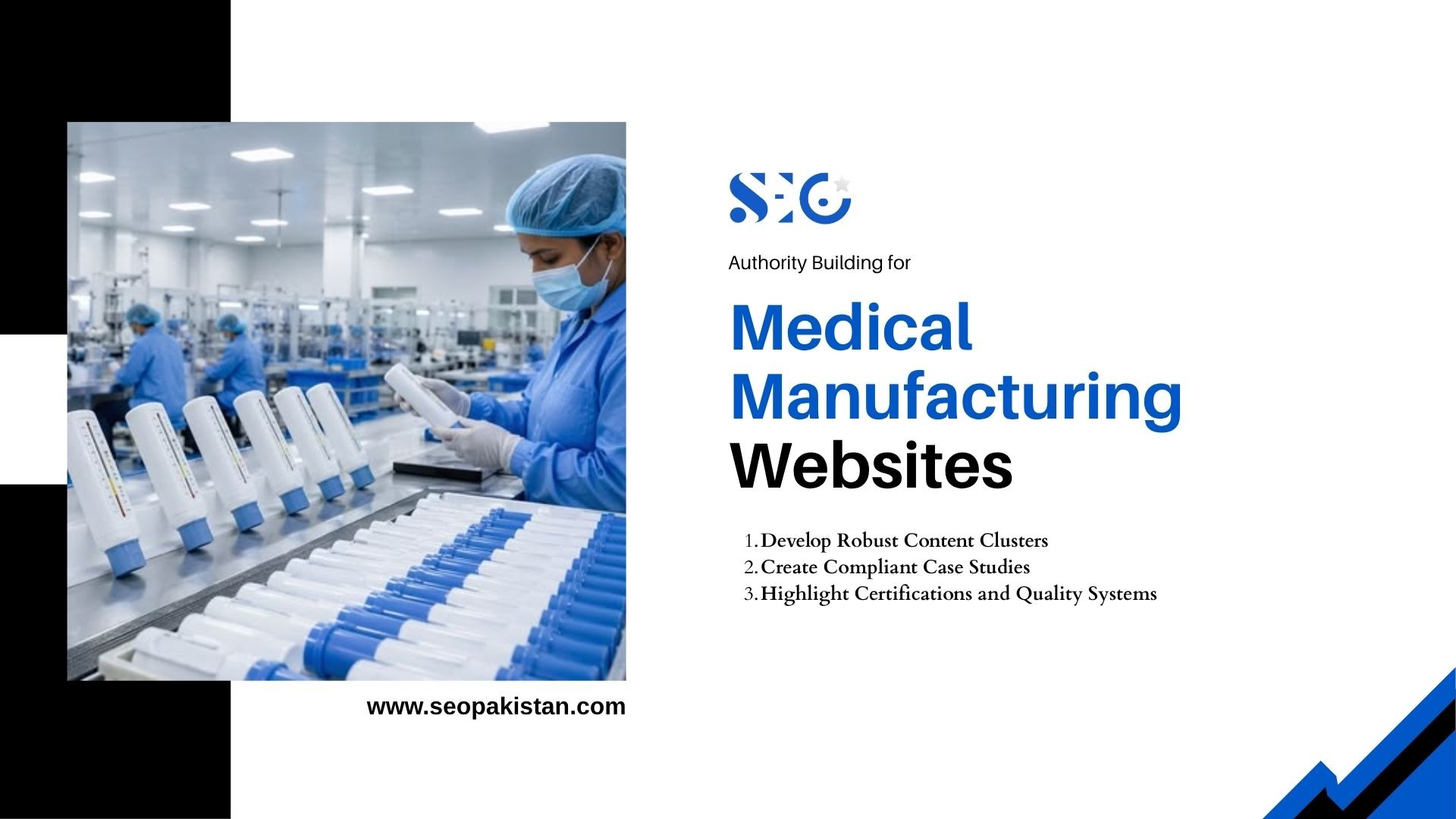
In medical manufacturing, establishing your website as an authoritative source is crucial. Rather than chasing a high number of backlinks, your focus should be on building deep topical authority.
This signals to search engines that your content is trustworthy and expert-led, which is a major ranking factor in this high-stakes industry.
Here’s how to build that authority effectively:
Develop Robust Content Clusters:
Create comprehensive content hubs around your core manufacturing processes. For example, if you specialize in micro-molding, build out a central pillar page and support it with detailed articles on material selection, tooling, and quality assurance for that specific service. This demonstrates deep expertise in one area.
Create Compliant Case Studies:
Case studies are powerful tools for showing your capabilities. To remain compliant, focus them on the manufacturing journey—not clinical outcomes. Detail the initial engineering challenge, the rationale behind material choices, and the specific quality control metrics you achieved for the client.
Highlight Certifications and Quality Systems:
Detail the processes within your quality manual to show potential clients and search engines that your operations are built on a foundation of documented, verifiable quality.
Manufacturing SEO Funnel for Medical Device Companies
To transform organic traffic into manufacturing inquiries, a meticulously mapped funnel is a cornerstone of manufacturing SEO for medical devices.
- Awareness: At the top of the funnel, compliance education content captures broad queries. Articles explaining the latest updates to FDA manufacturing guidelines or the material properties of medical-grade titanium attract early-stage researchers.
- Consideration: As buyers narrow their focus, manufacturing capability pages take over. This is where your highly optimized equipment lists, cleanroom specifications, and engineering capabilities live.
- Conversion: The bottom of the funnel relies on optimized RFQ and contact pages. These pages must reduce friction, offering secure CAD file uploads and clearly restating your primary certifications to reinforce trust at the exact moment of conversion.
Conclusion
To succeed with manufacturing SEO for medical devices, you need to continuously audit your website’s technical performance and compliance messaging. A successful strategy requires a deep understanding of your target audience, including engineers and quality assurance professionals.
Start by aligning your service pages with their specific search intents and showcase your certification prominently to build trust.
Ensure every claim on your site is backed by verifiable data. This not only strengthens credibility but also drives high-value organic growth and improves search engine rankings.
For a powerful and effective strategy tailored to the medical sector, consider partnering with experts. Visit seopakistan.com to explore premium, results-driven SEO services that can elevate your online presence.
Frequently Asked Questions
What is manufacturing SEO for medical devices?
It is a highly specialized search optimization strategy that targets regulated medical manufacturing companies. It focuses on driving B2B visibility through technical content, regulatory compliance phrasing, and targeted keyword mapping to attract engineers and procurement officers.
Why is SEO different for medical device companies?
Medical device SEO operates under strict regulatory restrictions from bodies like the FDA. Marketing language must be evidence-based, avoiding clinical claims or medical promises, requiring a focus on technical specifications and certified quality management systems.
What are FDA manufacturing keywords used for?
These keywords target compliance-driven search intent. Procurement managers and quality assurance teams use these specific search terms to find contract manufacturing partners that meet the strict legal requirements necessary to produce commercial medical devices.
How does ISO 13485 affect SEO strategy?
ISO 13485 certification heavily influences trust signals and content structure. Dedicated pages explaining adherence to this standard build topical authority, improve rankings for quality-based queries, and fulfill the strict vetting requirements of B2B medical buyers.
What type of content works best for medical device SEO?
The most effective content blends technical specifications, compliance-focused documentation, and educational resources. Detailed equipment capability pages, cleanroom validation protocols, and sanitized engineering case studies drive the highest quality organic traffic.
Can SEO content violate medical regulations?
Yes. Making unsupported clinical claims, guaranteeing patient outcomes, or misrepresenting facility capabilities in SEO content carries massive risks. Non-compliant messaging can result in search engine penalties and severe legal action from regulatory agencies.