

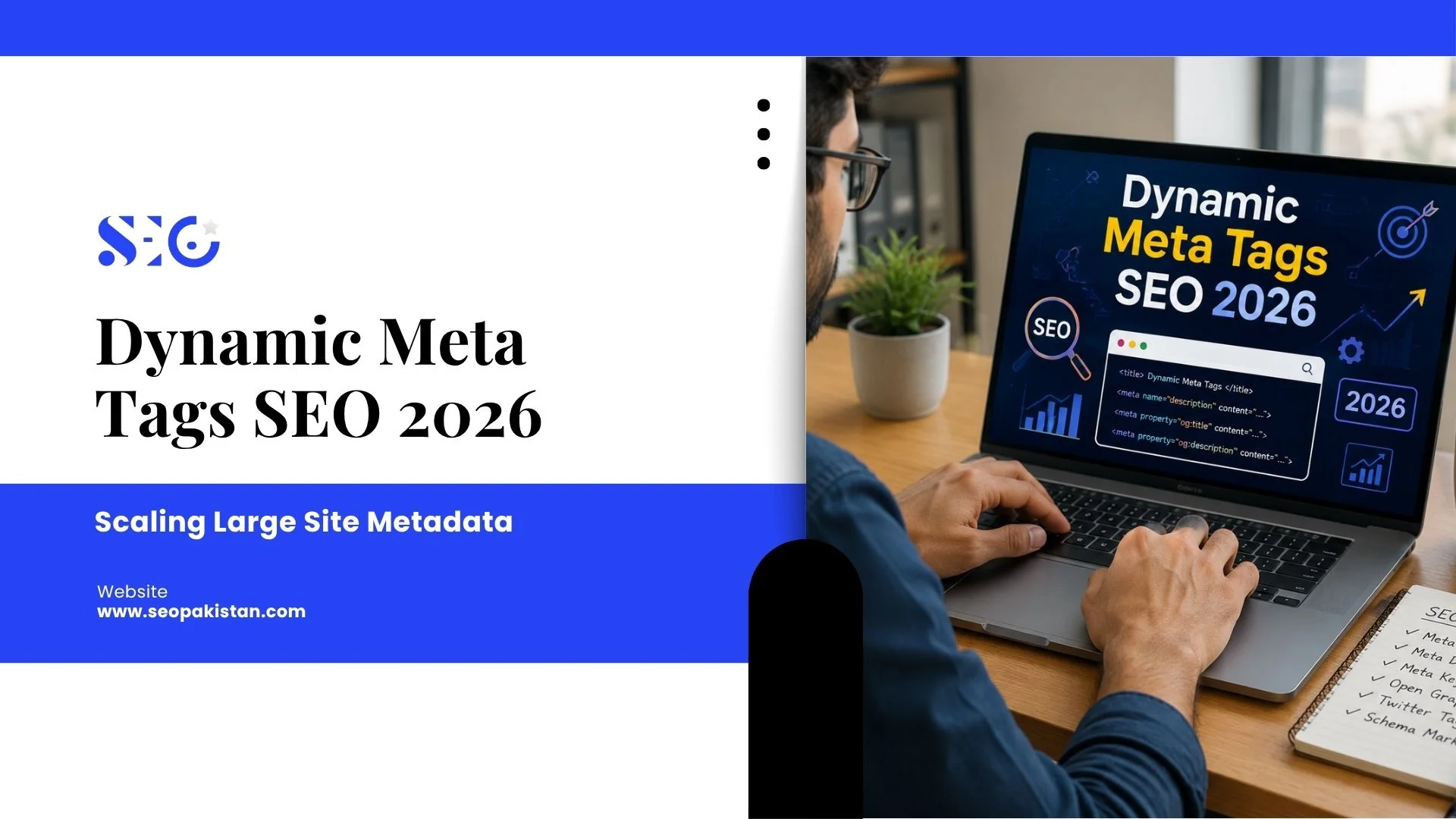
What is dynamic meta tags SEO 2026? It is the automated process of generating title tags and meta descriptions for websites with thousands of pages using programmable variables like product names, locations, and prices.
Implementing programmatic title tags eliminates manual data entry, ensures consistent optimization, and helps enterprise websites rank faster. Effective large-site meta optimization relies on intent-focused formulas and semantic entities, helping search engines and AI tools understand page context without duplicate content issues or thin metadata penalties.
Why Metadata Becomes a Scaling Problem on Large Websites
Large websites face a structural SEO challenge that small sites never experience. Metadata works well when a site has 20 or 50 pages. The system collapses when it reaches thousands or millions of URLs.
Search engines depend on metadata to understand relevance. Poor metadata reduces visibility, CTR, and index quality. Large sites often fail because they scale content faster than they scale SEO governance.
The breaking point of manual metadata management
Manual metadata management works perfectly for small websites with a few dozen pages. An SEO specialist writes unique titles and descriptions for 50 pages without losing quality or relevance.
However, this manual process completely breaks down when an ecommerce store or directory expands to 5,000 or 100,000 URLs. Writing unique tags for a massive inventory demands too much time and inevitably introduces human errors.
Understanding why manual metadata fails helps teams pivot to better systems. The most critical breakpoints include:
- Time consumption: Writing 100,000 tags manually takes years of uninterrupted labor.
- Human errors: Typographical mistakes ruin the professionalism of your search engine listings.
- Inconsistent optimization: Different writers apply different keyword strategies across the same site.
Common issues on sites with thousands of URLs
Websites without an automated metadata framework suffer from predictable technical SEO issues. Crawlers encounter messy code, confusing signals, and repetitive text across massive sections of the site.
These errors actively harm search rankings and reduce click-through rates. Without a structured approach like template-based meta SEO, large websites bleed potential traffic daily.
Recognizing these technical flaws allows you to fix them quickly. The most common metadata problems on massive sites include:
- Duplicate titles: Hundreds of pages share the exact same title tag.
- Missing descriptions: Search engines generate poor descriptions because the site lacks meta data entirely.
- Thin metadata: One-word titles provide zero context to users or search engine crawlers.
What Dynamic Meta Tags Actually Are
Dynamic vs static metadata
Static metadata remains identical until a human manually edits the code or CMS field. A static title like “Best Running Shoes | Brand Name” never updates unless an SEO manager rewrites it.
Dynamic metadata adapts automatically based on the content present on the specific URL. A dynamic formula like “Buy {Product Name} Online | Free Delivery” pulls the exact product name directly from the page database.
How variables populate metadata automatically
Dynamic variables act as placeholders that pull live data directly from your database. They are the building blocks of dynamic meta tags SEO 2026. When a user loads the page, the system replaces the bracketed variable with the actual database value.
Building a Dynamic Metadata Architecture

Defining metadata rules before implementation
Jumping straight into your CMS without a plan guarantees messy metadata across your site. You must define clear, mathematical rules for how your tags generate before writing a single formula.
Establishing clear guidelines protects your search visibility over the long term. Your metadata architecture document must define:
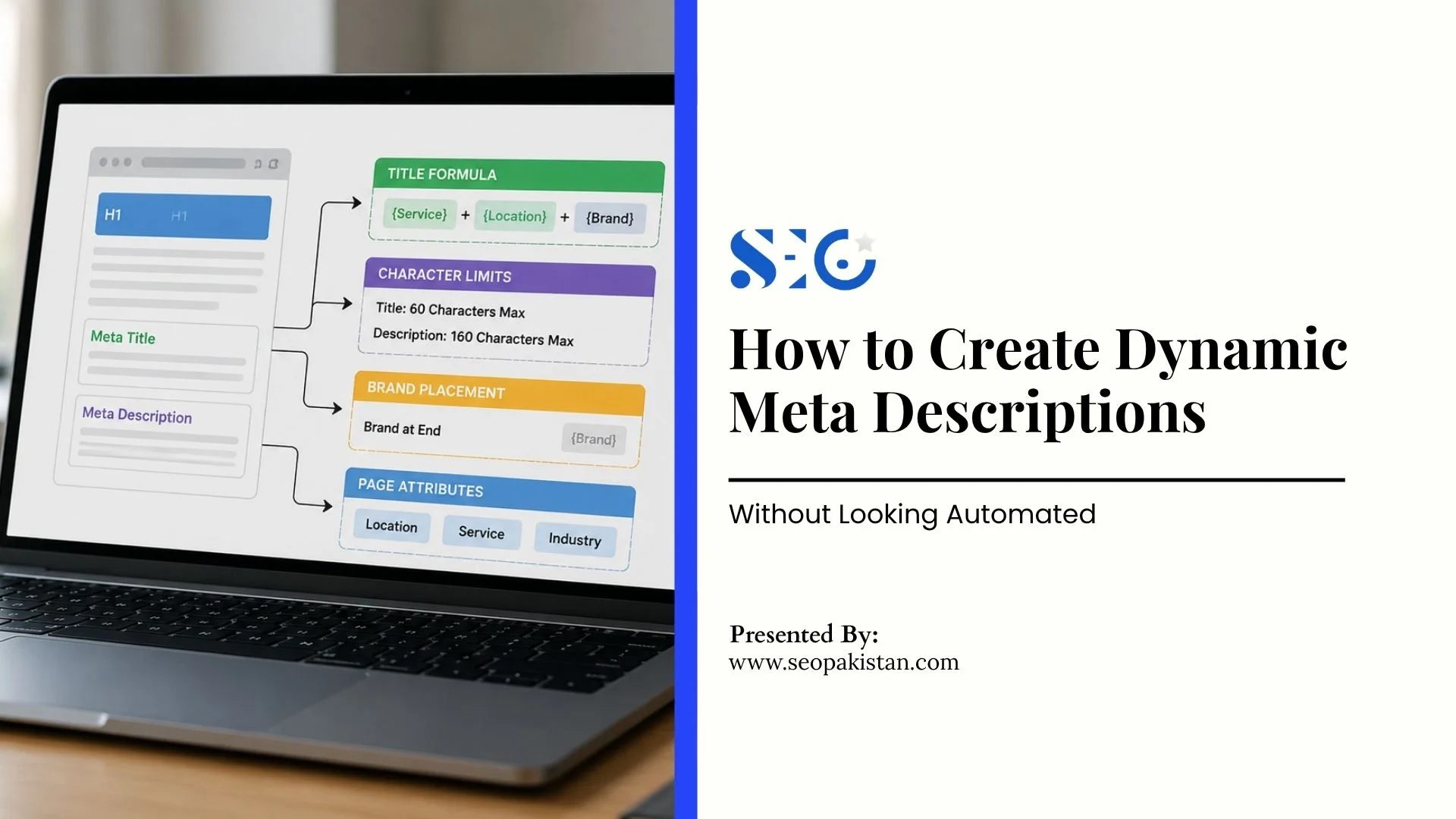
- Title formulas: The exact syntax and variable order for your H1 and Meta Titles.
- Character limits: Failsafes that prevent variables from exceeding Google’s display limits.
- Brand placement: Rules specifying whether the brand name appears at the start or end of the tag.
Choosing the right page attributes
Injecting too many variables into your metadata creates chaotic, unreadable titles and descriptions. You must select only the most relevant page attributes that match what users actually type into search engines.
Selecting powerful attributes ensures your dynamic meta tags SEO 2026 strategy drives actual traffic. The best variables to map include:
- Location: Captures local search intent effectively.
- Service: Identifies exactly what the business offers.
- Industry: Helps B2B companies target specific vertical markets.
Programmatic Title Tag Formulas That Scale
Product page title formulas
Product pages demand highly specific, transactional metadata to capture bottom-of-the-funnel buyers. By using dynamic meta tags SEO 2026 strategies, you can ensure your titles and descriptions are optimized for users searching for exact product names, who usually possess their credit cards ready for purchase.
Your formulas here must prioritize the product name early in the title tag. Adding trust signals or clear modifiers helps separate your listing from competitors selling the exact same item.
Effective product formulas capture immediate commercial intent. You should deploy formulas like:
- Buy {Product Name} Online | {Brand}: Direct, clear, and highly transactional.
- {Product Name} Price & Reviews: Captures users looking for validation before purchasing.
- Cheap {Product Name} Deals: Target cost-conscious searchers effectively.
Category page title formulas
Category pages act as digital storefronts for broad topics and high-volume keywords. Users landing on these pages usually want to browse options rather than buy one specific item immediately.
Your formulas must communicate variety, authority, and relevance to the current year. Keeping these pages updated dynamically signals freshness to search engine algorithms.
Strong category formulas invite users to explore your broader inventory. Deploy structures like:
- Best {Category} for {Year}: Signals fresh, updated content for research-focused users.
- Shop {Category} Online: Communicates a commercial browsing experience.
- Compare {Brand} {Category}: Captures users evaluating different product lines.
Location page title formulas
Local SEO relies heavily on matching service intent with specific geographic modifiers. Companies operating across multiple cities must generate unique, highly localized pages for every service area.
Location formulas dominate Google’s local search results when structured correctly. Utilize formats such:
- {Service} in {City} | {Brand}: The standard, highly effective local SEO format.
- Top-Rated {Service} Near {City}: Leverages trust and proximity modifiers.
- {City} {Service} Experts: Establishes local authority and specialized knowledge.
Service page title formulas
Service pages sell intangible offerings and require metadata that builds immediate trust and clarity. Unlike products, users cannot see a service, so the title must communicate the exact solution you provide.
Creating effective service metadata requires focusing on solutions rather than just features. Implement formulas such as:
- Professional {Service} Company | {Brand}: Establishes corporate authority.
- Affordable {Service} Solutions: Appeals to budget-conscious commercial buyers.
- Expert {Service} for {Industry}: Targets highly specific B2B niches.
How to Create Dynamic Meta Descriptions Without Looking Automated
The biggest mistake most templates make
Most SEO teams destroy their click-through rates by deploying aggressively generic auto-generated meta descriptions. A description that simply says “Learn more about our products” provides zero value to the user.
Users ignore robotic, templated text that fails to answer their specific query. Search engines increasingly ignore thin meta descriptions and rewrite them by pulling random text from the page body.
Avoiding generic text requires building formulas that actually communicate value. You must actively avoid mistakes such as:
- Zero specific details: Failing to include the product name or category in the text.
- Missing value propositions: Forgetting to tell the user why they should click your link.
- Robotic phrasing: Using disjointed variables that do not form a natural human sentence.
Building intent-focused description formulas
The most effective meta descriptions combine the user’s problem, your specific solution, and a clear benefit. You can program this narrative structure dynamically using your database variables.
Instead of writing static text, you engineer a sentence that seamlessly wraps around the live data. This ensures the description reads naturally while scaling perfectly across thousands of pages.
Constructing intent-focused formulas requires a clear mathematical structure. Your formula should execute this strategy:
- Identify the problem: Mention what the user seeks (e.g., “Looking for {Product}?”).
- Present the solution: Offer your specific inventory (e.g., “Browse our massive {Category} inventory.”)
- Deliver the benefit: Provide a reason to act (e.g., “Enjoy free shipping to {City}.”)
Large Site Meta Optimization Framework
Prioritizing high-value pages first
Attempting to implement dynamic metadata across a million pages simultaneously usually results in catastrophic technical failures. You must roll out automation strategically, starting with the pages that actually drive business value.
Prioritizing your revenue-generating pages protects your bottom line while you test your new template-based meta SEO framework. Leave low-value pages for the final phase of implementation.
A structured rollout prevents traffic loss and ensures measurable gains. You must prioritize optimization in this order:
- Revenue pages: Focus heavily on the product pages that generate actual sales.
- Traffic pages: Update the high-volume category pages driving top-of-funnel users.
- Conversion pages: Optimize lead-generation service pages and contact forms.
Segmenting templates by intent
A monolithic template applied across an entire website destroys user experience and search rankings. You must segment your formulas based on the exact search intent of the page cluster.
Product pages need transactional templates, while blog posts need informational templates. Separating these frameworks ensures every page type speaks to the user appropriately.
Segmenting your architecture allows for precise optimization. You should build distinct templates for:
- Product pages: Focused entirely on purchasing and specific details.
- Local pages: Focused entirely on geography and contact availability.
- Blog pages: Focused entirely on answering questions and providing deep information.
Managing metadata across millions of URLs
Managing millions of URLs requires enterprise-grade workflows and strict automation pipelines. You cannot rely on basic SEO plugins to handle database logic for a massive directory.
Running a massive infrastructure demands rigorous technical workflows. Managing this scale requires:
- Automation pipelines: Scripts that update metadata immediately when a database field changes.
- CMS rules: Hardcoded failsafes that prevent variables from breaking or returning empty data.
- Enterprise workflows: Clear approval processes before deploying new formulas globally.
| Page Type | Search Intent | Target Variable | Recommended Title Formula | Common Mistake to Avoid |
| Product | Transactional | {Product Name} | Buy {Product Name} | {Brand} | Omitting the exact model number. |
| Category | Commercial | {Category Name} | Best {Category Name} for {Year} | Keyword stuffing the category name repeatedly. |
| Location | Local | {City} | {Service} in {City} | {Brand} | Using broad states instead of specific cities. |
| Service | Informational | {Service Name} | Professional {Service Name} Solutions | Using vague corporate jargon instead of the service. |
| Article | Informational | {Topic} | {Topic}: A Complete Guide ({Year}) | Leaving outdated years in the static metadata. |
After mapping your strategy, you must ensure your CMS supports these dynamic executions.
Preventing Duplicate Metadata Across Thousands of Pages
Why duplication happens
Duplication occurs when your database contains products or locations that share nearly identical names or attributes. If you sell 50 different types of “Red T-Shirts,” your programmatic formula will generate 50 identical title tags.
Understanding the root causes of duplication helps you build better failsafes. Duplication generally happens due to:
- Similar products: Variants sharing the exact same base product name.
- Similar locations: Multiple service areas operating under the exact same broad category.
- Missing variables: Empty database fields causing the template to output the exact same base formula.
Template overlap issues
Template overlap happens when you apply identical formulas to different levels of your site hierarchy. If your category template and your subcategory template use the exact same syntax, they will cannibalize each other in search results.
Search engines will struggle to determine which page deserves the ranking, often fluctuating between both. You must design mutually exclusive formulas that clearly define the page’s depth in the site architecture.
Preventing overlap protects your core keyword rankings. You resolve overlap issues by:
- Adding hierarchy modifiers: Append words like “Category” or “Department” to parent pages.
- Isolating variables: Ensure child pages feature ultra-specific variables not present on the parent page.
- Reviewing architecture: Audit your logic map before deploying code to the live server.
Thin programmatic pages
Programmatic SEO fails spectacularly when developers generate thousands of pages with unique metadata but identical body content. If you create 1,000 unique city pages but copy-paste the exact same service text, Google will deindex the site.
Unique programmatic title tags cannot save a page that offers zero unique value to the user. Your dynamic metadata strategy must pair perfectly with dynamic, high-value page content.
Protecting your site requires focusing on page quality alongside meta quality. You avoid thin content penalties by:
- Injecting unique data: Provide unique statistics or pricing for every generated local page.
- Varying body text: Use programmatic logic to alter the core paragraphs on generated pages.
- Pruning empty pages: Ensure your CMS 404s any page that lacks sufficient inventory or content.
Conclusion ( Dynamic Meta Tags SEO 2026 )
Dynamic Meta Tags SEO 2026 helps large websites scale SEO by automatically generating unique titles and descriptions using structured variables. This system improves indexing, reduces duplication, and strengthens CTR across thousands of URLs. When applied correctly, programmatic SEO, semantic SEO, and entity SEO work together to improve search visibility and AI Overview eligibility.
Instead of relying on manual editing, dynamic systems ensure every page remains optimized, relevant, and focused on search intent.
Want to see these strategies in action? Explore how SEOPakistan.com can help you implement a powerful, data-driven SEO framework.
Frequently Asked Questions
What is dynamic meta tags SEO in large websites?
Dynamic meta tags SEO 2026 is a system where titles and descriptions are automatically generated using variables like product name, category, or location. It helps large sites avoid duplicate metadata and improves indexing at scale. This approach is widely used in ecommerce and programmatic SEO systems.
How do dynamic meta tags improve SEO performance?
Dynamic meta tags improve SEO by ensuring every page has unique, relevant metadata. This increases click-through rates, reduces duplication issues, and strengthens keyword relevance. When combined with entity SEO and LSI keywords like programmatic SEO and semantic SEO, search engines better understand page context.
What is the difference between static and dynamic meta tags?
Static meta tags remain fixed and must be edited manually, while dynamic meta tags change automatically using variables like product name, brand, and city. Static systems fail at scale, but dynamic metadata supports thousands of pages without losing consistency or SEO quality.
Why do large websites need dynamic metadata systems?
Large websites need dynamic metadata because manual SEO cannot manage thousands of URLs efficiently. Without automation, issues like duplicate titles, missing descriptions, and thin metadata occur. Dynamic systems solve this by ensuring scalable optimization across ecommerce, SaaS, and directory websites.
Can dynamic meta tags affect Google ranking directly?
Dynamic meta tags do not directly boost rankings, but they improve SEO signals like CTR, relevance, and indexation quality. When optimized properly using semantic SEO, LSI keywords, and entity-based optimization, they indirectly support higher visibility in Google organic search and AI Overviews.