

Is web scraping forbidden? No, not automatically. Scraping publicly available data is generally legal, confirmed by multiple US court rulings through 2024. Scraping behind a login, collecting personal data without consent, or ignoring a site’s terms of service and robots.txt rules is forbidden.
This guide breaks down exactly where the legal lines sit, using the actual court cases that decided them.
The Great Ambiguity: Decoding “Forbidden” Data
Imagine you’re ready to extract scraped data for legitimate purposes like market analysis, lead generation, or research. The question that stops most people: is scraping personal data or proprietary content allowed?
The answer: only if you stay within the boundaries set by privacy laws, website terms, and technological measures.
Before scraping public data directly, try these first:
- Official APIs: Most websites offer structured access through APIs. This is the most reliable channel for legal web scraping, especially for primarily factual, non-copyrighted data or text and data mining projects.
- Licensed Datasets. Consider a purchase-scraped-data arrangement instead, avoiding issues with extracting data from sites not meant for collection.
- Open Data Sources. Government and academic research institutions often make anonymized information accessible for public interest projects.
If you must scrape a public website directly, two legal pillars matter:
- Access. Did you stay out of private areas? Any attempt at bypassing authentication or a password-authentication barrier is treated as unauthorized access under laws like the Computer Misuse Act, since public access is the entire legal foundation this rests on.
- Behavior. Did you act as a respectful guest? Respect robots.txt files, honor rate limits, and avoid bypassing technical controls or other technological measures.
| Status of Data | Legal Risk Profile | Recommendation |
| Public & Follows robots.txt | Low | Proceed with caution; honor strict rules, avoid disrupting the web server. |
| Public, but violates ToS | Medium (Civil Liability) | Watch for legal risks; use APIs or obtain professional legal advice. |
| Behind a Login (Private) | EXTREME (CFAA Violation) | FORBIDDEN. Never scrape authenticated or proprietary content. |
| Contains PII (GDPR/CCPA) | EXTREME (Privacy Violation) | FORBIDDEN. Scraping personal information or storing such information is illegal. |
Bottom line: don’t assume all available data is fair game. Scraping public data for legal permission-backed purposes still requires full compliance with privacy laws.
Why the Code is Law: Importance and Requirements
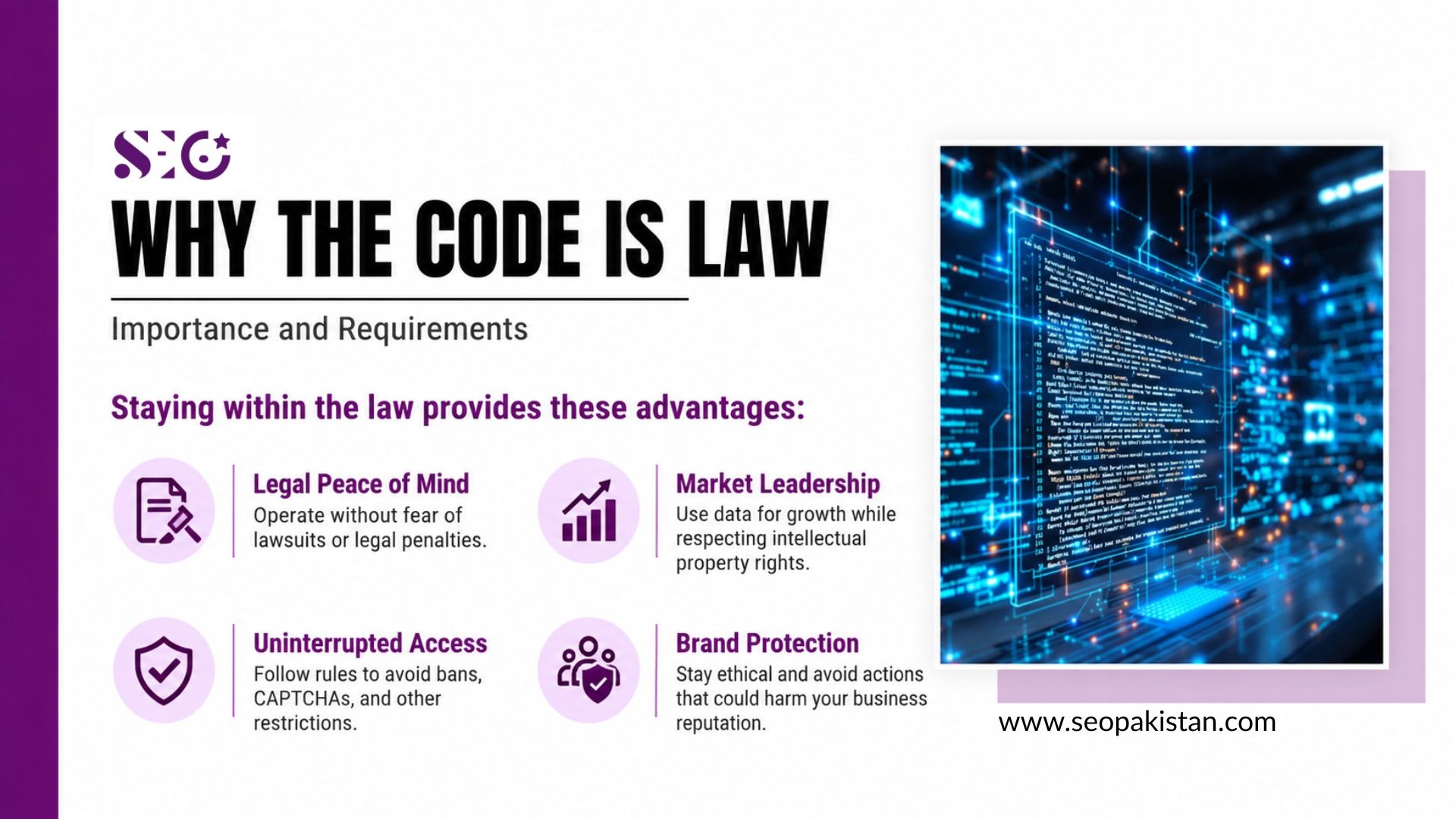
Staying within the law provides these advantages:
- Legal Peace of Mind: Operate without fear of being subject to the Electronic Documents Act or lawsuits resulting from web scraping illegal activities.
- Market Leadership: Use data scraping for lead generation or trend monitoring while avoiding infringement on database rights and intellectual property.
- Uninterrupted Access: Adhering to strict rules guards against web server bans and drastic technological measures, like CAPTCHA.
- Brand Protection: Ensure your actions are aligned with ethical implications and free from incidents that might harm your business’s public interest.
- Better Data Quality: Scrape only what’s needed, within ethical and existing legal boundaries, rather than aimlessly scraping personal information.
Three golden requirements to follow always:
- Personal Information Protection. The Zero PII Mandate means only data that’s anonymized or immediately deleted after use protects individuals and complies with privacy laws.
- Clear Authorization. Only collect data openly displayed on a public website. Never extract information through deceptive means, and always seek explicit permission when in doubt.
- Thorough Terms Review. Start with a legal review of the terms of service and robots.txt file. When unclear, get a proper legal analysis from a professional.
The Seven Master Keys: Secret Best Practices No One Else Knows
Leading web scrapers rely on advanced strategies to stay compliant and ethical. Here are the secret keys that enable legal web scraping and protect your project from legal or technical pitfalls.
- The Human Fingerprint Protocol
Move beyond basic rate limits. Mimic real browsing by varying delays to respect both the targeted website’s server and the technological measures protecting its data. - The Metadata Scrub Test
After extracting data, always remove hidden information like geo-coordinates or device identifiers to comply with privacy laws and prevent breaches through personal information protection. - The Honeypot Avoidance Protocol
Scrapers must ignore invisible elements meant to snare bots. This keeps your data mining aligned with ethical implications and reduces the risk of being deemed illegal. - The ToS Keyword Parser
Automate detection of terms like “prohibited data extraction” or “no spidering.” If such information is in the terms, reconsider data scraping or consult a legal expert. - Geo-Fencing Compliance Tactic
If your project involves global data, use region-appropriate proxies to align with international regulations and global privacy laws while collecting data. - The Session Resurrection Key
Blocked? Start a fresh new session, new user agent. Properly managing web scraper sessions prevents visibility and circumvents rules about extracting data in ways not intended by the site. - Server Load Modeling (The Real Rate Limit)
Adjust request frequency when the server slows down, using request rate tracking and limiting concurrent requests to stay within professional conduct bounds.
The Legal Minefield Map
Legal web scraping is full of hazards; violating the rules risks lawsuits, fines, or technical blocks. Below are the critical traps you must avoid to stay compliant and protected:
The CFAA Cliff: Accessing Private Data
Going beyond public sites may exceed authorized access limits under the Computer Fraud and Abuse Act. The hiQ Labs v. LinkedIn decision clarified that scraping publicly available information, not requiring a login, is typically legal and does not constitute unauthorized access. Scraping personal data from behind logins remains almost always illegal.
The Cases That Actually Decided This (2017 to 2024)
hiQ Labs v. LinkedIn isn’t the only case that matters anymore, and it’s not even the most recent.
hiQ Labs v. LinkedIn (2017 to 2022). Started when LinkedIn sent a cease and desist letter to hiQ over profile scraping. The Ninth Circuit ultimately ruled that scraping publicly accessible data doesn’t violate the CFAA, a decision that became foundational legal precedents for everything after it.
Meta v. Bright Data (2024). A US District Court ruled in favor of Bright Data, a scraping infrastructure provider, over data collected from public Facebook and Instagram content, reinforcing that publicly available social data remains fair game even when a platform objects.
X Corp v. Bright Data (2023). X (formerly Twitter) sued Bright Data over scraped public data. The case was dismissed. The court found X couldn’t enforce copyright over content it didn’t own, meaning its terms of service couldn’t block the scraping on that basis alone.
Facebook v. Power Ventures (2016). An older, foundational CFAA case establishing that continuing to access a site after being told to stop, even for public-facing features, can trigger liability, a useful contrast to the more permissive hiQ and Bright Data rulings.
Reddit v. Perplexity (ongoing). A newer, more complicated dispute. Reddit alleges ai training data collection bypassed technical protections, invoking the Digital Millennium Copyright Act rather than the CFAA, since accessing content indirectly through Google’s search results for machine learning purposes raises different legal questions than direct scraping does.
Online Travel Company v. Airline (July 2024). The other side of the line. A federal jury in Delaware found a travel booking company liable under the CFAA for using a third-party service to scrape an airline’s website through password-protected, account-only data, not public pages. This case, decided even after Meta v. Bright Data, confirms the same principle those rulings established: scraping public data tends to survive in court, but scraping anything behind a login still doesn’t.
These cases together answer the real question behind is web scraping forbidden: it depends entirely on what you’re accessing. Scraping genuinely public data keeps winning in court, but bypassing technical protections, scraping password-protected content, or using data for fair use-adjacent purposes like AI training is where the legal landscape is still actively being written.
The GDPR Swamp: The Risk of PII
Privacy laws like the General Data Protection Regulation and the California Consumer Privacy Act define collecting personal data very broadly, including things like biometric data. Even search engines restrict themselves from indexing sensitive data types across the European Union and beyond.
Accidentally scraping personal information exposes you to severe privacy law violations. Selling such information magnifies liability further, as does sharing or repurposing it, even if it seemed publicly available at the time.
Businesses operating in or with Canadian data should also know about the Personal Information Protection and Electronic Documents Act (PIPEDA), Canada’s federal privacy law governing how personal information gets collected and used, distinct from GDPR or CCPA but built on similar principles.
The Consequences of Failure
Violating legitimate purposes, database rights, or privacy mandates carries steep risks:
- Legal. Lawsuits, criminal charges under the Computer Misuse Act, and injunctions halting operations, sometimes triggered by contract claims or contract breaches tied to a site’s terms of service
- Technical. Website owners may deploy technological measures to block access or disrupt proxy infrastructure entirely, making data mining unsustainable long-term
Conclusion
Is web scraping forbidden? Not automatically, and not entirely risk-free either. You can legally scrape data by navigating strict rules, privacy laws, and the ethical guidelines this guide lays out, respecting existing laws across every jurisdiction you touch.
The legal landscape keeps shifting as cases like Meta v. Bright Data and Reddit v. Perplexity work through the courts. If you have doubts, get professional legal advice, document your compliance, and respect every relevant regulation before you scrape a single page.
Want help auditing your data practices or building a compliant SEO research process? Our SEO services cover exactly this. For the broader picture on scraping tools and techniques, see our complete web scraping guide and our breakdown of Google’s specific scraping policy.
Frequently Asked Questions
Why do websites not allow scraping?
Websites may ban scraping to protect their data, safeguard user privacy, prevent server overload, or maintain control over how their content is accessed and used. Some also cite competitive concerns, not wanting a rival platform building products from their data.
Can web scraping be detected?
Yes. Websites use tools like IP tracking, bot detection software, and access logs to spot scraping activity and block suspicious requests. Advanced detection can also flag unusual request patterns even from well-disguised scrapers.
Which websites am I allowed to scrape?
You can legally scrape publicly available data from websites that don’t prohibit it in their terms of service, where no privacy, copyright, or security laws are violated. Recent cases like Meta v. Bright Data reinforce that public data generally stays fair game even against a platform’s objections.
Is web scraping forbidden if I use BeautifulSoup or similar tools?
No. BeautifulSoup is a legal Python library for parsing HTML and XML. The tool itself is never the legal issue. How you use it, what data you collect, and whether you respect the target site’s rules determine legality.
Does Google block web scraping?
Yes. Google actively deploys anti-bot measures like CAPTCHA to limit scraping of its own services. Violating their terms can lead to IP blocking or worse. For the full breakdown of Google’s specific rules, see our dedicated guide.
Does YouTube allow web scraping?
No. YouTube’s terms of service explicitly prohibit scraping its content. Doing so may lead to account suspension or legal consequences, regardless of whether the underlying video data is technically public-facing.