


Technical SEO for real estate means fixing the backend elements that search engine crawlers use to evaluate and rank a website, including page speed, mobile optimization, schema markup, and clean site architecture. Real estate agents and investment firms lose serious buyers when slow pages, broken links, or weak local SEO signals push them away before the page even loads.
A site built on solid technical SEO for real estate earns stronger seo rankings, higher organic traffic, and better online visibility, turning casual browsers into qualified leads instead of bounced visitors.
Table of Contents
Introduction
Why Technical SEO for Real Estate Matters Right Now
Part 1: Speed and Performance
Point 1: Master the Core Web Vitals (CWVs)
Point 2: Implement Strategic Local Hosting & Image Optimization
Point 3: Audit Mobile-First Indexing Compliance
Point 4: Fix Broken Internal Linking Structure
Part 2: Structured Data (Schema) and Indexation
Point 5: Prioritize Investor-Focused Schema Markup
Point 6: Optimize Crawl Budget for High-Value Pages
Point 7: Enforce Canonicalization and Site Architecture Hygiene
Point 8: Strengthen On-Page SEO With Clean URLs and Metadata
Part 3: Local SEO and Off-Page Signals
Point 9: Claim and Optimize Your Google Business Profile
Point 10: Build Local Authority Through Off-Page SEO
Part 4: Security, Conversion & Final Audit
Point 11:Secure the Site With HTTPS and a Content Security Policy
Point 12: Test Every Conversion Element Across Devices
Point 13: Build a Recurring Technical SEO Audit Schedule
Point 14: Establish a Regular Technical SEO Audit Schedule
Best Practices and Expert Tips
Common Mistakes to Avoid
Conclusion
Frequently Asked Questions
Imagine a qualified investor, ready to commit to a multi-million dollar property, clicks on your website. They wait… and wait… the page crawls, images fail to load, and finally, after what feels like an eternity, they hit the back button, moving on to a competitor whose site actually works.
Another deal was lost. Not because your property wasn’t stellar, but because your website failed. Slow-loading pages, broken forms, and hidden technical flaws aren’t just minor glitches; they’re deal-breakers, driving serious investors away and costing you untold opportunities.
The stakes in real estate investment are high. When an investor is evaluating a $500,000 property deal, they expect your website to reflect the same level of professionalism and reliability they demand from their investments.
Why Technical SEO for Real Estate Matters Right Now
A qualified investor clicks a listing page ready to commit to a six-figure property. The page stalls, an image fails to load, and the buyer hits back within seconds. That single moment often decides whether a deal happens or disappears.
Real estate buyers judge a brand by its website the same way they judge a property by its foundation. Technical SEO for real estate builds that foundation. It controls whether search engine bots can crawl a site efficiently, whether pages load fast enough to hold attention, and whether relevant content actually reaches the target audience searching for it.
This checklist walks through ten technical priorities, grouped into speed, structure, local visibility, and security, so a real estate website performs like the professional asset it needs to be.
Part 1: Speed and Performance
Point 1: Master the Core Web Vitals (CWVs)
Core Web Vitals directly impact how investors experience your website and whether they trust your expertise enough to engage with your services. What specific metrics determine whether your site passes Google’s performance standards?
Google measures three critical performance indicators that affect user experience and search rankings:
- Largest Contentful Paint (LCP) measures loading speed and should occur within 2.5 seconds
- First Input Delay (FID) measures interactivity and should be less than 100 milliseconds
- Cumulative Layout Shift (CLS) measures visual stability and should be less than 0.1
Use PageSpeed Insights and GTmetrix to audit your current performance. These tools provide specific recommendations for improvement and show how your site performs on both mobile and desktop devices. Set a benchmark of achieving “Good” ratings across all three metrics, as this directly correlates with higher conversion rates and better search engine rankings.
Point 2: Implement Strategic Local Hosting & Image Optimization
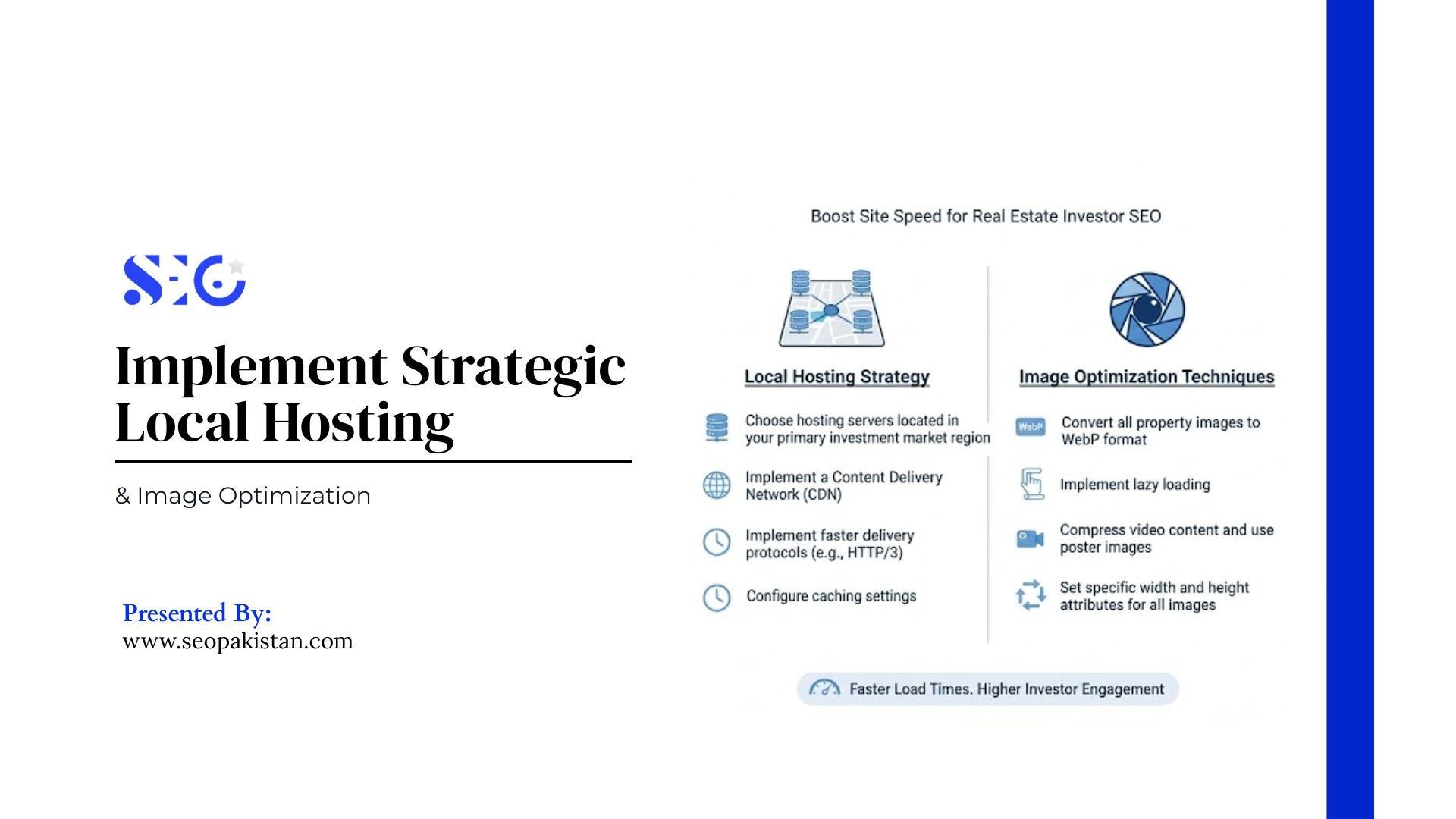
Hosting location and image weight directly affect website speed. A server based near the target market cuts latency for the buyers most likely to convert.
Property photos are usually the heaviest files on a real estate site, and unoptimized images are one of the most common reasons pages fail Core Web Vitals.
- Local hosting: Pick a server region close to the primary investment market.
- CDN delivery: Distribute content from multiple locations to shorten load times everywhere.
- WebP conversion: Compress listing photos without visible quality loss.
- Lazy loading: Delay offscreen images until a visitor scrolls to them.
- Fixed dimensions: Set width and height on every image to prevent layout shift.
Point 3: Audit Mobile-First Indexing Compliance
Google indexes the mobile version of a site first, which means mobile optimization is not optional for real estate seo. Any element missing on mobile directly limits how a page ranks.
Mobile-first indexing means Google’s crawlers evaluate your site based on the mobile experience. Any missing elements on mobile directly impact your search visibility:
- Verify that all contact forms, CTAs, and conversion elements appear identically on mobile and desktop
- Ensure internal navigation links are fully accessible on mobile devices
- Test that embedded calculators, market analysis tools, and lead magnets function properly on mobile
- Confirm that phone numbers are clickable and email addresses launch mail applications
Use Google Search Console’s Mobile Usability report to identify specific mobile issues. The URL Inspection tool shows exactly how Google’s mobile crawler sees your pages, revealing any content or functionality gaps that could cost you leads.
Point 4: Fix Broken Internal Linking Structure
Broken internal links waste your crawl budget and create frustrating experiences that undermine investor confidence. What happens when a potential client encounters multiple 404 errors while researching your investment opportunities?
Every broken link represents a lost opportunity to guide investors through your expertise and toward conversion. Real estate websites are particularly vulnerable to broken links due to:
- Retired property listings that generate 404 errors
- Updated market analysis reports with changed URLs
- Reorganized service pages without proper redirects
- Broken links to resources, calculators, or educational content
Implement a systematic approach to link maintenance:
- Use Screaming Frog or similar tools to crawl your entire site and identify 404 errors
- Create 301 redirects for all retired property listings to relevant category pages
- Audit internal links monthly, particularly those pointing to time-sensitive content
- Maintain a redirect map documenting all URL changes for future reference
Part 2: Structured Data (Schema) and Indexation
Point 5: Prioritize Investor-Focused Schema Markup
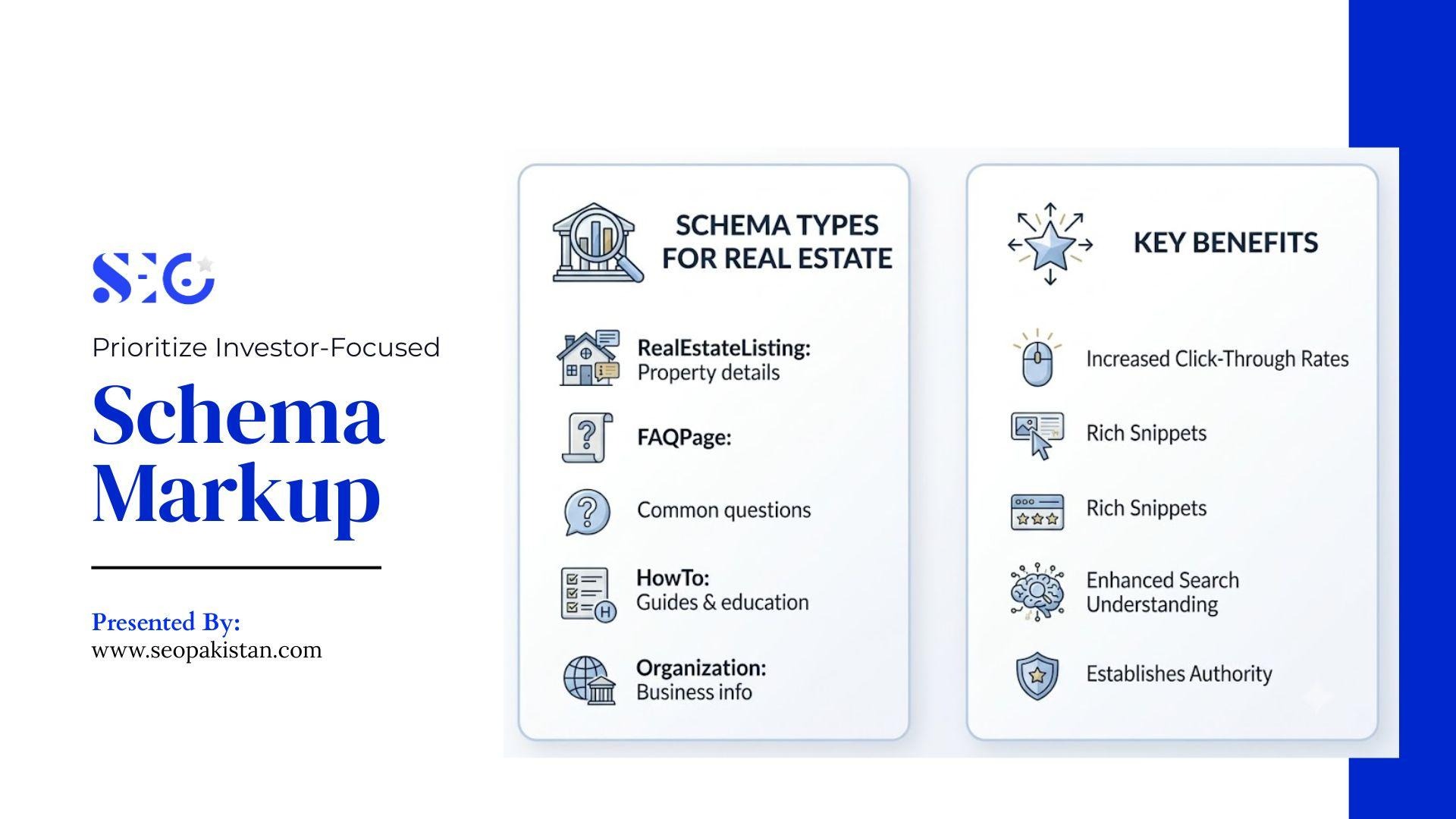
Schema markup helps other search engines interpret specialized real estate content and can unlock rich results that lift click-through rates directly in search engine results.
- RealEstateListing schema: Displays pricing, square footage, and key details in rich snippets.
- FAQPage schema: Targets featured snippets for common investor and buyer questions.
- HowTo schema: Positions investment guides for how-to rich results.
- Organization schema: Confirms business identity and contact details for Google’s Knowledge Graph.
Point 6: Optimize Crawl Budget for High-Value Pages
Search engines allocate limited crawling resources to your website. How can you ensure Google spends its crawl budget on your most important conversion-driving pages?
Crawl budget optimization prevents search engines from wasting time on low-value pages while ensuring your priority content gets indexed quickly:
Configure your robots.txt file to block crawler access to:
- Filtered search result pages that create infinite URL variations
- Internal search result pages and query parameters
- Login areas and user account sections
- Duplicate pagination beyond the first few pages
- Development or staging directories
Your XML sitemap should include only canonical, high-value pages:
- Homepage and main service pages
- Individual property listing pages
- Educational content and market analysis pages
- Author profile pages and about sections
- Contact and conversion landing pages
Submit separate sitemaps for different content types (properties, blog posts, pages) to help search engines understand your site structure and prioritize accordingly.
Point 7: Enforce Canonicalization and Site Architecture Hygiene
Real estate sites generate duplicate content naturally, through filtered URLs, overlapping listing descriptions, and market reports covering the same data from different angles. Left unresolved, this dilutes authority across ranking websites instead of consolidating it on one relevant page.
Duplicate content issues arise naturally in real estate through:
- Property listings that appear in multiple categories or locations
- Filtered search results are creating multiple URLs for the same content
- Similar property descriptions across comparable listings
- Market analysis reports with overlapping information
Implement canonical tags strategically:
- Set canonical tags on all filtered and parameterized URLs to point to the main category page
- Use self-referencing canonical tags on original content to prevent future duplication issues
- Implement canonical tags on paginated content to consolidate authority
- Review and update canonical tags when restructuring site architecture
Maintain clean URL architecture by establishing consistent patterns for different content types and avoiding unnecessary parameters that create duplicate versions of the same content.
Point 8: Strengthen On-Page SEO With Clean URLs and Metadata
On-page SEO determines whether a page that ranks actually earns the click. This is where keyword placement, clear and concise URLs, and metadata quality decide keyword rankings.
- URL structure: Keep URLs short, descriptive, and free of unnecessary parameters.
- Meta description: Write a unique, benefit-driven description for every page, not a duplicate template.
- Keyword optimization: Place the primary keyword in the title, first paragraph, and one subheading, without keyword stuffing.
- Header hierarchy: Use one H1 per page and organize H2s around search intent.
Part 3: Local SEO and Off-Page Signals
Point 9: Claim and Optimize Your Google Business Profile
Most property searches carry local search intent, whether an investor is looking in a specific city or a specific neighborhood. A complete Google Business Profile is often the first thing a prospect sees before they ever open the website.
- Full profile: Add accurate hours, service areas, categories, and photos.
- Business listing consistency: Match name, address, and phone number across every directory.
- Reviews: Respond to every review to signal an active, trustworthy business.
- Posts: Share new listings or market updates directly through the profile.
Point 10: Build Local Authority Through Off-Page SEO
Off-page SEO works alongside technical fixes, not instead of them. Link building from reputable websites in the local market strengthens the trust signals search engines already reward on a technically sound site.
- Local keywords: Target neighborhood and city-level terms alongside broader local SEO terms.
- Partnerships: Earn links from local news sites, chambers of commerce, and industry associations.
- Guest content: Contribute market insight to other websites with an engaged local audience.
- Citations: Keep business listings updated across real estate directories and local platforms.
Part 4: Security, Conversion & Final Audit
Point 10: Secure the Site With HTTPS and a Content Security Policy
Security affects both buyer trust and rankings. Real estate sites collect sensitive data through lead forms, inquiry submissions, and consultation bookings, which makes basic SSL only a starting point.
- CSP headers: Block cross-site scripting attempts before they execute.
- Whitelisted sources: Approve only trusted scripts, stylesheets, and embeds.
- CSP reporting: Monitor and address violations as they occur.
- Third-party audits: Review every integration for security gaps on a regular schedule.
Point 12: Test Every Conversion Element Across Devices
Technical work only pays off if conversion elements actually work when a buyer is ready to act.
- Form testing: Submit real test leads and confirm CRM delivery.
- Tool testing: Check calculators and market tools on multiple devices and browsers.
- Click-to-call: Confirm phone links dial correctly on mobile.
- Tracking setup: Configure Google Analytics goals and backup tracking for every conversion path.
Point 13: Build a Recurring Technical SEO Audit Schedule
Technical SEO is maintenance, not a one-time project. Markets shift, property types change, and small technical issues compound quietly if nobody checks for them.
Monthly:
- Core Web Vitals review through Google Search Console
- Broken link detection and repair
- SSL status and expiration check
- Conversion element testing
Quarterly:
- Full site crawl for technical issues
- Schema markup validation
- Mobile usability testing
- Security scan and speed review
Point 14: Establish a Regular Technical SEO Audit Schedule
Technical SEO requires ongoing maintenance rather than one-time implementation. How can you systematically monitor and maintain technical performance to prevent issues from impacting your business?
Establish a quarterly audit routine covering all technical elements:
Monthly monitoring:
- Core Web Vitals performance using Google Search Console
- Broken link detection and resolution
- SSL certificate status and expiration dates
- Conversion element functionality testing
Quarterly comprehensive audits:
- Full site crawl to identify technical issues
- Schema markup validation and updates
- Mobile usability testing across devices
- Security scan and vulnerability assessment
- Site speed optimization review and improvements
Real estate markets evolve, and your technical requirements change with new property types, market conditions, and business growth. Regular audits ensure your website continues supporting your business objectives rather than hindering them.
Best Practices and Expert Tips
A few habits separate real estate sites that maintain their rankings from those that lose ground every quarter.
- Audit before campaigns launch: Fix technical issues before investing in paid traffic through Google Ads, so the budget does not fund a leaking site.
- Track keyword-level performance: Monitor search volume and seo keywords by page, not just by domain, to spot which listings need attention.
- Keep content up to date: Refresh market data and listing details regularly; Google values current, accurate pages over stale ones.
- Document every change: Log redirects, schema updates, and canonical changes so the next audit starts with context instead of guesswork.
Common Mistakes to Avoid
Most seo efforts on real estate sites fail for the same handful of preventable reasons.
- Ignoring mobile parity: Treating mobile as an afterthought instead of the primary indexing source.
- Over-optimizing keywords: Forcing not all keywords naturally into copy, which reads as keyword stuffing rather than valuable content.
- Skipping redirects: Letting retired listings return 404s instead of guiding traffic to a relevant page.
- Neglecting the audit schedule: Treating seo optimization as a launch task instead of a recurring process.
Conclusion
Technical SEO for real estate is not a one-and-done checklist. It is the ongoing discipline that keeps page speed, mobile performance, structured data, and security working together so buyers stay on the page long enough to convert. Real estate agents and investment firms that treat this work as core infrastructure see the payoff in stronger organic traffic, better online visibility, and consistent seo success across every market they serve.
Prioritizing technical SEO for real estate, alongside a strong content and digital marketing strategy, is what separates sites that generate leads from those that only generate traffic. Fix the foundation first, then build the content strategy on top of it.
Frequently Asked Questions
How can I improve Core Web Vitals on my real estate website?
Compress property images, add a CDN, enable caching, and reduce unnecessary scripts. These changes are the fastest way to reach “Good” ratings for LCP, FID, and CLS in Google PageSpeed Insights, which supports better seo rankings across the site.
How do I fix broken links on my site?
Crawl the site with a tool like Screaming Frog to find every 404 error, then set up 301 redirects pointing to a relevant category or active listing page. Repeat this monthly, since real estate listings expire on a constant cycle.
What is crawl budget optimization?
Crawl budget optimization means managing how efficiently search engine crawlers move through a site. Blocking low-value pages in robots.txt and prioritizing high-conversion listing and service pages helps search engines index what matters most faster.
What are canonical tags, and why do they matter?
Canonical tags tell search engines which version of a page to index when duplicate or similar content exists. They prevent authority from splitting across multiple URLs, which protects technical SEO for real estate performance over time.
What is schema markup, and how does it help real estate agents?
Schema markup is structured data that helps search engines understand listing details like price, location, and property type. It can generate rich results in search engine results, which increases click-through rates for real estate agents competing on the same search terms.