

Off-page SEO for real estate is the process of optimizing external signals outside your website to improve search engine rankings and capture motivated seller leads. The ultimate goal of real estate off-page optimization is building a high-quality link profile.
By acquiring authoritative backlinks from trusted financial publications, local chambers of commerce, and real estate law blogs, you signal credibility to search engine bots. Cultivating these high-equity inbound links expands your overall search visibility, drives organic website traffic, and establishes long-term digital authority that outranks local competitors in competitive search engine results.
Table of Contents
Introduction
Why Off-Page SEO Dictates Real Estate Deal Flow
High-Leverage Off-Page Strategies for Investors
Strategy 1: The Authority Backlink Blueprint
Strategy 2: Deploying Linkable Assets (Passive Acquisition)
Strategy 3: Local Dominance & Strategic Partnerships
Auditing and Protecting Your Link Profile
The Investor’s Link Quality Checklist
Technical Foundations That Support Off-Page Success
Growth Timeline: What to Expect
Scale Your Deal Flow with Off-Page Real Estate SEO
Frequently Asked Questions
Why Off-Page SEO Dictates Real Estate Deal Flow
Modern search algorithms rely heavily on external signals to establish authority and trust. When external, reputable websites place inbound links pointing back to your asset, it acts as a digital vote of confidence. This execution directly improves your brand’s search visibility for high-value search terms and highly targeted specific keywords:
- “Sell my house fast [City]” (Targeting motivated sellers)
- “Real estate investment firms near me” (Targeting capital partners)
- “Commercial property joint ventures” (Targeting institutional deal flow)
According to historical performance data from platforms like Ahrefs, the vast majority of any given web page receives zero organic traffic simply because they lack an external link-building foundation. In highly competitive investment markets, robust seo efforts are the clear differentiator between market leaders and invisible firms on a search results page.
High-Leverage Off-Page Strategies for Investors
Strategy 1: The Authority Backlink Blueprint
In modern search engine optimization, quality fundamentally trumps quantity. A single contextual link from a hyper-relevant financial institution or legal entity carries more programmatic weight as a ranking factor than hundreds of low-tier directory listings.
Capitalizing on Financial & Wealth Management Publications
Real estate investing sits at the intersection of private equity, asset management, and tax strategy. You can earn high-equity backlinks by producing expert-level, valuable content centered around relevant keywords on technical topics:
- Structured 1031 exchanges and tax-deferral mechanisms
- Advanced creative financing and syndication structures
- Macroeconomic trends impacting regional multi-family yields
Contributing data-driven columns to trusted financial blogs passes strong link equity directly to your target landing pages, maximizing your long-term seo success.
Securing Legal, Academic, and Institutional Links
Links from .edu, .gov, or established legal domains possess massive trust scores. Investors can position themselves as authoritative resources by publishing clear, compliance-oriented insights regarding:
- Regional zoning variance updates and land-use regulations
- Evolving landlord-tenant statutory compliance
- Local municipal economic development initiatives
Strategy 2: Deploying Linkable Assets (Passive Acquisition)
Instead of relying continuously on manual outreach, you can scale your backlink profile passively by creating high-value assets that other websites naturally want to reference.
1. Proprietary Market Data & Intelligence Reports
Journalists, real estate bloggers, and market analysts regularly perform Google searches for hard statistics. By publishing localized research as part of your broader content strategy, you establish an authoritative reference node.
| Asset Type | Key Metrics to Include | Target Outreach Audience |
| Regional Investment Report | Average cap rates, localized net migration numbers, YoY rent growth | Financial journalists, local business editors |
| Fix & Flip ROI Index | Average rehab costs per square foot, gross margin trends by zip code | Real estate bloggers, regional trade outlets |
2. Interactive Valuation Tools
Interactive modules provide immediate utility, making them highly linkable assets across real estate and personal finance forums. Consider hosting a free tool on your site such as:
- Commercial debt service coverage ratio (DSCR) calculators
- Multi-family internal rate of return (IRR) projection models
- Residential rehab & construction cost estimators
Strategy 3: Local Dominance & Strategic Partnerships
Master Local Citation Consistency
For geographic-specific investing, maintaining precise NAP (Name, Address, Phone Number) data across the web is crucial for outperforming competitors when users look through local search listings. Ensure your exact corporate credentials match perfectly across Google Business Profile, local chambers of commerce, and regional business directories to solidify your local search footprint.
Leverage B2B Testimonial Swaps
Your existing B2B vendor network is a major source of untapped link equity. Provide comprehensive, unsolicited testimonials for your trusted partners—such as commercial escrow companies, specialized real estate attorneys, or general contractors—in exchange for a contextual link from their “Partners” or “Case Studies” pages to elevate your personal brand.
Auditing and Protecting Your Link Profile
A clean backlink profile requires ongoing maintenance to mitigate negative SEO vulnerabilities, fix broken links, or avoid algorithmic penalties. Real estate firms should use professional platforms like Semrush or Ahrefs to audit their profile against these core criteria:
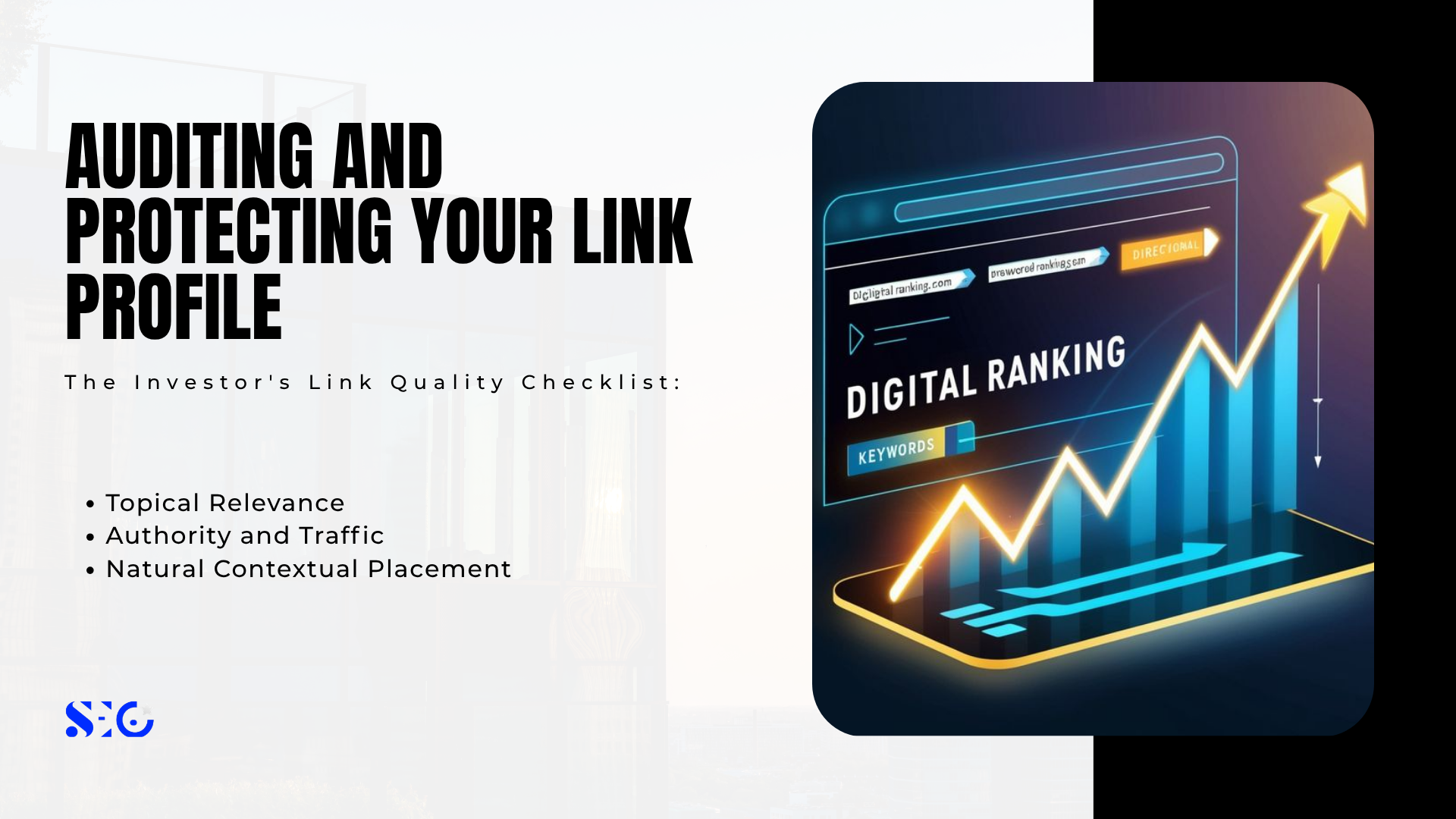
The Investor’s Link Quality Checklist:
- Topical Relevance: The referring domain must align with finance, law, real estate, or hyper-local business.
- Authority and Traffic: Prioritize referring domains that maintain steady organic traffic (ideally greater than 1,000 monthly visitors).
- Natural Contextual Placement: Links must live naturally within the body text of high-quality articles rather than sitewide footers or sidebar widgets.
If your structural audit reveals toxic, automated, or clearly spammy domains linking to your site, compile them into a clean text file and submit them via Google Search Console to insulate your site’s technical health.
Technical Foundations That Support Off-Page Success
An elite off-page strategy must be supported by bulletproof foundational optimization. If an external link drives a user to your asset and the site loads slowly, your bounce rate will spike, damaging how search engines interpret user behavior.
- Page Performance & Core Web Vitals: A high-performing real estate business must optimize its infrastructure. To prevent a scenario where a website speed drop hurts your authority, ensure you compress images, serve optimized images, and address indicators like site speed and page speed directly.
- Mobile and Security: Ensure flawless execution across mobile devices through adaptive mobile responsiveness. Additionally, always secure your domains with an active SSL certificate.
- Meta Optimization: To accurately satisfy target user intent right from the SERP, craft compelling title tags and write an engaging meta description for your core landing pages and localized neighborhood pages. Ensure you always use the right keywords based on careful keyword research, and avoid algorithmic penalties by preventing unnatural keyword stuffing.
- Asset Accessibility: Support your textual content with video seo, ensure all media includes descriptive alt text, and link your relevant assets together using clean internal linking pathways.
Growth Timeline: What to Expect
A successful seo strategy is a compounding corporate investment, not an instantaneous marketing push. Search engine bots and search engine crawlers require time to discover, crawl, and attribute value to new external signals.
Months 1–2: Discovery & Crawl Indexing
Phase 1
Search engine crawlers identify your initial batch of acquired contextual backlinks. Structural equity begins processing quietly behind the scenes.
Months 3–4: Long-Tail Traction
Phase 2
Your site begins securing improved visibility and initial organic impressions for long-tail keywords, low-competition phrases, and localized investor queries that show promising search volume.
Months 5–6: Authority Growth & Lead Flow
Phase 3
As high-authority links compound, core root keywords scale toward the first page of search results. Inbound organic deal flow and partner inquiries begin generating consistently, allowing you to gradually scale down reliance on paid ads or Google Ads.
Scale Your Deal Flow with Off-Page Real Estate SEO
Executing a robust strategy for off-page SEO for real estate is more than a technical requirement—it is the ultimate long-term investment in your firm’s digital authority. By systematically building high-equity backlinks from reputable financial, legal, and local networks, you turn your website into a powerful asset that passively captures high-intent motivated sellers and capital partners.
As search engine crawlers index your growing link profile, your domain authority will compound, securing your spot on the first page of search results and breaking your reliance on expensive paid ads. The digital landscape favors the proactive. Don’t let your local competitors dominate the search listings while your brand remains invisible online.
Ready to dominate the digital landscape? Start your journey with SEO Pakistan today and claim your market authority!
Frequently Asked Questions
What is the most critical factor for off-page SEO for real estate?
The absolute most critical factor is link quality and topical relevance. Acquiring a single contextual backlink from an authoritative real estate law firm, regional financial blog, or local chamber of commerce passes significantly more link equity than hundreds of generic web directories. High-trust inbound links signal credibility to search engine crawlers, protecting your site from algorithmic penalties and sustainably improving your keyword rankings.
How long does it take to see real estate SEO rankings improve?
Generally, a comprehensive real estate seo strategy takes three to six months to generate measurable search visibility. Search engine bots require time to discover, crawl, and evaluate new external backlinks. While technical fixes like improving page speed show faster results, compounding your domain authority through sustainable link building yields permanent, long-term organic traffic that paid ads cannot match.
Can real estate investors use local citations to boost off-page authority?
Absolutely. Consistent NAP data (Name, Address, Phone Number) across localized search listings, neighborhood pages, and local business networks is foundational for geographic keyword rankings. Maintaining matching data tells search engines that your real estate business is legitimate and active in your target market. This baseline trust directly amplifies the ranking power of your primary linkable assets.
Why should real estate agents prioritize organic SEO over paid ads?
While Google Ads stop generating traffic the exact second your budget runs out, organic search optimization constructs a permanent digital asset. Satisfying user intent with valuable content and localized real estate websites builds an inbound lead pipeline with zero recurring ad spend. Over time, organic optimization delivers a far lower customer acquisition cost and much higher conversion rates.
How do I identify and fix broken links on my real estate website?
You can easily track down broken links using Google Search Console or professional crawling tools like Ahrefs. Once identified, apply clean internal linking to redirect users to live, relevant content. Fixing these broken pathways prevents search engine crawlers from hitting dead ends, dramatically optimizing your site speed, core web vitals, and overall user behavior metrics.